

Two strategic forces driving global trends as 2025 wraps up, report reveals
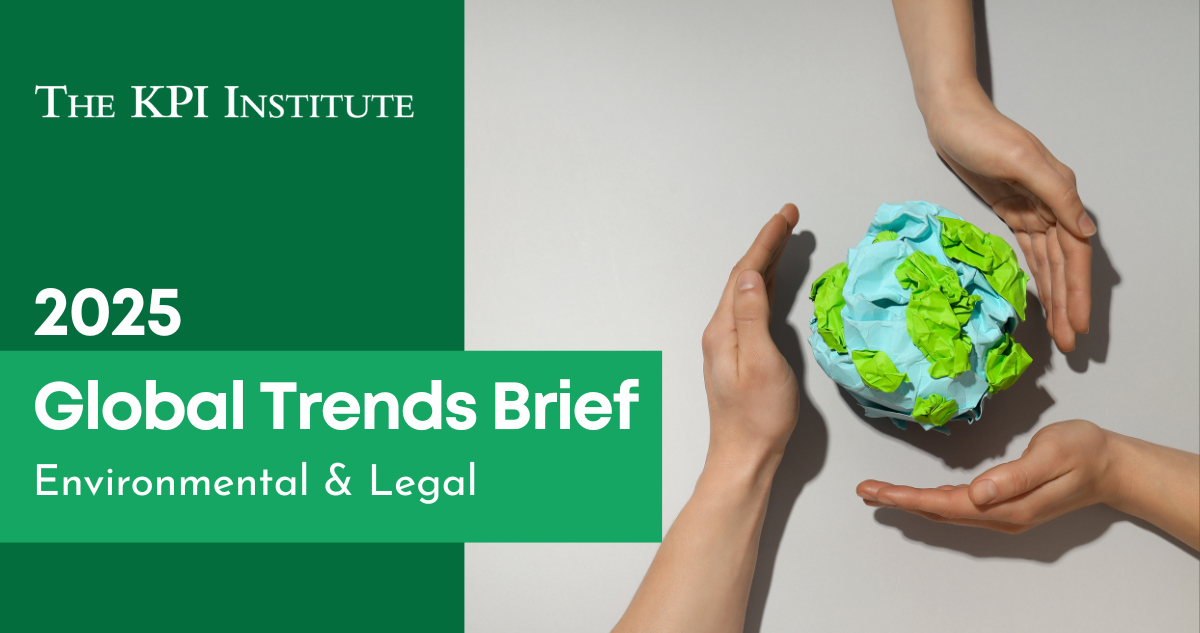
The 2025 Global Trends Brief by The KPI Institute outlines the key forces—geopolitical, economic, sociocultural, technological, environmental, and legal—shaping organizational strategy. While the first four dimensions are transforming the workforce and operations, the environmental and legal factors add further complexity to strategic planning.
According to the brief, investment in energy and natural resources is set to reach record levels in 2025, surpassing $1.5 trillion—about 6% higher than in 2024. This growth is closely tied to the accelerating focus on environmental, social, and governance (ESG), which is driving sustainable business practices, green mobility initiatives, and the adoption of circular economy models. Organizations are increasingly viewing ESG as essential to long-term resilience, supported by innovations like green AI that help reduce energy use and carbon emissions, even as rising AI-related energy demands renew interest in nuclear power.
The report also highlights that investors see government policy as a critical factor in clean-energy profitability, with about 64% of global energy transition investors citing measures such as carbon taxes as key to investment attractiveness. And despite the sharp drop in ESG inflows in 2023, global ESG assets are still expected to exceed $53 trillion by 2025—nearly one-third of total assets under management.
On the final force, legal and regulatory pressures are expected to intensify in 2025. The KPI Institute’s 2025 Global Trends Brief notes that extending U.S. tax cuts could generate over one million small business jobs annually and boost manufacturing and investment in underserved regions. At the same time, local policies and stricter AI regulations are reshaping how businesses operate, with regulators focusing heavily on cybersecurity, privacy, and national security risks.
Rising data center spending—up nearly 35% in 2024 and expected to grow by another $50 billion in 2025—comes alongside escalating fraud, identity theft, and AI-driven deepfakes, which are anticipated to push U.S. consumer losses past $10 billion per year. Financial crime enforcement is also tightening following the Financial Action Task Force’s updated standards. To keep up, organizations are increasingly adopting AI governance tools, while 76% of small business owners support government efforts that help them integrate new technologies responsibly.
Strategic priorities for organizations
To remain competitive, organizations need to prioritize operational efficiency, talent development, and risk management. The 2025 Global Trends Brief identifies key areas where strategic focus will be essential:
- AI skills and talent: Enhance AI capabilities and retain top talent to meet evolving technological and market demands.
- Supply chain resilience: Diversify suppliers and expand local sourcing to navigate ongoing geopolitical tensions.
- AI risk management: Strengthen controls to safeguard sensitive data and ensure regulatory compliance.
- Automation benefits: Leverage AI to reduce routine administrative tasks, freeing managers to focus on strategic initiatives.
- Employee engagement: Prioritize employee experience and engagement to attract and retain top talent.
Looking ahead, organizations need proactive strategies that combine agility, technology, and sustainability to thrive in a rapidly evolving environment. The 2025 Global Trends Brief key recommendations include:
- Agile performance systems: Implement frameworks that adapt quickly to geopolitical shifts and supply chain disruptions.
- Integrated analytics: Use advanced data platforms to monitor trends and adjust strategies during economic turbulence.
- Digital twin simulations: Model supply networks to test resilience against potential disruptions before they occur.
- Circular economy initiatives: Adopt IoT-enabled resource tracking to align profitability with sustainable practices.
- AI governance boards: Establish cross-functional teams to ensure innovation is balanced with regulatory compliance and workforce readiness.
The 2025 business landscape brings both challenges and opportunities. Organizations that embrace agility, sustainability, and employee engagement will be best positioned to navigate geopolitical, technological, and operational complexities for long-term success. End the year strong and start 2026 with the right guidance—download the full 2025 Global Trends Brief on the TKI Marketplace.