
Posts in Certification

The top 5 skills behind better data-driven decisions

October 1st, 2026 Posted by Certification, Courses 0 thoughts on “The top 5 skills behind better data-driven decisions”

Organizations have access to more business data than ever. Sales figures, customer information, financial results, operational metrics and employee data can all provide evidence for business decisions.

But having more data does not necessarily lead to better decisions.

The difference often comes down to the skills used to work with that data. Professionals need to know how to identify the right questions, prepare information for analysis, apply appropriate techniques and communicate what the results mean.

For organizations seeking stronger data-driven decision-making, these capabilities are becoming increasingly relevant.

Here are five skills that can help professionals make better use of business data.

1. Understanding the business problem

Effective data analysis starts with understanding what the organization is trying to solve.

A business question provides direction for the entire analytical process. It helps determine what information is needed, which variables should be examined and which analytical approach is appropriate.

Without a clearly defined problem, professionals can spend significant time processing data without producing findings that support an actual decision.

This makes business understanding an important foundation for data analysis. Analysts need to connect the information they are examining with organizational objectives, operational challenges and the decisions that need to be made.

2. Preparing and organizing data

Business data rarely arrives in a form that can immediately be analyzed.

Information may come from different sources, contain missing values or follow inconsistent formats. Data preparation involves organizing the information and identifying issues that could affect the reliability of the analysis.

Professionals therefore need to understand different data types, sources and collection approaches. They also need to recognize how data quality can affect the conclusions drawn from it.

Good analysis depends on having data that is fit for the question being investigated.

3. Applying the right analytical techniques

Knowing how to calculate a result is only part of data analysis.

Professionals also need to determine which technique is appropriate for the problem and the type of data available. Descriptive statistics can help summarize what has happened, while statistical testing can help assess whether observed differences or relationships are meaningful.

The objective is not to make an analysis unnecessarily complex.

It is to use an appropriate method and interpret the results correctly.

This requires familiarity with statistical concepts and analytical tools, as well as the ability to apply them within a business context.

4. Interpreting what the numbers mean

Data can show patterns, differences and relationships. Interpretation helps explain what those findings could mean for the organization.

Consider a business that notices a decline in sales in one customer segment. The number itself identifies a change, but further analysis is needed to understand whether the decline relates to pricing, customer behavior, seasonality, product availability or another factor.

This is where analytical thinking becomes important.

Professionals need to examine findings critically, consider the context and avoid drawing conclusions that the available evidence does not support.

A strong analyst does more than report numbers. They help others understand what the numbers are saying.

5. Communicating insights clearly

Even a technically sound analysis has limited usefulness if decision-makers cannot understand the findings.

Data analysts need to present information in ways that make important patterns and conclusions easier to identify. Tables, charts, statistical results and concise explanations can all help communicate findings to different audiences.

This skill becomes particularly important when working with managers and other stakeholders who may not have a technical background.

The goal is to move from “Here is what the data says” to “Here is what the data means for the business.”

Building practical data analysis capability

These five skills are connected. Understanding the business problem guides data collection and preparation. The quality and type of data influence the analytical techniques that can be applied. The results then need to be interpreted and communicated in a way that supports business decisions.

Developing these capabilities therefore requires more than learning individual statistical methods or spreadsheet functions. Professionals need a practical understanding of the broader data analysis process.

The Certified Data Analysis Professional and Practitioner certifications from The KPI Institute provide a structured learning pathway for professionals seeking to develop these capabilities.

The programs cover areas including business understanding, data collection, data preparation, statistical techniques, data analysis, interpretation and practical application. The Practitioner certification also focuses on applying analytical knowledge and tools within real business environments.

For professionals who work with business data or want to strengthen their analytical capabilities, structured data analysis training and certification can provide a practical way to develop these skills and apply them to organizational challenges.

Sign up for the Certified Data Analysis Professional and Practitioner certification:
https://kpiinstitute.org/certified-data-analysis-presentation/

AI is changing strategy. What does agile execution look like now?

September 10th, 2026 Posted by Certification, Courses, Strategy 0 thoughts on “AI is changing strategy. What does agile execution look like now?”

Artificial intelligence is changing how organizations make decisions, allocate resources and respond to opportunities. But as the business environment becomes more dynamic, how should organizations adapt the way they execute strategy?

Artificial intelligence is moving beyond experimentation and into the core of business operations. The World Economic Forum’s Future of Jobs Report 2025 found that 86% of employers expect AI and information-processing technologies to transform their businesses by 2030. At the same time, the Forum identifies resilience, flexibility and agility among the core skills expected to remain important as organizations adapt to technological and economic change.

This combination creates a strategic challenge.

Organizations can use AI to process information faster, identify patterns and support decisions. But they still need the organizational capability to translate those insights into action.

And when the assumptions behind a strategy change, execution may need to change with them.

This is where agile strategy execution becomes particularly relevant.

AI can accelerate decisions. What happens next?

AI can give organizations access to new sources of information and new ways of working. Yet adopting AI does not automatically translate into better organizational performance.

A peer-reviewed study published in the International Journal of Information Management examined data from 205 supply-chain executives in the United States and found that AI assimilation was associated with organizational agility, customer agility and firm performance. The researchers also found that organizational and customer agility partially mediated the relationship between AI assimilation and firm performance.

The finding suggests that the organizational response to AI matters alongside the technology itself.

More recent research reinforces the connection. A 2025 study in Industrial Marketing Management examined 246 B2B firms in Australasia and found that AI-enabled systems can support innovation through improved decision-making performance, while strategic agility plays a significant role in the relationship between AI adoption, decision-making and innovation.

The implication for strategy professionals is straightforward: AI may improve the information available for decision-making, but organizations still need the ability to respond effectively to what that information reveals.

Agile does not mean changing strategy every time something changes

Agility is sometimes reduced to the idea of moving quickly or changing direction whenever something new happens.

For strategy execution, that interpretation is too narrow.

Agility can instead mean having a structured way to sense changes, evaluate their implications, take action and adjust implementation while maintaining strategic direction.

Consider an organization that launches a strategic initiative based on a particular customer process. Six months later, an AI capability makes part of that process significantly faster or less expensive. The strategic objective may still be valid, but the initiative supporting it may no longer be the most effective way to achieve it.

An execution-oriented organization needs to be able to recognize that difference.

Recent research supports this broader view of agility. A 2025 study published in Industrial Marketing Management found that organizational learning can contribute to strategic agility in volatile, uncertain, complex and ambiguous environments, with the researchers emphasizing continuous learning, decentralized decision-making and adaptability.

Agility, therefore, is not simply about speed. It is about the organization’s capacity to respond intelligently to changing conditions.

The execution problem is also a coordination problem

Strategy does not execute itself.

A systematic review in the European Management Journal describes strategy implementation as a dynamic and complex process through which managers and employees turn strategic plans into reality. The review identifies managerial actions, organizational conditions and dynamic managerial capabilities as important elements of effective implementation.

That means execution involves considerably more than approving a strategic plan.

People need to understand what the strategy means for their work. Resources need to be aligned with priorities. Different functions need to coordinate their efforts. Leaders need to monitor progress and intervene when implementation begins to diverge from strategic intent.

This becomes even more important when technology is changing rapidly.

A peer-reviewed study on strategy implementation and organizational agility found that organizational agility can influence managerial discretion, which in turn supports strategy implementation and unit performance.

In practical terms, organizations need enough structure to maintain strategic alignment—but enough flexibility to allow decision-makers to respond when circumstances change.

What should organizations actually monitor?

This is where performance measurement enters the picture.

A strategy needs more than objectives and initiatives. Leaders also need evidence that implementation is moving in the intended direction.

KPIs can provide that visibility.

When appropriately connected to strategic objectives, KPIs can help organizations monitor implementation, identify performance gaps and determine where management attention may be required.

In a rapidly changing environment, however, measurement should not become purely retrospective.

A significant change in a KPI can prompt a broader strategic question:

Does the original plan still make sense?

This creates a feedback loop between strategy and execution. Performance information does not simply tell an organization whether it achieved a target; it can also provide evidence for deciding whether an initiative, resource allocation or implementation approach needs to change.

This view is consistent with research published in Long Range Planning on strategy implementation, which conceptualizes implementation through practices including structure and process matching, resource matching, monitoring, framing and negotiating.

The result is a more dynamic understanding of execution: strategy provides direction, while implementation generates information that can inform subsequent strategic decisions.

Agile strategy execution is becoming a practical discipline

Recent research is also beginning to connect agile principles directly with strategy deployment.

A 2025 study published in Management Research Review examined strategy development and deployment within an automotive company through 39 semi-structured interviews. The researchers identified challenges involving process integration, communication, information quality, strategy mentality and coordination, and proposed an agile framework for strategy development and deployment.

This is significant because agile principles have often been associated with project or product development rather than the broader process of executing organizational strategy.

The emerging research suggests that the same underlying challenge exists at the strategic level: how can organizations maintain direction while responding effectively to new information and changing conditions?

For professionals responsible for strategy and performance, that requires a combination of planning, measurement, stakeholder engagement, monitoring and change management.

Building the capability to execute strategy

The Certified Agile Strategy Execution Professional (C-ASE) from The KPI Institute is designed around this challenge.

The program introduces a proprietary framework for strategy implementation and combines best practices with practical advice, process maps and implementation tools.

Participants develop capabilities to:

  • Use strategy planning tools
  • Deploy KPIs to monitor strategy implementation
  • Engage the right stakeholders in strategy execution
  • Monitor strategy implementation
  • Drive organizational change

The live-online certification involves 40 hours in total, including four hours of pre-course requirements, 20 hours of live online sessions delivered over five consecutive days, three hours for an Individual Learning Map, a one-hour certification exam and 12 hours of after-course requirements.

Participants also gain access to the international Certified Agile Strategy Professional Community and can pursue international recognition for their strategy execution skills.

The next question for strategy professionals

AI is changing what organizations can do. It is also changing the speed at which assumptions can become outdated.

The strategic challenge, therefore, is not simply adopting AI. It is developing the organizational capability to turn new information and capabilities into coordinated action—and adjust that action when circumstances change.

That is where agile strategy execution becomes relevant.

For professionals working in strategy, performance management and organizational transformation, developing this capability can help strengthen the connection between strategic objectives, initiatives, KPIs, stakeholders and organizational change.

Explore the Certified Agile Strategy Execution Professional →

Over 44,900+ professionals took TKI’s KPI and performance management courses. What did they learn?

August 26th, 2026 Posted by Certification, Courses, E-learning 0 thoughts on “Over 44,900+ professionals took TKI’s KPI and performance management courses. What did they learn?”

The KPI Institute recorded 44,900 participants across its educational programs as of the latest mid-year attendance record. Behind that figure is a community of professionals who have taken part in courses covering strategy, performance management and related areas through different learning formats.

The programs have reached professionals across multiple regions worldwide, with the Middle East accounting for the largest share of participants, followed by APAC, Africa, Europe, South America, and North America.

What are participants learning?

The KPI Institute serves professionals with different learning preferences, with face-to-face courses attracting the highest participation, followed by live online and pre-recorded formats. This mix reflects a combination of classroom-based and digitally accessible learning.

Certification represents an important part of the institute’s professional development offering, covering areas related to performance management, KPI management, strategy and business planning, data, and organizational performance.

Its international reach is reflected in activity across 60 countries, with more than 3,000 courses delivered as of the latest available data. This geographic spread highlights the accessibility of the company’s learning and certification offerings to professionals across different markets and organizational contexts.

Participation has also shown steady growth over the reporting period, increasing month by month from January through July. The latest available figure reached 44,900 participants, reflecting continued expansion of the institute’s global learning community.

The course portfolio covers a broad range of disciplines in strategy, business planning, performance management, and KPI development. Participants can develop skills in Strategic Planning, Strategy Execution, Business Planning, the Balanced Scorecard, Performance Management, Performance Measurement, Performance Management Systems, and Performance Maturity.

The portfolio includes specialized learning in Key Performance Indicators (KPIs), KPI Measurement and Reporting, KPI Target Setting, KPI Selection, and KPI Management, as well as Objectives and Key Results (OKRs). Together, these courses help professionals translate strategy into measurable objectives, establish appropriate performance measures, design management systems, and use performance information to support organizational improvement.

Moreover, the portfolio extends into employee performance, data, analytics, and decision-making, addressing the practical capabilities needed to manage and interpret performance information. Courses cover Employee Performance Management, Data Analysis, Data Visualization, Benchmarking, and Performance Reporting, alongside topics that strengthen the use of evidence in organizational decision-making. Participants learn how to work with performance data, identify meaningful patterns and comparisons, communicate insights effectively, and apply structured approaches to monitoring and improving results. Across the portfolio, the focus is on giving professionals practical frameworks, methods, and tools that can be applied directly to organizational performance and professional practice.

What graduates say

Participants have highlighted the practical and engaging nature of the learning experience. Meshal Almotairi, Senior Dietitian at the Saudi Food and Drug Authority, described the course as “a great learning and revision tool,” noting that the quizzes helped reinforce understanding and that the knowledge gained was valuable enough to share with colleagues.

Ibrahim Neyaz, Director of Business Process Management & Strategic Information Department at the Saudi Food and Drug Authority, similarly emphasized the practical focus, saying the course helped him understand KPIs and how to implement them within his organization. He particularly valued the real-life exercises, which enabled him to analyze how KPIs could be developed for different departments and aligned with strategic objectives.

The organizational impact of the learning is also reflected in the experience of Ferenc Gabor, Managing Director of Process Solutions S.R.L. Following training in the Balanced Scorecard and KPI areas, Gabor said his organization was “very pleased with the quality of the course and training” and was applying the knowledge gained within the company. These experiences point to the practical application of the institute’s training beyond the classroom, from strengthening individual understanding of performance concepts to supporting organizations in applying structured approaches to strategy and performance management.

For professionals looking to build similar capabilities, the full range of courses is available here:

How much time does a performance management certification take? And other questions

August 21st, 2026 Posted by Certification, Courses, E-learning 0 thoughts on “How much time does a performance management certification take? And other questions”

Considering a strategy and performance management certification can raise practical questions about registration, time commitment, certification requirements, interaction, support, resources, and technical requirements.

The KPI Institute’s FAQ for its 2026 worldwide live-online certifications addresses these questions.

How do I register for the course?

Similar to the open face-to-face programs, the online programs have an application and admission process in place. Participants are required to fill in the application form and process the payment for the course in order to register. A confirmation email will be sent once the registration has been completed.

How much time should I expect to allocate to complete all course requirements?

The total expected time is 40 hours. This includes:

  • Pre-course requirements: 4 hours
  • Live online sessions: 20 hours, 4 hours per day, for 5 consecutive days
  • Individual Learning Map and exam preparation: 3 hours, 0.5 hours per day after each live session, and 0.5 hours for the final recap before the exam
  • Certification Exam: 1 hour
  • After-course requirements: 12 hours

What will I receive upon completing the program?

The certification process is finalized only when all three stages of the learning experience have been completed. Participants will receive the following:

  • Certificate of Completion: After completing the pre-course activities and passing the Certification Exam
  • Certificate of Attendance: After participating in the online training course
  • Certified Professional diploma: After successfully completing all three stages of the learning experience
  • CPD Certificate of Attendance: Once Professional status has been successfully obtained

Will I be able to interact with the facilitator and other participants?

Yes. The learning experience is designed to encourage interaction. The facilitator will address participants’ questions and provide feedback during the sessions, as well as share best-practice information on the topics being discussed.

Participants will also be encouraged to share their own experiences and work and participate in group discussions during the online course and through the E-Learning platform before and after the course.

What support can I expect throughout the program?

Participants can expect support throughout the program. Content-related questions will be addressed by the facilitator, certification process queries by the Education Team, and technical questions by IT specialists.

Challenges during the course can be addressed through the E-Learning platform, email, phone, or during the live online sessions.

What resources will I get access to?

To help participants implement the knowledge they have gained in their organization and support further learning on the topic, the following resources will be made available:

  • Premium Subscription on smartKPIs.com for 6 months, providing access to 500 fully documented KPIs and over 20,000 KPI examples
  • One research report from the Top 25 KPIs series
  • Free access to all webinars from the 2014 to 2016 Performance Management series
  • Performance Management Toolkit containing Excel-based templates for Desired State of Evolution, Strategy Map, Scorecard, Dashboard, Portfolio of Initiatives, KPI Documentation Form, KPI Report Form, and Initiative Description Form
  • The KPI Infographic
  • The Performance Management in 2012, 2013, and 2014 reports
  • Catalogues and Fact Sheets
  • VideoDoodles
  • Training slides and course notes

What technical requirements are needed to join the course?

Joining the platform is simple, and participants do not need advanced technical skills. They simply need to click on a link to open the app and join. After that, they select “use computer audio” and are ready to participate.

If I have attended face-to-face training before, can I get a 1:1 session with a consultant?

Yes. 1:1 sessions with subject matter experts can be organized on request, regardless of whether participants have attended a past public or in-house course.

*********

Check out the schedule of the strategy and performance management courses for the rest of 2026:


What professionals in 100+ countries say about getting certified in strategy and performance management

August 19th, 2026 Posted by Certification, Courses, E-learning, Uncategorized 0 thoughts on “What professionals in 100+ countries say about getting certified in strategy and performance management”

Certification in strategy and performance management is intended to change how professionals approach measurement, planning, and execution in their organizations. To understand whether it does, The KPI Institute reviewed testimonials left by participants who completed a strategy and performance management certification course, from HR managers in Bahrain to strategy directors in Malaysia, and identified the recurring patterns, the standout accounts, and the courses mentioned most often.

What people keep saying, over and over

Read enough of these, and a few things start to repeat.

The word “practical” or “applicable” shows up more than 750 times across the testimonials. People aren’t just saying the course was informative, they’re saying they could take it back to their desk and use it the next day. “Structured” and “organized” together appear in over 650 testimonials, a strong signal that the course design itself, not just the content, is something participants notice and value.

Nearly 500 testimonials use the word “recommend,” often unprompted, often specifically naming colleagues they plan to send next. And a smaller but consistent group goes further than “useful,” describing the course in terms of confidence, career, or a shift in how they think about their work. Words like “life,” “career,” “journey” and “transform” show up hundreds of times combined.

These patterns are drawn from direct participant feedback rather than promotional material, reflecting the experiences of professionals who completed between three and five days of training and chose to describe that experience in their own words.

Where they’re writing in from

The testimonials span more than 100 countries across Asia, Southeast Asia, the Middle East, Africa, Europe, North America, Central and South America, the Caribbean, and Australia. Saudi Arabia, Egypt, the United Arab Emirates and Malaysia show up most often, but the range is genuinely global: the same course shows up in feedback from a HR manager in Bahrain, a strategy consultant in Kenya, and a general manager in the Dominican Republic.

10 that stood out

While many testimonials describe the course in similar terms of structure and practicality, the following ten offer more detailed or distinctive accounts.

1. The one who compared KPIs to your phone battery

Taha Shahzad, IT Quality Team Leader at ARASCO in Saudi Arabia, took the Certified KPI Practitioner and Professional course and offered this:

“Either if it’s your cellphone’s battery percentage or your rate of production at work, KPIs are everywhere.”

2. The skeptic who got converted

Dayang Poh Wan Ying, known as Felicia, an Executive Officer at Brunei’s Ministry of Defence, didn’t expect much going in:

“I did not come to the course with a positive mind, but this course has changed my perspective on KPIs and the possible simplicity of it.”

3. The one who now can’t stop measuring things

Ihab Najeeb Abuziyad, Kingdom Biomaintenance Manager at Salehiya Medical in Saudi Arabia, took it home with him:

“The KPI course has changed the way to measure the performance of many elements in my everyday life.”

4. The one who called the facilitator a genius

Mohammad Afzal Saheer, a participant in Saudi Arabia, did not hold back:

“The facilitator is a genius. He managed to inject the KPIs into us slowly but swiftly.”

5. The one who was hooked before the course even started

Mohammed A. Alaryan, a Specialist at the Capital Markets Authority in Kuwait, was won over by the pre-course homework:

“Very much loved the experience. The nice thing about it is that it got me engaged on the topic even before the actual course starting, with the pre-course assessments and assignments.”

6. The one who turned into an unofficial recruiter

Naglaa Kassem, a Clinical Quality Reviewer at the International Medical Center in Saudi Arabia, did our marketing for us without being asked:

“Best course I’ve taken, as well as the most applicable and useful for me in my career… I have already encouraged several colleagues to sign up for the next time it is presented.”

7. The facilitator who made a “dry” topic actually fun

Siti Norliyana Haji Mat Salleh, from Malaysia’s Ministry of Home Affairs, expected the topic to be dry. It wasn’t:

“His friendly and funny personality made this dry, supposedly, topic become interesting and fun to learn.”

8. The one who realized everything is measurable

Onuorah Nkem Michael, from Nigeria, had a lightbulb moment:

“The course exposed me to realize that everything we do is measurable, and that measuring what people do in the workplace is fundamental to making businesses successful.”

9. The one who found her “excellent product” thousands of miles from home

Karina Mabrich, General Manager at Talent y Management MH in the Dominican Republic, traveled to a session delivered in Lima, Peru:

“I attended this because of its reputation in the market, and once more time they deliver an excellent product.”

10. The one who kept it straight to the point

Jane Rowe, Assistant Director at ACT NoWaste, Transport Canberra and City Services in Australia, summed up her course in one line:

“Fantastic course. Very relevant, easily understood, would recommend to others happily.”

The courses behind the quotes

The testimonials cover 69 distinct course titles in total. The ones mentioned most often are:

  • Certified KPI Professional (C-KPI)
  • Certified Professional and Practitioner in Performance Indicators (C-KPIPP)
  • Certified Strategy and Business Planning Professional (C-SBP)
  • Certified Balanced Scorecard Professional (C-BSC)
  • Certified OKR Professional (C-OKR)
  • Certified Performance Management Professional (C-PM)

It’s never too late to see for yourself

Reading about it is one thing.

The next course could be a few weeks away.


Choosing the right data analytics certification for career growth banner

Choosing the right data analytics certification for career growth

June 10th, 2026 Posted by Business Education, Career Growth, Certification, Courses, E-learning, Upskilling 0 thoughts on “Choosing the right data analytics certification for career growth”

Choosing the right data analytics certification for career growth banner

The demand for data and analytics skills continues to grow as organizations increasingly rely on evidence-based decision-making. According to the World Economic Forum’s Future of Jobs Report 2025, technological transformation is expected to create 170 million new jobs globally by 2030, while analytical thinking remains one of the most important skills employers seek across industries. The report also highlights the growing importance of data and AI-related competencies in the evolving workforce.

Against this backdrop, many professionals are exploring certifications that can help them strengthen their analytical capabilities and remain competitive in a rapidly changing job market.

The search for the best data analytics certification often leads to one important question: which programs provide skills that can be applied in real business situations?

The KPI Institute’s Certified Data Analysis Professional and Practitioner certification is one example of a program that combines statistical concepts with practical application.

Why Data Analytics Certifications Matter

Data is no longer limited to specialist departments. Today, professionals across operations, finance, strategy, human resources, marketing, and performance management are expected to interpret information, identify trends, and support decision-making using data.

As a result, employers increasingly value professionals who can:

  • Analyze data accurately
  • Translate findings into business insights
  • Support strategic and operational decisions
  • Communicate analytical results effectively
  • Solve problems using evidence rather than assumptions

A well-designed certification can help bridge the gap between technical knowledge and practical business application.

What Should You Look for in a Data Analytics Certification?

Not all certifications are built the same. While some focus heavily on software tools or statistical theory, others emphasize the application of analytics within real organizational contexts.

When evaluating a certification, consider whether it develops the following areas:

Business Understanding

Before data can generate value, professionals must understand the business problem they are trying to solve.

Strong programs typically cover:

  • The role of data analysis in organizations
  • Business problem framing
  • Data analysis processes
  • Decision-making frameworks

Statistical Foundations

Statistics remains a critical component of effective analysis.

Professionals should be familiar with:

  • Data collection methods
  • Sampling techniques
  • Hypothesis testing
  • Data interpretation
  • Statistical reasoning

Data Preparation and Organization

Analysts often spend significant time preparing and validating data before any analysis begins.

Understanding how to structure, clean, and organize information is essential for generating reliable insights.

Practical Application

Perhaps the most important consideration is whether participants have opportunities to apply what they learn.

Employers generally place greater value on professionals who can demonstrate analytical capabilities in realistic business situations rather than simply completing theoretical coursework.

A Closer Look at The KPI Institute’s Certified Data Analysis Professional and Practitioner

The KPI Institute’s certification program is structured around both knowledge acquisition and practical application.

The learning experience consists of:

  • Pre-course activities
  • Three days of core-course learning
  • Post-course assignments and assessments

The program is designed to help participants develop competencies across the full data analysis cycle, from understanding business needs and collecting data to interpreting results and presenting findings.

Key Skills Developed

Participants learn how to:

  • Define the role of data analysis in business
  • Apply statistical techniques for decision-making
  • Structure and prepare data for analysis
  • Solve business problems using advanced Excel techniques
  • Interpret analytical findings
  • Present data-driven insights effectively

Core Learning Areas

The curriculum includes topics such as:

Business Understanding

  • What is data analysis?
  • Types of data analysis
  • Data analysis in business
  • Data analysis processes

Data Collection

  • Types of data
  • Data sources
  • Sampling methods

Data Analytics Foundations

  • Organizational context understanding
  • Problem framing
  • Data cleaning
  • Data preparation

Statistical Techniques

  • One-sample hypothesis testing
  • Two-sample hypothesis testing
  • Statistical analysis methods
  • Business-focused interpretation of results

Benefits Beyond Technical Knowledge

One characteristic that professionals often seek in a certification is the opportunity to demonstrate practical competence.

The Practitioner component of the program focuses on the application of analytical methods in business environments, encouraging participants to adapt concepts and techniques to real organizational challenges.

Additional benefits include:

  • Recognition of practitioner-level expertise
  • Development of a professional portfolio
  • Feedback from assessors on analytical approaches and processes
  • Exposure to practical business scenarios
  • Enhanced confidence in data-driven decision-making

Who Can Benefit from This Certification?

The program may be relevant for:

  • Data analysts
  • Business analysts
  • Performance management professionals
  • Consultants
  • Operations specialists
  • Team leaders and managers
  • Professionals transitioning into analytics-focused roles

It can also benefit individuals who regularly work with data and want a more structured understanding of statistical methods and business analytics practices.

Choosing the Right Certification

The best data analytics certification ultimately depends on your professional goals. Some individuals may prioritize technical specialization, while others may be looking for a broader understanding of how data supports business performance and decision-making.

For professionals seeking a balance between statistical knowledge, practical application, and business relevance, The KPI Institute’s Certified Data Analysis Professional and Practitioner certification offers a structured approach to developing analytical skills that can be applied across a range of organizational contexts.

KPI and business strategy courses

___________________________________________________________________________________

The KPI Institute is a global leader in business performance research and solutions, specializing in practice domains including strategy, key performance indicators (KPIs), employee performance, customer service, and innovation management. For over 20 years, The KPI Institute has established international standards and best practices for KPIs across both private and public sectors.

What We Offer:

  • Certifications & Training: Practical programs delivered worldwide—live online, offsite, and customized—spanning 6 continents and 7 offices in Australia, Southeast Asia, Europe, and the Middle East.
  • Knowledge Platforms: Access to www.smartKPIs.com, the world’s largest documented database of KPIs, with over 21,600 examples published and 148,000+ members in our online communities.
  • Publications: Over 460 publications, including books, research papers, and practical guides, providing insights to enhance organizational performance.
  • Advisory & Implementation Support: Expert guidance to apply insights in practice for measurable impact.

Our Reach and Impact:

  • 81,000+ companies registered on our platforms
  • 2.5 million+ professionals reached through training and knowledge services
  • 128 research client countries and 120 global partner organizations

Website: www.kpiinstitute.org.

Email: office@kpiinstitute.org

LinkedIn: The KPI Institute

Is a performance management certification actually worth it? Here’s the truth

April 29th, 2026 Posted by Certification, Certifications, Courses, Performance Management 0 thoughts on “Is a performance management certification actually worth it? Here’s the truth”


Performance management looks straightforward when it is written down. KPIs get defined, dashboards get built, reports go upward, and decisions are expected to follow. In practice, the link between measurement and action often feels weaker than it should be.

A study published in the International Journal of Productivity and Performance Management found that a large portion of organizations struggle to connect performance measurement systems with actual strategic execution, even when KPI frameworks are already in place .

That gap tends to push performance management work into redesign territory rather than simple reporting.

When KPIs exist but decisions still drift

Most organizations do not suffer from a lack of data. They suffer from too much of it, without clear structure.

Research shows that excessive KPI counts can reduce managerial focus and weaken prioritization quality, especially when metrics are not clearly tied to strategic objectives .

This is where dashboards start looking complete but still leave leadership discussions unclear.

Strategy execution still struggles in many settings

A peer-reviewed study in Strategic Management Journal observed that strategy implementation failures often stem from weak alignment between planning systems and operational measurement structures .

Even when strategic goals are well defined, the absence of a structured performance system can slow down execution and reduce consistency across departments.

What structured performance management training focuses on

The KPI Institute’s Certified Performance Management Professional program is built around this type of gap between strategy and execution.

The focus is less about isolated KPIs and more about how a full performance system operates. Strategy mapping is used to translate high-level objectives into measurable elements. Scorecards and dashboards are treated as decision tools rather than reporting outputs.

A significant part of the learning also looks at performance governance. That includes how reporting flows are structured, how accountability is distributed across teams, and how data quality is maintained so that reporting cycles remain consistent.

There is also emphasis on how performance systems support real operational decisions, particularly when KPIs signal underperformance and require structured action rather than informal response.

Topics usually discussed inside the program

The content moves across several connected areas of performance practice rather than isolated tools.

There is coverage of how performance management systems developed over time and how modern environments introduced new pressures such as digital transformation, ESG reporting requirements, and stakeholder expectations.

A large portion of the discussion focuses on system architecture. This includes how strategy maps, scorecards, dashboards, and initiative portfolios work together rather than function separately.

Governance models also take a central role. Topics include reporting structures, data quality control, audit readiness, and how performance responsibilities are distributed across organizational levels.

On the operational side, attention goes into diagnosing weak KPIs, tracing root causes, and translating findings into structured improvement initiatives that can be tracked over time.

Educational resources and practical support materials

Alongside the sessions, participants receive a set of structured materials that support real application work.

At The KPI Institute, these typically include course slides, detailed notes, quizzes, and reference guides that explain how performance systems are built and maintained in practice. There is also a performance management poster and supporting documentation formats used for initiative tracking.

The learning materials extend further into published research reports on performance management trends and strategy execution practices, covering multiple years of industry observation.

A large part of the toolkit focuses on ready-to-use templates. These include strategy maps, scorecards, dashboards, performance maturity models, initiative portfolios, KPI documentation forms, and monthly reporting structures. Separate guides also explain how to build and administer scorecards and dashboards in operational settings.

Additional resources include KPI catalogues, glossary references, and curated publications that document how organizations structure performance systems in real environments.

Participants also gain access to video content and webinar series that cover applied performance management topics, along with a KPI database containing hundreds of fully documented indicators and thousands of additional KPI references for benchmarking and design work.

So does a certification like this actually matter?

The usefulness depends on where someone stands inside an organization.

When performance systems already function smoothly, the benefit may feel incremental. When reporting is fragmented, KPIs are overloaded, or strategy execution feels disconnected from measurement, structured training becomes more relevant.

The core focus is not on learning more metrics. It is on understanding how performance systems are built, governed, and used so that strategy, measurement, and action do not operate in separate lanes.

In many organizations, that alignment is still the missing piece.

To better understand whether a performance management certification fits your needs, take a look at how The KPI Institute delivers the Certified Performance Management Professional program in this brochure.

KPI and business strategy courses

_____________________________________________________________________________________

The KPI Institute is a global leader in business performance research and solutions, specializing in practice domains including strategy, key performance indicators (KPIs), employee performance, customer service, and innovation management. For over 20 years, The KPI Institute has established international standards and best practices for KPIs across both private and public sectors.

What We Offer:

  • Certifications & Training: Practical programs delivered worldwide—live online, offsite, and customized—spanning 6 continents and 7 offices in Australia, Southeast Asia, Europe, and the Middle East.
  • Knowledge Platforms: Access to www.smartKPIs.com, the world’s largest documented database of KPIs, with over 21,600 examples published and 148,000+ members in our online communities.
  • Publications: Over 460 publications, including books, research papers, and practical guides, providing insights to enhance organizational performance.
  • Advisory & Implementation Support: Expert guidance to apply insights in practice for measurable impact.

Our Reach and Impact:

  • 81,000+ companies registered on our platforms
  • 2.5 million+ professionals reached through training and knowledge services
  • 128 research client countries and 120 global partner organizations 

Website: www.kpiinstitute.org.

Email: office@kpiinstitute.org

LinkedIn: The KPI Institute

Professional development certifications

10 most in-demand certifications and programs for professional development

March 27th, 2026 Posted by Certification, KPIs 0 thoughts on “10 most in-demand certifications and programs for professional development”

Professional development certifications

Staying ahead in today’s competitive environment requires targeted learning. Professional development certifications help future-ready professionals advance their careers, strengthen strategic and performance skills, and maintain a competitive edge.

For over 20 years, The KPI Institute has supported this journey through its training and professional development programs. As a global leader in performance research and solutions, the institute establishes international standards and best practices in practice domains such as strategy, key performance indicators (KPIs), employee performance, customer service, and innovation management. These are reflected in the company’s sought-after programs, most of which are accredited Continuing Professional Development (CPD) courses.

Here are the top 10 certifications most pursued by professionals, as reflected in the company’s participation data from 2025:

1. Certified KPI Professional

Professionals learn to identify, select, and manage key performance indicators (KPIs) to turn data into actionable insights. The program provides practical frameworks and tools that can support both strategic and operational decision-making. Participants leave equipped to integrate KPIs effectively into performance management systems. Get more details here.

2. Certified Strategy and Business Planning Professional

Structured strategic and operational planning is at the core of this program. Participants explore environmental scanning, objective formulation, initiative prioritization, and integrated business planning. The frameworks taught help translate strategy into actionable execution. Discover more about the program here.

3. Certified KPI Professional and Practitioner

Hands-on application complements conceptual understanding, allowing professionals to implement KPI systems effectively. Skills include KPI selection, data collection, and performance reporting via dashboards and scorecards. This combination ensures participants can apply insights immediately in organizational contexts. Check out more information here.

4. Certified OKR Professional

The program introduces the methodology of objectives and key results (OKRs) to align teams around measurable goals. Professionals learn to define objectives, set key results, and monitor progress through review cycles. By the end, participants can drive greater organizational focus and accountability. To experience this yourself, you can sign up here.

5. KPI Masterclass

This condensed, practical masterclass focuses on the value of KPIs and their role in performance management. Participants gain hands-on guidance in selection, documentation, and reporting, with real-world examples. The format allows professionals to quickly apply best practices in their organizations. Check out page 11 here.

6. Certified Balanced Scorecard Management System Professional

The balanced scorecard is presented as a holistic framework for executing strategy effectively. Professionals learn strategy mapping, KPI alignment with objectives, and dashboard development for monitoring performance. Participants of this course gain the tools to link organizational strategy with measurable outcomes. Learn more about these concepts here.

7. Certified Data Analysis Professional

Analytical competencies are developed through techniques such as data preparation, exploration, descriptive statistics, and regression analysis. Participants learn to turn raw data into insights that inform decision-making. The program equips professionals to support evidence-based strategies across organizational contexts. Start your data analysis journey here.

8. Performance Management Masterclass

This high-impact masterclass provides a structured overview of performance management systems, including governance and enabling processes. Participants explore emerging trends and practical tools for driving organizational effectiveness. The condensed format ensures participants can quickly integrate performance management best practices into their work. Get 22% off this course and other select programs here.

9. KPI Essentials

Fundamental concepts of KPIs and performance measurement are covered, including terminology, governance, SMART objectives, and KPI lifecycle. Participants learn methods for KPI selection and alignment across organizational levels. By the end, professionals have a solid foundation to manage performance effectively. See page 11 here.

10. Certified Performance Management Professional

Governance and design of performance management systems are explored at corporate, departmental, and individual levels. Participants learn about performance processes, system enablers, and continuous improvement mechanisms. This program prepares professionals to coordinate performance frameworks and drive measurable results. See what else you can get from the program here.

Why These Certifications Matter

As organizations increasingly focus on measurable results, professional development certifications provide professionals with the skills, frameworks, and credibility to accelerate their careers, strengthen expertise in strategy and performance, and stay competitive in a results-driven world.

Professionals looking to advance their careers can explore The KPI Institute’s 2026 training calendars, including Live Online Courses, Face-to-Face Courses 2026 EMEA, and Face-to-Face Courses 2026 SEA.

Wait, there’s more!

The KPI Institute is celebrating 22 years of excellence with a special anniversary deal. You can enjoy 22% off all online courses, pre-recorded programs, and ExEdu certifications. Read further details here.

KPI and business strategy courses

Don’t miss this opportunity!

_______________________________________________________________________

The KPI Institute is a global leader in business performance research and solutions, specializing in practice domains including strategy, key performance indicators (KPIs), employee performance, customer service, and innovation management.

For over 20 years, The KPI Institute has established international standards and best practices for KPIs across both private and public sectors.

What We Offer:

  • Certifications & Training: Practical programs delivered worldwide—live online, offsite, and customized—spanning 6 continents and 7 offices in Australia, Southeast Asia, Europe, and the Middle East.
  • Knowledge Platforms: Access to www.smartKPIs.com, the world’s largest documented database of KPIs, with over 21,600 examples published and 148,000+ members in our online communities.
  • Publications: Over 460 publications, including books, research papers, and practical guides, providing insights to enhance organizational performance.
  • Advisory & Implementation Support: Expert guidance to apply insights in practice for measurable impact.

Our Reach and Impact:

  • 81,000+ companies registered on our platforms
  • 2.5 million+ professionals reached through training and knowledge services
  • 128 research client countries and 120 global partner organizations 

Website: www.kpiinstitute.org.

Email: office@kpiinstitute.org

LinkedIn: The KPI Institute

Make the most of Ramadan: enjoy 20% OFF 2026 Certifications and share the Gift of Opportunity

March 4th, 2026 Posted by Certification 0 thoughts on “Make the most of Ramadan: enjoy 20% OFF 2026 Certifications and share the Gift of Opportunity”

Ramadan is a month that calls for a change in pace. It is a time to turn inward, prioritize family, and seek moments of meaningful connection. At The KPI Institute, we recognize that this year, the need for quiet reflection and communal support feels particularly vital.

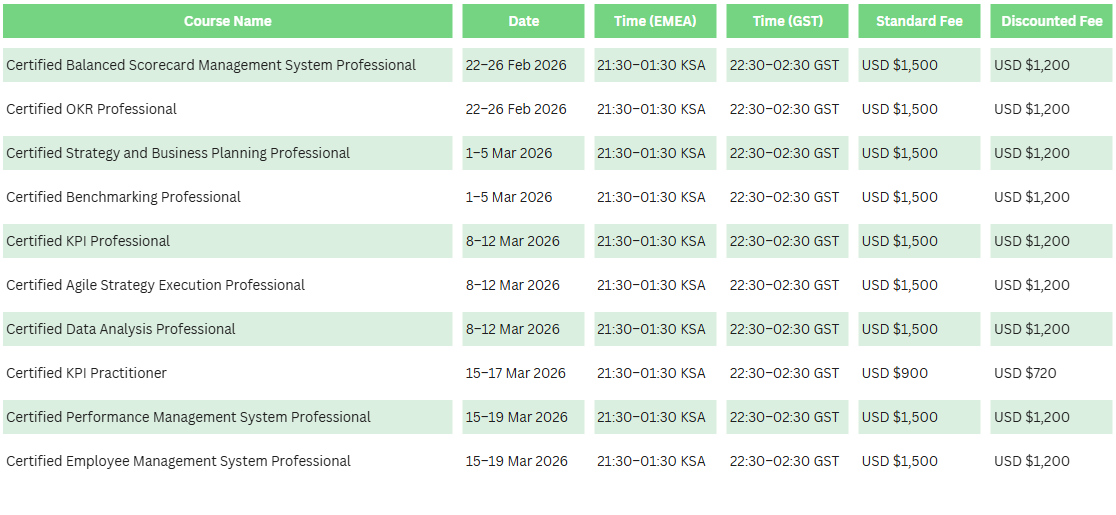
Our 2026 Ramadan Live-Online Arabic Training Certification sessions (see Figure 1) are structured to honor the rhythm of your spiritual life. We have moved our live, interactive programs to the late evening hours, providing a dedicated space for growth after the day’s obligations are met.

Figure 1. 2026 Radaman Live-Online Training Certifications Calendar

These sessions are built on the principle of convenience. They are not just about professional curriculum; they are about creating a calm, shared environment where colleagues across the region can gather, share insights, and look toward the future with a sense of purpose.

A Meaningful Eidiya

The tradition of the Eidiya reminds us of the power of a thoughtful gesture. In a world that often feels fast-paced and uncertain, the most lasting gift we can offer one another is a sense of possibility.

This Eid, you can offer a colleague or a loved one a Gift of Opportunity. Our gift vouchers ($1,500 value) cover the full enrollment for a certification course—a quiet, dignified way to say you believe in their path.

To arrange a gift:

  • Submit your interest through our form for early access: https://kpiinstitute.org/ramadan-courses#gift-voucher 
  • A representative will contact you within 24 hours to provide a seamless, personalized experience.
  • We will provide a digital voucher for you to share directly with your recipient.

We look forward to growing together, in the quiet of the night and the spirit of the season.

Build future-ready training leaders with The KPI Institute’s Certified Training Professional course

February 18th, 2026 Posted by Certification 0 thoughts on “Build future-ready training leaders with The KPI Institute’s Certified Training Professional course”

Across industries, the art of developing people has become just as critical as refining products, which is reshaping how leaders invest in their workforce. Skill-building is no longer optional—it is strategic.

As organizations strive to remain adaptive and competitive, the demand for knowledgeable trainers and facilitators continues to grow. Strong talent development and modern training delivery are now central to organizational success.

Course overview

The KPI Institute’s Certified Training Professional course, presented by Maentae, is designed to strengthen participants’ capabilities in talent development and training delivery. This new program equips learners with practical skills in needs analysis, assessment, and the customization of training solutions for specific audiences.

Participants will also build strong competencies in training design, facilitation, and evaluation, using established instructional design models and measurement frameworks. By the end of the course, they will be able to:

  • Conduct a focused Training Needs Analysis (TNA) aligned with organizational goals
  • Apply proven instructional design models and learning theories to create effective learning experiences
  • Develop structured training programs that integrate diverse methods and activities
  • Facilitate engaging and high-impact training sessions
  • Use evaluation tools to measure training effectiveness and identify areas for improvement

Benefits and importance

This course strengthens core training capabilities and equips participants with practical tools they can immediately apply in their organizations. In addition, learners gain several key benefits, including:

  • Apply instructional design models such as ADDIE and SAM
  • Design courses with SMART objectives and engaging training materials
  • Evaluate training impact using methods like Kirkpatrick’s Four Levels and ROI
  • Six-month access to smartKPIs.com with 500 documented KPIs and 20,000+ listed KPIs, and one Top 25 KPIs research report

Course structure and methodology

The course follows a three-part learning journey totaling approximately 40 hours:

  1. Pre-course stage: Participants will assess their skills, engage with other learners in a live forum, and establish a strong start to the group learning journey.
  2. Core-course stage: Focuses on active participation in course sessions, developing an individual learning map, preparing for exams, creating presentations, and evaluating training demos.
  3. After-course stage: Participants will provide course feedback, engage in forum discussions, reflect in a learning journal, explore additional readings, and create a tailored action plan aligned with their organization’s needs.

Upon completion of the training, participants will be awarded the following certificates (soft copy):

  • Certificate of Attendance: given after participating in the five-day live session course
  • Certificate of Completion: presented upon completion of the pre-course activities and the online certification exam
  • Certified Professional Diploma: awarded upon successfully completed all three stages of the learning experience

The journey through The KPI Institute’s Certified Training Professional course is just the beginning. Designed for a workforce where training is now strategic, the program equips trainers to meet rising organizational expectations with confidence.

Are you ready to take the next step? Read more about the program and sign up to secure your spot. Visit https://kpiinstitute.org/certified-training-professional/ for more information.

Recent Comments

    Archives