Posts tagged "The KPI Institute"

ESG reporting is no longer optional. Where does the balanced scorecard fit in?

September 15th, 2026 Posted by Balanced Scorecard, Certifications, Courses, E-learning 0 thoughts on “ESG reporting is no longer optional. Where does the balanced scorecard fit in?”


Sustainability reporting has moved from a voluntary communications exercise to a regulatory obligation. Under the EU’s Corporate Sustainability Reporting Directive (CSRD), thousands of companies now face detailed, audited disclosure requirements on environmental, social and governance (ESG) performance — with similar expectations building through the ISSB standards internationally.

For many organizations, the instinct has been to treat this as a reporting problem: build the disclosures, satisfy the auditors, move on. A growing body of research suggests that framing is too narrow — and that organizations already running a Balanced Scorecard (BSC) are better positioned to meet these requirements as a matter of strategy rather than compliance.

Compliance is the floor, not the framework

A 2025 study in Management Decision makes this case directly. Examining how companies can operationalize the CSRD, the researchers propose implementing its requirements through a sustainability balanced scorecard, arguing that the exercise should integrate sustainability with corporate governance rather than sit alongside it as a separate disclosure workstream. Their proposed framework moves through four steps — identifying material themes, assessing current capability, formulating strategy and then reporting — deliberately placing reporting last, as an output of strategic work rather than its starting point.

That sequencing matters. Organizations that build ESG metrics only to satisfy disclosure rules tend to end up with indicators that are audit-ready but strategically disconnected — numbers that describe activity without informing decisions.

A well-established extension of a familiar framework

The idea of adapting the BSC for sustainability is not new; the “sustainability balanced scorecard” (SBSC) has been studied for over two decades. A 2025 bibliometric review of 247 publications on the subject found that the SBSC consistently strengthens organizations’ capacity to align sustainability goals with core strategic objectives, while also flagging persistent implementation barriers — chiefly, the difficulty of choosing sustainability indicators that are both meaningful and comparable across business units.

Sector-specific applications reinforce the pattern. A 2024 study of fast-moving consumer goods companies proposed a method for operationalizing ESG-adapted corporate strategy through the BSC’s four perspectives, translating climate and sustainability targets into the same cause-and-effect logic FMCG firms already use to manage financial and customer outcomes. Separate research on Indonesian manufacturing firms found that integrating ESG considerations into BSC design produced positive, statistically significant improvements in sustainability performance across all four scorecard dimensions — evidence that the framework does not need to be reinvented to absorb ESG, only extended.

It is not only a private-sector question

The pressure to link sustainability reporting to genuine strategic management extends beyond corporations. A 2025 study of local government organizations examined how municipalities are implementing ESG indicators within their balanced scorecards, finding that institutions incorporating sustainability into their performance frameworks — rather than treating it as a separate policy initiative — reported stronger policy coherence and citizen engagement. Leadership commitment and stakeholder participation emerged as the critical success factors, echoing what the private-sector research also finds: the framework only delivers value when it is genuinely used to manage strategy, not simply populated with new metrics.

The strategic risk of getting this wrong

None of this suggests ESG integration is straightforward. The same body of research is candid about where organizations struggle: selecting indicators that are material rather than merely available, avoiding a proliferation of metrics that dilutes strategic focus, and ensuring that sustainability targets are cascaded through the organization with the same discipline applied to financial ones.

That is precisely the discipline a well-designed Balanced Scorecard system is meant to enforce. The organizations best placed to meet ESG reporting obligations without derailing focus are, generally, the ones that already have a structured way of connecting objectives, KPIs and initiatives across the business — and are extending that same structure to sustainability, rather than building a parallel system for it.

Building the capability

As reporting requirements tighten and stakeholders — investors, regulators, customers — expect sustainability performance to be managed with the same rigor as financial performance, the ability to design and cascade a scorecard that genuinely integrates ESG becomes a strategic capability, not an accounting task.

The Certified Balanced Scorecard Management System Professional program from The KPI Institute equips participants to design, implement and cascade a Balanced Scorecard system built to hold up under exactly this kind of pressure — where strategy, KPIs and reporting obligations all need to move as one.

Over 44,900+ professionals took TKI’s KPI and performance management courses. What did they learn?

August 26th, 2026 Posted by Certification, Courses, E-learning 0 thoughts on “Over 44,900+ professionals took TKI’s KPI and performance management courses. What did they learn?”

The KPI Institute recorded 44,900 participants across its educational programs as of the latest mid-year attendance record. Behind that figure is a community of professionals who have taken part in courses covering strategy, performance management and related areas through different learning formats.

The programs have reached professionals across multiple regions worldwide, with the Middle East accounting for the largest share of participants, followed by APAC, Africa, Europe, South America, and North America.

What are participants learning?

The KPI Institute serves professionals with different learning preferences, with face-to-face courses attracting the highest participation, followed by live online and pre-recorded formats. This mix reflects a combination of classroom-based and digitally accessible learning.

Certification represents an important part of the institute’s professional development offering, covering areas related to performance management, KPI management, strategy and business planning, data, and organizational performance.

Its international reach is reflected in activity across 60 countries, with more than 3,000 courses delivered as of the latest available data. This geographic spread highlights the accessibility of the company’s learning and certification offerings to professionals across different markets and organizational contexts.

Participation has also shown steady growth over the reporting period, increasing month by month from January through July. The latest available figure reached 44,900 participants, reflecting continued expansion of the institute’s global learning community.

The course portfolio covers a broad range of disciplines in strategy, business planning, performance management, and KPI development. Participants can develop skills in Strategic Planning, Strategy Execution, Business Planning, the Balanced Scorecard, Performance Management, Performance Measurement, Performance Management Systems, and Performance Maturity.

The portfolio includes specialized learning in Key Performance Indicators (KPIs), KPI Measurement and Reporting, KPI Target Setting, KPI Selection, and KPI Management, as well as Objectives and Key Results (OKRs). Together, these courses help professionals translate strategy into measurable objectives, establish appropriate performance measures, design management systems, and use performance information to support organizational improvement.

Moreover, the portfolio extends into employee performance, data, analytics, and decision-making, addressing the practical capabilities needed to manage and interpret performance information. Courses cover Employee Performance Management, Data Analysis, Data Visualization, Benchmarking, and Performance Reporting, alongside topics that strengthen the use of evidence in organizational decision-making. Participants learn how to work with performance data, identify meaningful patterns and comparisons, communicate insights effectively, and apply structured approaches to monitoring and improving results. Across the portfolio, the focus is on giving professionals practical frameworks, methods, and tools that can be applied directly to organizational performance and professional practice.

What graduates say

Participants have highlighted the practical and engaging nature of the learning experience. Meshal Almotairi, Senior Dietitian at the Saudi Food and Drug Authority, described the course as “a great learning and revision tool,” noting that the quizzes helped reinforce understanding and that the knowledge gained was valuable enough to share with colleagues.

Ibrahim Neyaz, Director of Business Process Management & Strategic Information Department at the Saudi Food and Drug Authority, similarly emphasized the practical focus, saying the course helped him understand KPIs and how to implement them within his organization. He particularly valued the real-life exercises, which enabled him to analyze how KPIs could be developed for different departments and aligned with strategic objectives.

The organizational impact of the learning is also reflected in the experience of Ferenc Gabor, Managing Director of Process Solutions S.R.L. Following training in the Balanced Scorecard and KPI areas, Gabor said his organization was “very pleased with the quality of the course and training” and was applying the knowledge gained within the company. These experiences point to the practical application of the institute’s training beyond the classroom, from strengthening individual understanding of performance concepts to supporting organizations in applying structured approaches to strategy and performance management.

For professionals looking to build similar capabilities, the full range of courses is available here:

How much time does a performance management certification take? And other questions

August 21st, 2026 Posted by Certification, Courses, E-learning 0 thoughts on “How much time does a performance management certification take? And other questions”

Considering a strategy and performance management certification can raise practical questions about registration, time commitment, certification requirements, interaction, support, resources, and technical requirements.

The KPI Institute’s FAQ for its 2026 worldwide live-online certifications addresses these questions.

How do I register for the course?

Similar to the open face-to-face programs, the online programs have an application and admission process in place. Participants are required to fill in the application form and process the payment for the course in order to register. A confirmation email will be sent once the registration has been completed.

How much time should I expect to allocate to complete all course requirements?

The total expected time is 40 hours. This includes:

  • Pre-course requirements: 4 hours
  • Live online sessions: 20 hours, 4 hours per day, for 5 consecutive days
  • Individual Learning Map and exam preparation: 3 hours, 0.5 hours per day after each live session, and 0.5 hours for the final recap before the exam
  • Certification Exam: 1 hour
  • After-course requirements: 12 hours

What will I receive upon completing the program?

The certification process is finalized only when all three stages of the learning experience have been completed. Participants will receive the following:

  • Certificate of Completion: After completing the pre-course activities and passing the Certification Exam
  • Certificate of Attendance: After participating in the online training course
  • Certified Professional diploma: After successfully completing all three stages of the learning experience
  • CPD Certificate of Attendance: Once Professional status has been successfully obtained

Will I be able to interact with the facilitator and other participants?

Yes. The learning experience is designed to encourage interaction. The facilitator will address participants’ questions and provide feedback during the sessions, as well as share best-practice information on the topics being discussed.

Participants will also be encouraged to share their own experiences and work and participate in group discussions during the online course and through the E-Learning platform before and after the course.

What support can I expect throughout the program?

Participants can expect support throughout the program. Content-related questions will be addressed by the facilitator, certification process queries by the Education Team, and technical questions by IT specialists.

Challenges during the course can be addressed through the E-Learning platform, email, phone, or during the live online sessions.

What resources will I get access to?

To help participants implement the knowledge they have gained in their organization and support further learning on the topic, the following resources will be made available:

  • Premium Subscription on smartKPIs.com for 6 months, providing access to 500 fully documented KPIs and over 20,000 KPI examples
  • One research report from the Top 25 KPIs series
  • Free access to all webinars from the 2014 to 2016 Performance Management series
  • Performance Management Toolkit containing Excel-based templates for Desired State of Evolution, Strategy Map, Scorecard, Dashboard, Portfolio of Initiatives, KPI Documentation Form, KPI Report Form, and Initiative Description Form
  • The KPI Infographic
  • The Performance Management in 2012, 2013, and 2014 reports
  • Catalogues and Fact Sheets
  • VideoDoodles
  • Training slides and course notes

What technical requirements are needed to join the course?

Joining the platform is simple, and participants do not need advanced technical skills. They simply need to click on a link to open the app and join. After that, they select “use computer audio” and are ready to participate.

If I have attended face-to-face training before, can I get a 1:1 session with a consultant?

Yes. 1:1 sessions with subject matter experts can be organized on request, regardless of whether participants have attended a past public or in-house course.

*********

Check out the schedule of the strategy and performance management courses for the rest of 2026:


The 10 best-selling KPI dictionaries of 2026 (so far)

August 12th, 2026 Posted by KPIs, Publications 0 thoughts on “The 10 best-selling KPI dictionaries of 2026 (so far)”

Every organization says it’s “data-driven.” Far fewer can say every manager in the room means the same thing when they say “customer satisfaction,” “on-time delivery,” or “risk exposure.” That gap — between having metrics and having shared, defensible metrics — is where most performance management initiatives quietly stall.

It’s also the gap this list is built to close. Drawing on The KPI Institute’s own sales records for the first eight months of 2026, these are the ten KPI dictionaries that strategy and performance professionals turned to most often. Each earns its place here not because of how well it sold, but because of the specific problem it solves for the people who lead performance conversations rather than just sit in them.

1. The Healthcare KPI Dictionary: 300+ Key Performance Indicator Definitions

Healthcare performance is uniquely hard to standardize: clinical outcomes, patient experience, operational efficiency, and financial sustainability all compete for the same dashboard real estate. This dictionary lays out precise, industry-recognized definitions across all of them, so a hospital administrator and a clinical director can finally sit in the same meeting and agree on what “quality of care” is actually measuring.

Download here

2. The Constructions and Capital Works KPI Dictionary: 70+ Key Performance Indicator Definitions

Capital projects are notorious for cost overruns and timeline slippage that only become visible once it’s too late to correct course. This dictionary gives project sponsors and site leadership a common set of indicators — covering cost control, schedule adherence, safety, and quality — early enough in the project lifecycle to actually act on them.

Download here

3. The KPI Dictionary: 4,800+ Key Performance Indicator Definitions — Volume 2: Industries

For leaders operating across multiple sectors, or benchmarking against companies outside their own industry, this volume is the closest thing to a universal translator. It organizes thousands of indicators by industry vertical, making it possible to compare performance logic across manufacturing, retail, energy, and beyond — instead of assuming every sector measures success the same way.

Download here

4. The Local Government KPI Dictionary: 660+ Key Performance Indicator Definitions

Public-sector leaders answer to a harder audience than most: taxpayers, auditors, and elected officials, often with conflicting definitions of success. This dictionary gives municipal and government performance teams a vocabulary that holds up under public scrutiny — turning “we’re improving services” into indicators that can actually be reported and defended.

Download here

5. The KPI Dictionary: 3,200+ Key Performance Indicator Definitions — Volume 1: Functional Areas

Where Volume 2 organizes by industry, this companion volume organizes by function — HR, finance, marketing, operations, and more, all under one cover. It’s built for leaders whose real challenge isn’t finding a KPI, but finding the right one across departments that rarely speak the same performance language.

Download here

6. The Supply Chain KPI Dictionary: 360+ Key Performance Indicator Definitions

Supply chain reporting has outgrown “on-time delivery” as a catch-all metric. This dictionary reflects how granular the discipline has become — covering everything from inventory accuracy to supplier performance to fulfillment cost — giving supply chain leaders a reference precise enough to match how the function is actually run today.

Download here

7. The Accounting KPI Dictionary: 220+ Key Performance Indicator Definitions

Accounting functions tend to inherit their KPIs informally, one controller passing a slightly different ratio set to the next. This dictionary offers a standardized foundation instead — definitions precise enough to survive an audit and consistent enough to hold their meaning as teams and leadership change.

Download here

8. The Finance KPI Dictionary: 190+ Key Performance Indicator Definitions

Where accounting records what happened, finance is responsible for deciding what happens next — and that shift in purpose demands a different set of indicators. This dictionary picks up where its accounting counterpart leaves off, giving finance leaders the metrics to support forecasting, capital allocation, and strategic decision-making rather than historical reporting alone.

Download here

9. The Governance, Compliance and Risk KPI Dictionary: 130+ Key Performance Indicator Definitions

As ESG obligations and risk oversight climb further up every board agenda, “we’re managing risk” is no longer an acceptable answer on its own. This dictionary equips governance, compliance, and risk leaders with indicators built to be reported, audited, and defended — not just discussed.

Download here

10. The Knowledge and Innovation KPI Dictionary: 130+ Key Performance Indicator Definitions

Innovation is one of the hardest areas to measure honestly — it’s easy to track activity (patents filed, ideas submitted) and much harder to track whether any of it moved the business forward. This dictionary gives strategy leaders a way to measure knowledge management and innovation output with the same rigor applied to more traditional functions, instead of leaving it to anecdote.

Download here

The Common Thread

None of these are generic introductions to KPIs. Each is a specific, functional reference chosen by people who already understood they needed better metrics and were looking for precision, not inspiration. That’s the real signal here: the professionals shaping strategy and performance management in 2026 aren’t short on ideas — they’re closing the gap between having a metric and having one that survives contact with a boardroom, an auditor, or a cross-functional argument.

Still relying on experience? Continuing professional development has entered a new chapter

July 23rd, 2026 Posted by Career Growth, Certifications, Employees, High-Performing Professionals, Professional Development, Upskilling 0 thoughts on “Still relying on experience? Continuing professional development has entered a new chapter”

Experience has always carried weight. It signals credibility, builds confidence, and helps professionals tackle familiar challenges. For decades, it also served as one of the strongest indicators of career growth.

Today, experience still matters. It just doesn’t tell the whole story.

Business priorities change more often. Artificial intelligence has become part of everyday work. Data plays a bigger role in decision-making. New regulations appear. Customer expectations shift. The result is simple. Professionals who stop learning can find themselves working with knowledge that no longer reflects current practice.

This is why continuing professional development (CPD) has entered a new chapter. It is no longer a once-a-year activity or a box to tick for compliance. It has become an ongoing commitment to staying current in a workplace that refuses to stand still.

The data points in the same direction.

According to the LinkedIn Learning Workplace Learning Report 2025, 49% of learning and talent development professionals say executives worry that employees lack the skills needed to execute business strategy. Skill gaps no longer sit quietly in the background. They now affect organizational performance and business results.

Experience has a shelf life

Many professionals assume that years in the field naturally translate into future success. Research suggests otherwise.

The World Economic Forum’s Future of Jobs Report 2025 estimates that 39% of workers’ core skills will change by 2030. Employers already expect significant changes in areas such as analytical thinking, technological literacy, leadership, resilience, and lifelong learning.

This does not mean that experience has become less important.

It means that experience must keep pace with new knowledge.

A project manager who mastered planning tools five years ago now works alongside AI-powered platforms. A strategy professional now handles larger volumes of data than before. KPI practitioners face growing expectations around analytics, automation, and business intelligence. HR professionals support workforces with different learning needs than they did only a few years ago.

The responsibilities remain familiar.

The context keeps changing.

Why many professionals still fall behind

The challenge is not always a lack of interest.

Time remains one of the biggest barriers to learning.

The LinkedIn report found that 50% of learning professionals believe managers do not have enough time to support employee development, while 45% say employees themselves struggle to make time for learning.

As work becomes busier, professional development often slips down the priority list.

The problem is that industries do not slow down while professionals catch up.

Research from Cedefop, the European Centre for the Development of Vocational Training, also shows that many adults receive limited job-related training, despite growing demand for new skills across industries. Smaller organizations often face greater challenges because budgets and operational pressures leave fewer opportunities for structured learning.

Continuing professional development now means learning with purpose

The amount of learning content available today can feel overwhelming.

Thousands of webinars, podcasts, articles, videos, and AI tools compete for attention every day. Access is no longer the biggest problem. Choosing the right learning path is.

Research from the OECD Skills Outlook 2025 highlights that adults benefit most from learning that responds to labour market needs and builds skills that remain relevant across changing economic conditions.

This explains why structured learning continues to play an important role.

A well-designed course offers more than information. It brings together current research, practical applications, expert facilitators, and peer discussions that help professionals connect ideas with day-to-day work. Learning also becomes easier to sustain when it follows a clear progression instead of a collection of unrelated resources.

What comes next?

Continuing professional development has become less about collecting certificates and more about staying relevant.

Professionals who work in strategy, performance management, KPIs, business analysis, customer experience, human resources, or organizational performance face growing expectations every year. Technical knowledge still matters. Business knowledge matters just as much. Both require regular attention.

For those looking for structured learning opportunities, The KPI Institute’s 2026 training calendar offers several options across different regions and learning formats. Professionals can choose from Live Online Training Courses, Face-to-Face Training Courses in EMEA, and Face-to-Face Training Courses in Southeast Asia. The portfolio covers topics such as strategy and business planning, KPI development, performance measurement, data analysis, employee performance, customer service performance, and other disciplines that organizations continue to prioritize.

Rather than treating professional development as an annual event, many organizations now view it as part of everyday performance. The same mindset can benefit individual professionals who want to stay current in a business environment that keeps raising the bar.

Continue your continuing professional development

Whether you prefer learning online or in person, The KPI Institute’s 2026 training calendar offers opportunities to build practical skills with experienced facilitators and professionals from different industries.

Explore the available courses:

Because experience still matters. The professionals who pair it with continuous learning place themselves in a stronger position to respond to whatever comes next.

__________________________________________________________________________________

The KPI Institute is a global leader in business performance research and solutions, specializing in practice domains including strategy, key performance indicators (KPIs), employee performance, customer service, and innovation management. For over 20 years, The KPI Institute has established international standards and best practices for KPIs across both private and public sectors.

What We Offer:

  • Certifications & Training: Practical programs delivered worldwide—live online, offsite, and customized—spanning 6 continents and 7 offices in Australia, Southeast Asia, Europe, and the Middle East.
  • Knowledge Platforms: Access to www.smartKPIs.com, the world’s largest documented database of KPIs, with over 21,600 examples published and 148,000+ members in our online communities.
  • Publications: Over 460 publications, including books, research papers, and practical guides, providing insights to enhance organizational performance.
  • Advisory & Implementation Support: Expert guidance to apply insights in practice for measurable impact.

Our Reach and Impact:

  • 81,000+ companies registered on our platforms
  • 2.5 million+ professionals reached through training and knowledge services
  • 128 research client countries and 120 global partner organizations

Website: www.kpiinstitute.org.

Email: office@kpiinstitute.org

LinkedIn: The KPI Institute

The training challenge many organizations are trying to solve

June 30th, 2026 Posted by Business Education, Career Growth, Certifications, Courses, E-learning, Employees 0 thoughts on “The training challenge many organizations are trying to solve”

Finding time for professional development has become a familiar challenge across industries.

Teams need new skills to keep pace with changing business demands, yet many organizations also need employees to remain focused on day-to-day operations. Standard training programs can address broad topics, but they do not always reflect the realities of a specific industry, department, or business function.

Recent research points to a growing need for targeted workforce development.

The World Economic Forum’s Future of Jobs Report 2025, which remains one of the most widely referenced workforce studies in 2026, found that 59% of the global workforce will require training by 2030. The report also found that 63% of employers identify skills gaps as a major barrier to business transformation, while nearly 40% of current skill requirements are expected to change by 2030. The findings draw from responses submitted by more than 1,000 employers across 55 economies, representing over 14 million workers.

The need for workforce development also appears in learning and development research. LinkedIn Learning’s 2025 Workplace Learning Report, which continues to guide many learning strategies in 2026, found that 91% of learning and development professionals believe continuous learning has become more important than ever for career success, while organizations continue to look for learning programs that connect closely with business priorities.

These findings raise an important question:

How can organizations provide meaningful learning opportunities without disrupting business operations or asking employees to step away from work for several days?

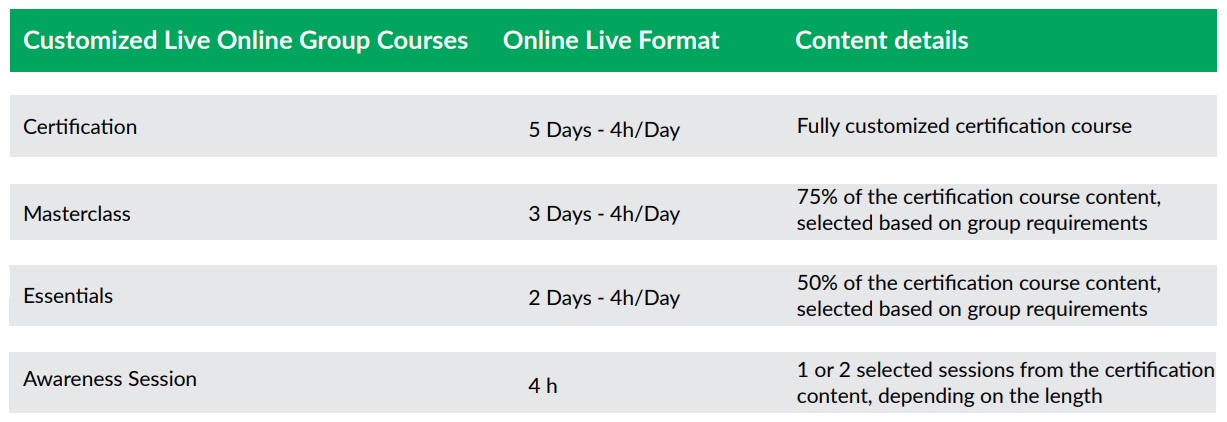
One option comes through The KPI Institute’s customized live online group training programs, which combine live instruction with research-based content and practical application. Rather than following a standard curriculum, each program reflects the organization’s industry, functional area, and competency development requirements.

For over 20 years, The KPI Institute has advanced research and professional solutions in business performance worldwide, with expertise in strategy, key performance indicators (KPIs), employee performance, customer service, and innovation management.

When customized group training makes sense

A customized learning program may suit organizations that:

  • Need examples and case studies that reflect their own industry.
  • Want teams to build knowledge together instead of training employees individually.
  • Need learning schedules that fit around operational commitments.
  • Seek consistent knowledge across departments, business units, or regional offices.
  • Want to address specific competency gaps through focused learning.

The delivery format also gives organizations greater flexibility. Sessions can take place over consecutive days within one week or across selected days over two or more weeks. Each session lasts up to four hours, which gives participants time to attend training while continuing with their regular responsibilities.

What participants can expect

The KPI Institute’s customized live online group training programs include:

  • Flexible scheduling
    Organizations select a schedule that aligns with business requirements and team availability.
  • Customized course content
    Course materials, case studies, and practical exercises reflect the group’s industry, business functions, and learning priorities.
  • Business continuity
    Four-hour sessions allow participants to continue with daily responsibilities while attending live instruction.
  • Virtual collaborative learning
    Interactive discussions, group activities, and digital collaboration tools encourage knowledge sharing throughout the program.
  • Cost efficiency
    Organizations can save up to 40% compared with traditional face-to-face in-house training because travel, accommodation, venue, and other logistical costs do not apply.

Learning topics available for customization

Organizations can customize live online training across The KPI Institute’s professional learning portfolio:

  • Certified KPI Professional and Practitioner
    Learn how to select, document, monitor, and report Key Performance Indicators that support organizational objectives.
  • Certified OKR Professional
    Build practical knowledge on designing and implementing Objectives and Key Results across teams.
  • Certified Strategy and Business Planning Professional
    Study frameworks and methods used to develop and execute strategic and business plans.
  • Certified Performance Management Professional
    Explore approaches to organizational performance measurement, reporting, and decision-making.
  • Certified Strategy and Performance Maturity Assessment Professional
    Assess the maturity of performance management systems through structured methodologies.
  • Certified Employee Performance Management Professional
    Examine performance planning, employee evaluation, coaching, and development practices.
  • Certified Data Analysis Professional
    Develop skills for collecting, analyzing, and interpreting business data.
  • Certified Data Visualization Professional
    Present complex information through dashboards, charts, and visual reporting techniques.
  • Certified Benchmarking Professional
    Learn structured benchmarking methods to compare practices and performance with industry peers.
  • Certified Balanced Scorecard Management System Professional
    Understand the Balanced Scorecard framework and its application in strategy execution.
  • Certified Agile Strategy Execution Professional
    Explore agile practices that support strategy implementation in changing business environments.

Organizations may also choose the learning format that best fits their objectives:

For more than 20 years, The KPI Institute has supported professionals and organizations through research, consulting, audit services, publications, and training in strategy and performance management. The customized live online group training programs add another learning option for organizations that want training built around their own priorities, people, and schedules.

Learn more

Organizations interested in arranging a customized live online group training program can contact the regional representative below.

Middle East

Teodora Gorski
Managing Director, MENA
E: teo.gorski@kpiinstitute.com
M: +971 55 787 6427

_____________________________

Asia Pacific

Sasikala Annamalai
Sales Director, Southeast Asia
E: sasikala.annamalai@kpiinstitute.com
M: +60 12 591 1366

_____________________________

Rest of the World

Alexandru Muntean
Head of Customer Engagement
E: alex.muntean@kpiinstitute.com
M: +40 747 060 997

__________________________________________________________________________________________

The KPI Institute is a global leader in business performance research and solutions, specializing in practice domains including strategy, key performance indicators (KPIs), employee performance, customer service, and innovation management. For over 20 years, The KPI Institute has established international standards and best practices for KPIs across both private and public sectors.

What We Offer:

  • Certifications & Training: Practical programs delivered worldwide—live online, offsite, and customized—spanning 6 continents and 7 offices in Australia, Southeast Asia, Europe, and the Middle East.
  • Knowledge Platforms: Access to www.smartKPIs.com, the world’s largest documented database of KPIs, with over 21,600 examples published and 148,000+ members in our online communities.
  • Publications: Over 460 publications, including books, research papers, and practical guides, providing insights to enhance organizational performance.
  • Advisory & Implementation Support: Expert guidance to apply insights in practice for measurable impact.

Our Reach and Impact:

  • 81,000+ companies registered on our platforms
  • 2.5 million+ professionals reached through training and knowledge services
  • 128 research client countries and 120 global partner organizations

Website: www.kpiinstitute.org

Email: office@kpiinstitute.org

LinkedIn: The KPI Institute

World’s largest KPI database now features 21,772 documented key performance indicators

June 1st, 2026 Posted by KPIs, Performance Management, Research 0 thoughts on “World’s largest KPI database now features 21,772 documented key performance indicators”

Organizations collect vast amounts of data, yet many still face a familiar challenge: identifying the right key performance indicators (KPIs) to measure performance and support decision-making. The search for reliable business metrics has fueled interest in KPI databases that provide documented KPIs, KPI examples, and established performance measurement practices.

smartKPIs, developed by The KPI Institute, has reached a new milestone with a database containing 21,772 documented KPIs.

This achievement strengthens its position as the world’s largest KPI database and one of the most extensive KPI libraries available to professionals across industries.

The KPI database includes more than 7,000 premium documented KPIs and covers 16 functional areas and 25 industries. Its collection spans sectors such as finance, healthcare, manufacturing, education, retail, logistics, public administration, sustainability, customer service, human resources, and supply chain management. Users can explore KPI examples and business metrics based on industry, department, or area of expertise.

What sets the platform apart is the breadth of contexts covered within its KPI library. Organizational context KPIs focus on business performance at the industry and functional level. Global context KPIs address topics such as economic development, public health, social progress, environmental performance, and sustainability. Personal context KPIs provide metrics related to productivity, time management, work-life balance, budgeting, and personal well-being.

The platform also serves as a resource for professionals who want to strengthen their understanding of KPI managementand performance measurement. Its learning materials cover topics such as performance management and measurement, KPI formulation and selection, target setting, KPI visualization, analytics, reporting practices, performance management levels, and common KPI pitfalls. These resources help both newcomers and experienced practitioners build stronger measurement frameworks.

Interest in KPI benchmarking and KPI documentation has grown as organizations seek greater consistency in reporting. Different teams often use different definitions for the same metric, which can affect reporting accuracy and make performance comparisons more difficult. Access to documented KPIs gives professionals a common reference point when selecting indicators and developing performance management systems.

The platform’s reach extends beyond its database. More than 75,000 members form a global community focused on KPI management, business metrics, organizational performance, and performance measurement. This network allows professionals to exchange ideas, discuss industry practices, and learn from peers across different sectors.

A comprehensive KPI database can help organizations reduce the time spent searching for relevant indicators and provide access to proven KPI examples. Documented KPIs that include definitions, formulas, data sources, reporting frequencies, and interpretation guidelines can support more informed performance discussions and stronger reporting practices.

Free Preview Subscription and More!

Professionals interested in exploring the platform can begin with the free Preview subscription.

The plan provides access to 100 KPI names, the KPI Dashboard, and the Top 10 KPIs, offering an introduction to the world’s largest KPI database at no cost.

Those who require deeper KPI documentation, premium KPI examples, industry KPI reports, and expanded access to documented KPIs can review the Starter, Standard, and Premium subscription options. These plans provide varying levels of access based on individual and organizational needs. Subscribe to smartKPIs for free and discover how KPI documentation, KPI benchmarking resources, and performance measurement guidance can support better business decisions.

For additional features, premium content, and expanded access to the world’s largest KPI database, visit the platform and explore the subscription plan that best matches your requirements.

FREE mid-year performance review resources to help organizations finish 2026 strong

May 25th, 2026 Posted by Performance Management, Publications, Research, Webinar 0 thoughts on “FREE mid-year performance review resources to help organizations finish 2026 strong”

Half of 2026 has already passed.

Many organizations now face a familiar question: What comes next?

January brought ambitious plans. Leadership teams approved strategic initiatives. Departments rolled out new KPIs. Managers tracked targets with optimism. Then daily operations took over. Priorities shifted. Reports piled up. Some initiatives lost momentum.

A mid-year performance review gives organizations a chance to pause and reassess. This period can expose weak reporting practices, misaligned KPIs, and execution gaps. It can also uncover new opportunities.

Several business leaders now look for practical support instead of lengthy theory. Free performance management resources can help teams rethink priorities, refine KPI reporting, and improve decision-making during the second half of the year.

The KPI Institute offers a wide range of free resources that support strategy and performance management. From articles and webinars to KPI toolkits and publications, these materials can support organizations that want clearer direction for the months ahead.

Why a Mid-Year Performance Review Matters

A business strategy may look solid on paper and still fall short during execution.

Some organizations collect too many metrics. Others track KPIs with little connection to strategic priorities. In some cases, teams produce reports every month without any discussion about performance trends.

A mid-year performance review can help organizations identify:

  • KPIs that no longer reflect current priorities
  • Reporting practices that consume too much time
  • Departments that work in silos
  • Initiatives with weak follow-through
  • Data that lacks context

Business conditions also change throughout the year. Market shifts, operational issues, and workforce challenges can alter priorities within a few months. Companies that revisit performance data during the middle of the year often gain a clearer picture of what deserves attention.

Free KPI Resources for Better Performance Tracking

KPI reporting remains a challenge for many organizations.

Some reports contain too much information. Others focus on metrics that offer little insight into operational performance. Confusing dashboards can also slow down decision-making.

The KPI Institute provides free KPI resources that can help teams improve reporting practices and KPI selection.

These resources include:

Organizations can use these materials to review existing KPIs and remove metrics that no longer serve a purpose. Clear KPI documentation can also reduce confusion among departments.

A KPI should support action. A metric without direction often turns into noise.

Strategy Execution Resources for the Second Half of 2026

A strategy document alone will not keep projects on track.

Execution problems usually appear during the middle of the year. Deadlines slip. Teams lose focus. Managers shift attention to urgent operational concerns. Strategic initiatives move into the background.

This pattern appears across many industries.

Strategy execution resources can help organizations reassess priorities and restore alignment between objectives and day-to-day work.

The KPI Institute shares free materials on:

Readers can also explore Performance Magazine articles that discuss real business cases, performance trends, and management practices from different sectors.

These resources can help leadership teams ask better questions during a mid-year performance review:

  • Which initiatives still support strategic priorities?
  • Which KPIs need revision?
  • Which projects no longer justify additional resources?
  • Which departments require stronger coordination?

Clear discussions often produce better outcomes than lengthy reports.

Free Business Performance Review Resources

A business performance review should go beyond numbers.

Financial results matter, but they rarely tell the full story. Operational delays, employee engagement issues, and weak communication can affect organizational performance long before financial problems appear.

Free business performance review resources can help managers examine performance from multiple perspectives.

The KPI Institute offers:

Common Mid-Year Performance Problems

Several issues tend to surface during a mid-year performance review.

  • KPI overload: Some organizations track too many metrics. Teams spend more time collecting data than discussing results.
  • Reporting fatigue: Employees may see reports as routine paperwork instead of decision-support tools.
  • Weak alignment: Departments may pursue different priorities without clear coordination.
  • Outdated targets: Business conditions can change after the first quarter. Some targets may no longer reflect current realities.
  • Lack of accountability: KPIs without ownership often lead nowhere.

These problems rarely disappear on their own. Organizations need structured discussions, practical tools, and reliable resources.

A Practical Time for Reassessment

The second half of the year still offers enough time for course correction.

Organizations do not always need major restructuring. Small adjustments can produce noticeable results. A revised KPI dashboard, a focused review meeting, or a clearer reporting structure may improve performance discussions across teams.

A mid-year performance review can also help organizations prepare for next year. Teams that identify recurring problems early may avoid the same issues during annual planning cycles.

The KPI Institute continues to publish research, articles, newsletters, and performance management resources for professionals across industries. And this may be the right time to review what works, address weak spots, and move forward with clearer priorities.

_____________________________________________________________________________________

The KPI Institute is a global leader in business performance research and solutions, specializing in practice domains including strategy, key performance indicators (KPIs), employee performance, customer service, and innovation management. For over 20 years, The KPI Institute has established international standards and best practices for KPIs across both private and public sectors.

What We Offer:

  • Certifications & Training: Practical programs delivered worldwide—live online, offsite, and customized—spanning 6 continents and 7 offices in Australia, Southeast Asia, Europe, and the Middle East.
  • Knowledge Platforms: Access to www.smartKPIs.com, the world’s largest documented database of KPIs, with over 21,600 examples published and 148,000+ members in our online communities.
  • Publications: Over 460 publications, including books, research papers, and practical guides, providing insights to enhance organizational performance.
  • Advisory & Implementation Support: Expert guidance to apply insights in practice for measurable impact.

Our Reach and Impact:

  • 81,000+ companies registered on our platforms
  • 2.5 million+ professionals reached through training and knowledge services
  • 128 research client countries and 120 global partner organizations 

Website: www.kpiinstitute.org.

Email: office@kpiinstitute.org

LinkedIn: The KPI Institute

postgraduate strategy diploma thumbnail

Exclusive postgraduate diploma answers growing demand for strategy expertise

May 21st, 2026 Posted by Certifications, Courses, Strategy 0 thoughts on “Exclusive postgraduate diploma answers growing demand for strategy expertise”

postgraduate strategy diploma banner

Organizations rarely struggle with ideas alone. Most already have plans, targets, and dashboards in place. The real problem appears later, when execution stalls and performance drifts off course.

The Executive Program in Strategy and Performance by The KPI Institute entered the spotlight through its Graduate Certificate in Strategy and Performance. The 12-month program gives professionals a structured route through core disciplines such as strategy planning, KPI selection, performance management, and agile execution.

For many professionals, though, the graduate certificate marks only the starting point.

The Postgraduate Diploma in Strategy and Performance takes the program much further.

Built for executives, consultants, managers, and business analysts who already work close to strategy and performance functions, the diploma stretches across three semesters over 18 months and covers a broader range of organizational disciplines.

The program stands out for one simple reason. Few courses place strategy, execution, performance management, employee performance, maturity assessment, benchmarking, data analysis, and visualization under one curriculum.

Participants complete eight certification courses and select two elective topics from the program portfolio. The final semester focuses on practical application through a Final Practitioner Portfolio based on a real business case.

The curriculum includes certifications such as:

  • Certified Strategy and Business Planning Professional
  • Certified KPI Professional
  • Certified Performance Management Professional
  • Certified Employee Performance Management Professional
  • Certified Agile Strategy Execution Professional
  • Certified Strategy and Performance Maturity Assessment Professional
  • Certified Objectives and Key Results Professional
  • Certified Balanced Scorecard Management Professional
  • Certified Data Analysis Professional
  • Certified Data Visualization Professional
  • Certified Benchmarking Professional

The structure differs from traditional postgraduate programs. Participants schedule courses based on their availability. Each module combines live online sessions with assignments before and after training. Group discussions bring together professionals from different industries and regions, which opens the door to wider business perspectives and long-term professional connections.

No fixed cohort moves through the diploma together from start to finish. Each course introduces a different mix of participants. Consultants may sit alongside CEOs, department managers, or analysts from organizations across the world. Conversations often shift from theory to direct operational problems within minutes.

That format appeals to professionals who already carry leadership responsibilities and need flexibility without giving up academic depth.

The Graduate Certificate in Strategy and Performance remains the shorter route for professionals who want focused exposure to strategy and performance management across four mandatory courses and a practitioner portfolio with 20 assignments.

The postgraduate diploma, however, targets those who want broader specialization and stronger differentiation in a competitive market.

Companies continue to look for professionals who can connect planning, execution, analytics, employee performance, and measurement systems without working in silos. The diploma places all those disciplines under one umbrella.

Full curriculum details and program structure are available in the brochure: TKI Executive Program in Strategy & Performance Postgraduate Diploma 

For enrollment details, contact the ExEdu Advisory Team at exeduoffice@kpiinstitute.com 

_____________________________________________________________________________________

The KPI Institute is a global leader in business performance research and solutions, specializing in practice domains including strategy, key performance indicators (KPIs), employee performance, customer service, and innovation management. For over 20 years, The KPI Institute has established international standards and best practices for KPIs across both private and public sectors.

What We Offer:

  • Certifications & Training: Practical programs delivered worldwide—live online, offsite, and customized—spanning 6 continents and 7 offices in Australia, Southeast Asia, Europe, and the Middle East.
  • Knowledge Platforms: Access to www.smartKPIs.com, the world’s largest documented database of KPIs, with over 21,600 examples published and 148,000+ members in our online communities.
  • Publications: Over 460 publications, including books, research papers, and practical guides, providing insights to enhance organizational performance.
  • Advisory & Implementation Support: Expert guidance to apply insights in practice for measurable impact.

Our Reach and Impact:

  • 81,000+ companies registered on our platforms
  • 2.5 million+ professionals reached through training and knowledge services
  • 128 research client countries and 120 global partner organizations 

Website: www.kpiinstitute.org

Email: office@kpiinstitute.org

LinkedIn: The KPI Institute

business strategy online courses

5 must-know factors before investing in business strategy online courses

April 14th, 2026 Posted by Certifications, Courses 0 thoughts on “5 must-know factors before investing in business strategy online courses”

business strategy online courses

Choosing the right business strategy online course can be overwhelming, especially with so many programs claiming to deliver results.

At The KPI Institute, we’ve spent over 20 years working with professionals and organizations globally to refine frameworks, teaching methods, and practical tools that align with international standards in performance and strategy management.

Before investing your time and money, consider the following research-backed factors.

They highlight what actually contributes to meaningful learning outcomes and long-term professional value.

And they’re the kinds of experiences that our own Certified Strategy and Business Planning Professional program is built to provide.

1. Check whether you’ll be practicing, not just listening

Research consistently shows that active learning, including case studies, simulations, and applied exercises, leads to better understanding, retention, and real-world application than passive lecture formats. A meta-analysis in Frontiers in Education found that active learning significantly improves performance outcomes compared to traditional instruction.

To identify hands-on courses, review the syllabus for practical exercises, scenario work, templates, and collaborative projects.

The KPI Institute’s Certified Strategy and Business Planning Professional program integrates real-world strategic exercises, giving learners opportunities to apply concepts directly to challenges they face in their organizations.

2. Scrutinize the credibility of the provider

Reputation and institutional legitimacy matter because they signal quality, standards, and trustworthiness—attributes both learners and employers pay attention to when evaluating credentials. Research on micro‑credentials finds that employers use the source of a credential as part of their assessment of its value, showing that credentials issued by recognized institutions are more likely to be valued in hiring decisions.

Credibility ensures that the course content is rigorous, relevant, and aligned with international benchmarks.

The KPI Institute’s decades of experience with global organizations and practitioners ensures its programs reflect proven frameworks and professional standards.

3. Verify Continuing Professional Development (CPD) credits

CPD credits are more than a bonus—they provide structured, recognized learning that supports career growth.

Research in professional learning contexts shows that CPD-accredited programs enhance reflection, skill application, and professional performance.

The Certified Strategy and Business Planning Professional program is CPD-accredited, meaning participants gain both practical skills and recognized professional development credits—strengthening their professional portfolio and demonstrating commitment to ongoing skill growth.

4. Look for reported professional impact and skill development

Testimonials and peer feedback matter. When evaluating a program, focus on whether alumni describe how they applied frameworks, solved organizational challenges, or improved decision-making.

The Certified Strategy and Business Planning Professional program consistently receives feedback from professionals reporting improved strategic clarity, planning confidence, and actionable results in their organizations:

“The comprehensive curriculum coupled with engaging, real-world case studies provided by our knowledgeable instructor gave me a deeper understanding of strategic frameworks and their practical applications. I particularly appreciated the interactive sessions, which were not only informative but also stimulating. Collaborating with peers from various backgrounds enriched the experience, offering diverse insights into strategic challenges. This course has significantly enhanced my strategic thinking and planning abilities, making it an invaluable part of my professional development. Highly recommended for anyone looking to elevate their strategic management skills!”
— Ramy AbuElEla
Associate Director, KPMG

“The Strategy and Business Planning Professional course offered a comprehensive and practical approach to understanding the fundamentals of strategy and business planning. The content was well-structured, with a perfect balance between theoretical concepts and real-world applications. Each module built on the previous one, providing clear insights into strategy formulation, implementation, and performance evaluation. The case studies and interactive activities made the learning experience engaging and immediately applicable to professional settings. I now feel equipped with the tools and knowledge to develop effective business strategies with confidence.”
— Amal Alhamazany
Assistant Professor, University of Hail (Saudi Arabia)

“Attending the KPI Institute’s 3-day session in Kuala Lumpur was a transformative experience. The practical and actionable learning has already proven its value in my work as a business consultant. The course served as a strong validation of my professional expertise, and I now feel immensely confident in my ability to deliver results in this area moving forward.”
— Bimal Kandel
Managing Director, Froxjob

“As a Lead Budget Analyst, I often work with the numbers behind the strategy. This course provided the perfect framework to understand the ‘why’ behind those numbers. The deep dive into Deliberate Strategic Planning and the practical application of KPIs has given me a stronger toolkit to align our financial planning with the organization’s long-term objectives. Highly recommended for finance professionals looking to think more strategically.”
— Abdullah Adel A Alsuhaimi
Lead Budget Analyst, STC

“This training program exceeded my expectations in terms of the depth of information and the practical skills included in the training material. In addition, the trainer demonstrated exceptional competence and extensive experience in the field. I highly recommend my colleagues to join this course whenever the opportunity arises, as it opens up many avenues for both personal and professional development.”
— Yousif Al-Nas
HR Consultant & Professional Coach, Planning & Programming Supervisor (Retired from Saudi Aramco)

5. Make sure the course uses technologically advanced tools

Technology isn’t just the delivery channel. It’s part of how you learn.

Research on interactive and adaptive learning technologies shows that platforms that support personalization, problem solving, and real‑time interaction can improve engagement and performance compared with static, lecture‑style systems alone.

Evaluate whether the learning environment supports adaptive paths, practical simulations, performance tracking, and collaboration.

The Certified Strategy and Business Planning Professional program is delivered via Lerero, a science‑driven platform built on cognitive research that supports adaptive learning paths, performance insights, personalized interactions, and meaningful engagement—all elements research suggests can enhance learning outcomes.

Invest in learning that works today

The KPI Institute’s Certified Strategy and Business Planning Professional program brings these five factors to life.

Experience it firsthand—secure your slot here.

KPI and business strategy courses

________________________________________________________________________________

The KPI Institute is a global leader in business performance research and solutions, specializing in practice domains including strategy, key performance indicators (KPIs), employee performance, customer service, and innovation management.

For over 20 years, The KPI Institute has established international standards and best practices for KPIs across both private and public sectors.

What We Offer:

  • Certifications & Training: Practical programs delivered worldwide—live online, offsite, and customized—spanning 6 continents and 7 offices in Australia, Southeast Asia, Europe, and the Middle East.
  • Knowledge Platforms: Access to www.smartKPIs.com, the world’s largest documented database of KPIs, with over 21,600 examples published and 148,000+ members in our online communities.
  • Publications: Over 460 publications, including books, research papers, and practical guides, providing insights to enhance organizational performance.
  • Advisory & Implementation Support: Expert guidance to apply insights in practice for measurable impact.

Our Reach and Impact:

  • 81,000+ companies registered on our platforms
  • 2.5 million+ professionals reached through training and knowledge services
  • 128 research client countries and 120 global partner organizations 

Website: www.kpiinstitute.org.

Email: office@kpiinstitute.org

LinkedIn: The KPI Institute

Recent Comments

    Archives