Posts tagged "Performance Management"

The training challenge many organizations are trying to solve

June 30th, 2026 Posted by Business Education, Career Growth, Certifications, Courses, E-learning, Employees 0 thoughts on “The training challenge many organizations are trying to solve”

Finding time for professional development has become a familiar challenge across industries.

Teams need new skills to keep pace with changing business demands, yet many organizations also need employees to remain focused on day-to-day operations. Standard training programs can address broad topics, but they do not always reflect the realities of a specific industry, department, or business function.

Recent research points to a growing need for targeted workforce development.

The World Economic Forum’s Future of Jobs Report 2025, which remains one of the most widely referenced workforce studies in 2026, found that 59% of the global workforce will require training by 2030. The report also found that 63% of employers identify skills gaps as a major barrier to business transformation, while nearly 40% of current skill requirements are expected to change by 2030. The findings draw from responses submitted by more than 1,000 employers across 55 economies, representing over 14 million workers.

The need for workforce development also appears in learning and development research. LinkedIn Learning’s 2025 Workplace Learning Report, which continues to guide many learning strategies in 2026, found that 91% of learning and development professionals believe continuous learning has become more important than ever for career success, while organizations continue to look for learning programs that connect closely with business priorities.

These findings raise an important question:

How can organizations provide meaningful learning opportunities without disrupting business operations or asking employees to step away from work for several days?

One option comes through The KPI Institute’s customized live online group training programs, which combine live instruction with research-based content and practical application. Rather than following a standard curriculum, each program reflects the organization’s industry, functional area, and competency development requirements.

For over 20 years, The KPI Institute has advanced research and professional solutions in business performance worldwide, with expertise in strategy, key performance indicators (KPIs), employee performance, customer service, and innovation management.

When customized group training makes sense

A customized learning program may suit organizations that:

  • Need examples and case studies that reflect their own industry.
  • Want teams to build knowledge together instead of training employees individually.
  • Need learning schedules that fit around operational commitments.
  • Seek consistent knowledge across departments, business units, or regional offices.
  • Want to address specific competency gaps through focused learning.

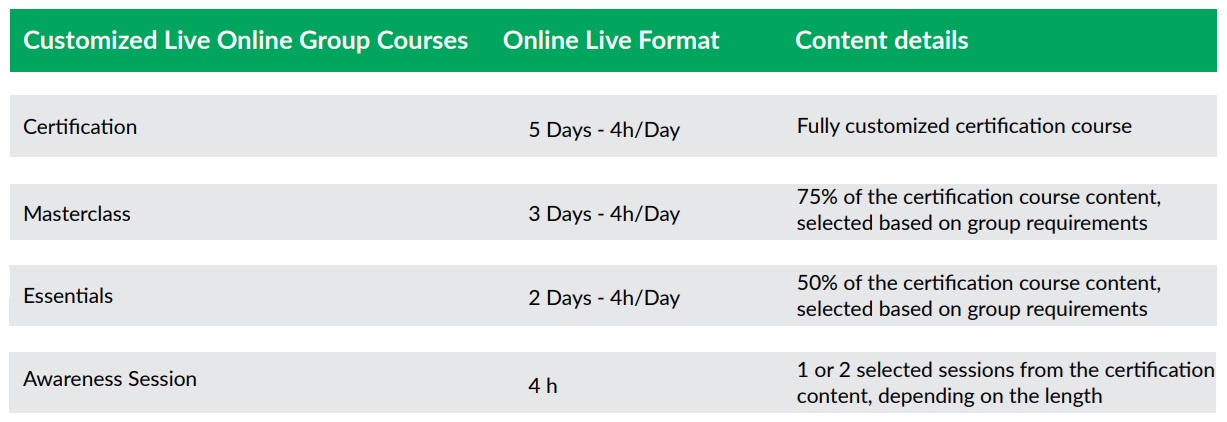
The delivery format also gives organizations greater flexibility. Sessions can take place over consecutive days within one week or across selected days over two or more weeks. Each session lasts up to four hours, which gives participants time to attend training while continuing with their regular responsibilities.

What participants can expect

The KPI Institute’s customized live online group training programs include:

  • Flexible scheduling
    Organizations select a schedule that aligns with business requirements and team availability.
  • Customized course content
    Course materials, case studies, and practical exercises reflect the group’s industry, business functions, and learning priorities.
  • Business continuity
    Four-hour sessions allow participants to continue with daily responsibilities while attending live instruction.
  • Virtual collaborative learning
    Interactive discussions, group activities, and digital collaboration tools encourage knowledge sharing throughout the program.
  • Cost efficiency
    Organizations can save up to 40% compared with traditional face-to-face in-house training because travel, accommodation, venue, and other logistical costs do not apply.

Learning topics available for customization

Organizations can customize live online training across The KPI Institute’s professional learning portfolio:

  • Certified KPI Professional and Practitioner
    Learn how to select, document, monitor, and report Key Performance Indicators that support organizational objectives.
  • Certified OKR Professional
    Build practical knowledge on designing and implementing Objectives and Key Results across teams.
  • Certified Strategy and Business Planning Professional
    Study frameworks and methods used to develop and execute strategic and business plans.
  • Certified Performance Management Professional
    Explore approaches to organizational performance measurement, reporting, and decision-making.
  • Certified Strategy and Performance Maturity Assessment Professional
    Assess the maturity of performance management systems through structured methodologies.
  • Certified Employee Performance Management Professional
    Examine performance planning, employee evaluation, coaching, and development practices.
  • Certified Data Analysis Professional
    Develop skills for collecting, analyzing, and interpreting business data.
  • Certified Data Visualization Professional
    Present complex information through dashboards, charts, and visual reporting techniques.
  • Certified Benchmarking Professional
    Learn structured benchmarking methods to compare practices and performance with industry peers.
  • Certified Balanced Scorecard Management System Professional
    Understand the Balanced Scorecard framework and its application in strategy execution.
  • Certified Agile Strategy Execution Professional
    Explore agile practices that support strategy implementation in changing business environments.

Organizations may also choose the learning format that best fits their objectives:

For more than 20 years, The KPI Institute has supported professionals and organizations through research, consulting, audit services, publications, and training in strategy and performance management. The customized live online group training programs add another learning option for organizations that want training built around their own priorities, people, and schedules.

Learn more

Organizations interested in arranging a customized live online group training program can contact the regional representative below.

Middle East

Teodora Gorski
Managing Director, MENA
E: teo.gorski@kpiinstitute.com
M: +971 55 787 6427

_____________________________

Asia Pacific

Sasikala Annamalai
Sales Director, Southeast Asia
E: sasikala.annamalai@kpiinstitute.com
M: +60 12 591 1366

_____________________________

Rest of the World

Alexandru Muntean
Head of Customer Engagement
E: alex.muntean@kpiinstitute.com
M: +40 747 060 997

__________________________________________________________________________________________

The KPI Institute is a global leader in business performance research and solutions, specializing in practice domains including strategy, key performance indicators (KPIs), employee performance, customer service, and innovation management. For over 20 years, The KPI Institute has established international standards and best practices for KPIs across both private and public sectors.

What We Offer:

  • Certifications & Training: Practical programs delivered worldwide—live online, offsite, and customized—spanning 6 continents and 7 offices in Australia, Southeast Asia, Europe, and the Middle East.
  • Knowledge Platforms: Access to www.smartKPIs.com, the world’s largest documented database of KPIs, with over 21,600 examples published and 148,000+ members in our online communities.
  • Publications: Over 460 publications, including books, research papers, and practical guides, providing insights to enhance organizational performance.
  • Advisory & Implementation Support: Expert guidance to apply insights in practice for measurable impact.

Our Reach and Impact:

  • 81,000+ companies registered on our platforms
  • 2.5 million+ professionals reached through training and knowledge services
  • 128 research client countries and 120 global partner organizations

Website: www.kpiinstitute.org

Email: office@kpiinstitute.org

LinkedIn: The KPI Institute

What really causes strategic initiatives to lose momentum?

June 25th, 2026 Posted by Certifications, Courses, E-learning, Professional Development, Strategy 0 thoughts on “What really causes strategic initiatives to lose momentum?”

Organizations rarely struggle to come up with strategic initiatives.

Leadership teams spend weeks or even months on planning sessions. Objectives become clear. Roadmaps receive approval. Budgets follow. Teams know what they need to accomplish.

Then something changes.

New priorities emerge. Resources shift. Urgent operational work begins to compete with long-term goals. Before long, strategic initiatives lose momentum.

This challenge has led many organizations to adopt more agile approaches to strategy execution. The KPI Institute has long advocated this approach through its research and professional education. The principles behind agile strategy execution focus on regular prioritization, disciplined performance reviews, and continuous alignment between strategic objectives and day-to-day work. These principles also form the foundation of The KPI Institute’s Certified Agile Strategy Execution Professional course.

This pattern appears across industries. According to the Project Management Institute’s Pulse of the Profession research, organizations with mature project and execution practices report stronger business performance and lower levels of wasted investment than their peers.

Priorities need regular review

Organizations rarely pursue a single initiative at a time.

Most manage a portfolio of projects, transformation programs, operational improvements, and compliance requirements. Each initiative competes for attention, funding, and people.

Without a clear process for prioritization, teams can spread their efforts too thin. Critical initiatives move forward at a slower pace while lower-impact work continues simply because it started months earlier.

Successful organizations review priorities on a regular basis. They ask difficult questions. Does this initiative still support strategic objectives? Does it deserve the same level of investment today? Has another opportunity become more urgent?

These conversations help leaders focus resources where they matter most.

Four questions every strategy review should answer

A strategy review does not have to become a lengthy exercise. A few well-chosen questions can reveal whether strategic initiatives still deserve attention and resources.

Ask these questions:

  • Does this initiative still support at least one strategic objective?
  • Are the expected business benefits still realistic?
  • Has another initiative become a higher priority?
  • What obstacle is slowing progress, and who owns the next action?

These questions create a simple structure for executive discussions. They also reduce the risk of keeping initiatives alive simply because time or money has already gone into them.

Practical tools that support strategy execution

Clear discussions need clear documentation. Many organizations rely on simple tools that keep strategic initiatives organized and make review meetings more productive.

Some of the most common tools include:

  • Initiative portfolios to compare priorities across the organization.
  • Benefits realization registers to monitor expected business outcomes.
  • Initiative description forms that define ownership, timelines, milestones, and success criteria.
  • Performance reports and scorecards that track progress against strategic objectives.
  • Process maps that clarify complex initiatives and identify bottlenecks.

These tools create consistency across the execution process. They also give leaders better information when priorities need to change.

Progress deserves more than status updates

Many organizations rely on project updates to monitor strategic initiatives.

Completion percentages and milestone reports have their place. They show whether activities move forward.

Business leaders also need answers to different questions.

What results has the initiative produced so far? Do the expected benefits still look realistic? Have new risks appeared? Does the initiative still support current business priorities?

A structured review process creates room for these discussions. It shifts attention from activity to business outcomes and gives decision-makers stronger evidence when plans require adjustment.

Strategy works best when teams stay connected

Even well-designed initiatives can lose momentum when departments work in isolation.

Marketing, operations, finance, and human resources often contribute to the same strategic objective. If each function follows separate priorities without regular coordination, progress slows. Small disconnects grow into larger obstacles over time.

Frequent communication and shared visibility help teams stay aligned. Leaders gain a clearer picture of progress across the organization. Employees also understand how their work contributes to broader business objectives.

Adaptability supports long-term execution

Business conditions rarely stay the same for long.

A strategy may remain relevant while the path toward it changes. Customer expectations shift. New technologies appear. Market conditions create fresh opportunities or new constraints.

Organizations that review initiatives on a regular basis can adjust timelines, redistribute resources, or revise priorities without losing sight of strategic objectives.

This approach reflects the principles of agile strategy execution. Teams continue to move toward long-term goals while they respond to changing business conditions with discipline and consistency.

Building stronger strategy execution skills

These practices require more than experience alone. Professionals also need practical methods for initiative prioritization, portfolio development, benefits realization, performance reporting, and agile organizational practices.

The KPI Institute’s Certified Agile Strategy Execution Professional course covers these topics through a structured learning experience. Participants explore strategy execution frameworks, initiative planning, portfolio development, benefits realization, performance reviews, and agile organizational practices. Practical exercises and assessments give participants the opportunity to apply these concepts to realistic business scenarios.

Strategic initiatives rarely lose momentum because organizations lack ambition. Priorities shift. Resources become stretched. Execution practices fall behind business needs.

Professionals who want a more structured approach to strategy execution can build these capabilities through dedicated learning. To learn more about The KPI Institute’s Certified Agile Strategy Execution Professional course and reserve a place in an upcoming cohort, visit the course page and complete the registration process.

KPI and business strategy courses

__________________________________________________________________________________________

The KPI Institute is a global leader in business performance research and solutions, specializing in practice domains including strategy, key performance indicators (KPIs), employee performance, customer service, and innovation management. For over 20 years, The KPI Institute has established international standards and best practices for KPIs across both private and public sectors.

What We Offer:

  • Certifications & Training: Practical programs delivered worldwide—live online, offsite, and customized—spanning 6 continents and 7 offices in Australia, Southeast Asia, Europe, and the Middle East.
  • Knowledge Platforms: Access to www.smartKPIs.com, the world’s largest documented database of KPIs, with over 21,600 examples published and 148,000+ members in our online communities.
  • Publications: Over 460 publications, including books, research papers, and practical guides, providing insights to enhance organizational performance.
  • Advisory & Implementation Support: Expert guidance to apply insights in practice for measurable impact.

Our Reach and Impact:

  • 81,000+ companies registered on our platforms
  • 2.5 million+ professionals reached through training and knowledge services
  • 128 research client countries and 120 global partner organizations

Website: www.kpiinstitute.org

Email: office@kpiinstitute.org

LinkedIn: The KPI Institute

World’s largest KPI database now features 21,772 documented key performance indicators

June 1st, 2026 Posted by KPIs, Performance Management, Research 0 thoughts on “World’s largest KPI database now features 21,772 documented key performance indicators”

Organizations collect vast amounts of data, yet many still face a familiar challenge: identifying the right key performance indicators (KPIs) to measure performance and support decision-making. The search for reliable business metrics has fueled interest in KPI databases that provide documented KPIs, KPI examples, and established performance measurement practices.

smartKPIs, developed by The KPI Institute, has reached a new milestone with a database containing 21,772 documented KPIs.

This achievement strengthens its position as the world’s largest KPI database and one of the most extensive KPI libraries available to professionals across industries.

The KPI database includes more than 7,000 premium documented KPIs and covers 16 functional areas and 25 industries. Its collection spans sectors such as finance, healthcare, manufacturing, education, retail, logistics, public administration, sustainability, customer service, human resources, and supply chain management. Users can explore KPI examples and business metrics based on industry, department, or area of expertise.

What sets the platform apart is the breadth of contexts covered within its KPI library. Organizational context KPIs focus on business performance at the industry and functional level. Global context KPIs address topics such as economic development, public health, social progress, environmental performance, and sustainability. Personal context KPIs provide metrics related to productivity, time management, work-life balance, budgeting, and personal well-being.

The platform also serves as a resource for professionals who want to strengthen their understanding of KPI managementand performance measurement. Its learning materials cover topics such as performance management and measurement, KPI formulation and selection, target setting, KPI visualization, analytics, reporting practices, performance management levels, and common KPI pitfalls. These resources help both newcomers and experienced practitioners build stronger measurement frameworks.

Interest in KPI benchmarking and KPI documentation has grown as organizations seek greater consistency in reporting. Different teams often use different definitions for the same metric, which can affect reporting accuracy and make performance comparisons more difficult. Access to documented KPIs gives professionals a common reference point when selecting indicators and developing performance management systems.

The platform’s reach extends beyond its database. More than 75,000 members form a global community focused on KPI management, business metrics, organizational performance, and performance measurement. This network allows professionals to exchange ideas, discuss industry practices, and learn from peers across different sectors.

A comprehensive KPI database can help organizations reduce the time spent searching for relevant indicators and provide access to proven KPI examples. Documented KPIs that include definitions, formulas, data sources, reporting frequencies, and interpretation guidelines can support more informed performance discussions and stronger reporting practices.

Free Preview Subscription and More!

Professionals interested in exploring the platform can begin with the free Preview subscription.

The plan provides access to 100 KPI names, the KPI Dashboard, and the Top 10 KPIs, offering an introduction to the world’s largest KPI database at no cost.

Those who require deeper KPI documentation, premium KPI examples, industry KPI reports, and expanded access to documented KPIs can review the Starter, Standard, and Premium subscription options. These plans provide varying levels of access based on individual and organizational needs. Subscribe to smartKPIs for free and discover how KPI documentation, KPI benchmarking resources, and performance measurement guidance can support better business decisions.

For additional features, premium content, and expanded access to the world’s largest KPI database, visit the platform and explore the subscription plan that best matches your requirements.

FREE mid-year performance review resources to help organizations finish 2026 strong

May 25th, 2026 Posted by Performance Management, Publications, Research, Webinar 0 thoughts on “FREE mid-year performance review resources to help organizations finish 2026 strong”

Half of 2026 has already passed.

Many organizations now face a familiar question: What comes next?

January brought ambitious plans. Leadership teams approved strategic initiatives. Departments rolled out new KPIs. Managers tracked targets with optimism. Then daily operations took over. Priorities shifted. Reports piled up. Some initiatives lost momentum.

A mid-year performance review gives organizations a chance to pause and reassess. This period can expose weak reporting practices, misaligned KPIs, and execution gaps. It can also uncover new opportunities.

Several business leaders now look for practical support instead of lengthy theory. Free performance management resources can help teams rethink priorities, refine KPI reporting, and improve decision-making during the second half of the year.

The KPI Institute offers a wide range of free resources that support strategy and performance management. From articles and webinars to KPI toolkits and publications, these materials can support organizations that want clearer direction for the months ahead.

Why a Mid-Year Performance Review Matters

A business strategy may look solid on paper and still fall short during execution.

Some organizations collect too many metrics. Others track KPIs with little connection to strategic priorities. In some cases, teams produce reports every month without any discussion about performance trends.

A mid-year performance review can help organizations identify:

  • KPIs that no longer reflect current priorities
  • Reporting practices that consume too much time
  • Departments that work in silos
  • Initiatives with weak follow-through
  • Data that lacks context

Business conditions also change throughout the year. Market shifts, operational issues, and workforce challenges can alter priorities within a few months. Companies that revisit performance data during the middle of the year often gain a clearer picture of what deserves attention.

Free KPI Resources for Better Performance Tracking

KPI reporting remains a challenge for many organizations.

Some reports contain too much information. Others focus on metrics that offer little insight into operational performance. Confusing dashboards can also slow down decision-making.

The KPI Institute provides free KPI resources that can help teams improve reporting practices and KPI selection.

These resources include:

Organizations can use these materials to review existing KPIs and remove metrics that no longer serve a purpose. Clear KPI documentation can also reduce confusion among departments.

A KPI should support action. A metric without direction often turns into noise.

Strategy Execution Resources for the Second Half of 2026

A strategy document alone will not keep projects on track.

Execution problems usually appear during the middle of the year. Deadlines slip. Teams lose focus. Managers shift attention to urgent operational concerns. Strategic initiatives move into the background.

This pattern appears across many industries.

Strategy execution resources can help organizations reassess priorities and restore alignment between objectives and day-to-day work.

The KPI Institute shares free materials on:

Readers can also explore Performance Magazine articles that discuss real business cases, performance trends, and management practices from different sectors.

These resources can help leadership teams ask better questions during a mid-year performance review:

  • Which initiatives still support strategic priorities?
  • Which KPIs need revision?
  • Which projects no longer justify additional resources?
  • Which departments require stronger coordination?

Clear discussions often produce better outcomes than lengthy reports.

Free Business Performance Review Resources

A business performance review should go beyond numbers.

Financial results matter, but they rarely tell the full story. Operational delays, employee engagement issues, and weak communication can affect organizational performance long before financial problems appear.

Free business performance review resources can help managers examine performance from multiple perspectives.

The KPI Institute offers:

Common Mid-Year Performance Problems

Several issues tend to surface during a mid-year performance review.

  • KPI overload: Some organizations track too many metrics. Teams spend more time collecting data than discussing results.
  • Reporting fatigue: Employees may see reports as routine paperwork instead of decision-support tools.
  • Weak alignment: Departments may pursue different priorities without clear coordination.
  • Outdated targets: Business conditions can change after the first quarter. Some targets may no longer reflect current realities.
  • Lack of accountability: KPIs without ownership often lead nowhere.

These problems rarely disappear on their own. Organizations need structured discussions, practical tools, and reliable resources.

A Practical Time for Reassessment

The second half of the year still offers enough time for course correction.

Organizations do not always need major restructuring. Small adjustments can produce noticeable results. A revised KPI dashboard, a focused review meeting, or a clearer reporting structure may improve performance discussions across teams.

A mid-year performance review can also help organizations prepare for next year. Teams that identify recurring problems early may avoid the same issues during annual planning cycles.

The KPI Institute continues to publish research, articles, newsletters, and performance management resources for professionals across industries. And this may be the right time to review what works, address weak spots, and move forward with clearer priorities.

_____________________________________________________________________________________

The KPI Institute is a global leader in business performance research and solutions, specializing in practice domains including strategy, key performance indicators (KPIs), employee performance, customer service, and innovation management. For over 20 years, The KPI Institute has established international standards and best practices for KPIs across both private and public sectors.

What We Offer:

  • Certifications & Training: Practical programs delivered worldwide—live online, offsite, and customized—spanning 6 continents and 7 offices in Australia, Southeast Asia, Europe, and the Middle East.
  • Knowledge Platforms: Access to www.smartKPIs.com, the world’s largest documented database of KPIs, with over 21,600 examples published and 148,000+ members in our online communities.
  • Publications: Over 460 publications, including books, research papers, and practical guides, providing insights to enhance organizational performance.
  • Advisory & Implementation Support: Expert guidance to apply insights in practice for measurable impact.

Our Reach and Impact:

  • 81,000+ companies registered on our platforms
  • 2.5 million+ professionals reached through training and knowledge services
  • 128 research client countries and 120 global partner organizations 

Website: www.kpiinstitute.org.

Email: office@kpiinstitute.org

LinkedIn: The KPI Institute

postgraduate strategy diploma thumbnail

Exclusive postgraduate diploma answers growing demand for strategy expertise

May 21st, 2026 Posted by Certifications, Courses, Strategy 0 thoughts on “Exclusive postgraduate diploma answers growing demand for strategy expertise”

postgraduate strategy diploma banner

Organizations rarely struggle with ideas alone. Most already have plans, targets, and dashboards in place. The real problem appears later, when execution stalls and performance drifts off course.

The Executive Program in Strategy and Performance by The KPI Institute entered the spotlight through its Graduate Certificate in Strategy and Performance. The 12-month program gives professionals a structured route through core disciplines such as strategy planning, KPI selection, performance management, and agile execution.

For many professionals, though, the graduate certificate marks only the starting point.

The Postgraduate Diploma in Strategy and Performance takes the program much further.

Built for executives, consultants, managers, and business analysts who already work close to strategy and performance functions, the diploma stretches across three semesters over 18 months and covers a broader range of organizational disciplines.

The program stands out for one simple reason. Few courses place strategy, execution, performance management, employee performance, maturity assessment, benchmarking, data analysis, and visualization under one curriculum.

Participants complete eight certification courses and select two elective topics from the program portfolio. The final semester focuses on practical application through a Final Practitioner Portfolio based on a real business case.

The curriculum includes certifications such as:

  • Certified Strategy and Business Planning Professional
  • Certified KPI Professional
  • Certified Performance Management Professional
  • Certified Employee Performance Management Professional
  • Certified Agile Strategy Execution Professional
  • Certified Strategy and Performance Maturity Assessment Professional
  • Certified Objectives and Key Results Professional
  • Certified Balanced Scorecard Management Professional
  • Certified Data Analysis Professional
  • Certified Data Visualization Professional
  • Certified Benchmarking Professional

The structure differs from traditional postgraduate programs. Participants schedule courses based on their availability. Each module combines live online sessions with assignments before and after training. Group discussions bring together professionals from different industries and regions, which opens the door to wider business perspectives and long-term professional connections.

No fixed cohort moves through the diploma together from start to finish. Each course introduces a different mix of participants. Consultants may sit alongside CEOs, department managers, or analysts from organizations across the world. Conversations often shift from theory to direct operational problems within minutes.

That format appeals to professionals who already carry leadership responsibilities and need flexibility without giving up academic depth.

The Graduate Certificate in Strategy and Performance remains the shorter route for professionals who want focused exposure to strategy and performance management across four mandatory courses and a practitioner portfolio with 20 assignments.

The postgraduate diploma, however, targets those who want broader specialization and stronger differentiation in a competitive market.

Companies continue to look for professionals who can connect planning, execution, analytics, employee performance, and measurement systems without working in silos. The diploma places all those disciplines under one umbrella.

Full curriculum details and program structure are available in the brochure: TKI Executive Program in Strategy & Performance Postgraduate Diploma 

For enrollment details, contact the ExEdu Advisory Team at exeduoffice@kpiinstitute.com 

_____________________________________________________________________________________

The KPI Institute is a global leader in business performance research and solutions, specializing in practice domains including strategy, key performance indicators (KPIs), employee performance, customer service, and innovation management. For over 20 years, The KPI Institute has established international standards and best practices for KPIs across both private and public sectors.

What We Offer:

  • Certifications & Training: Practical programs delivered worldwide—live online, offsite, and customized—spanning 6 continents and 7 offices in Australia, Southeast Asia, Europe, and the Middle East.
  • Knowledge Platforms: Access to www.smartKPIs.com, the world’s largest documented database of KPIs, with over 21,600 examples published and 148,000+ members in our online communities.
  • Publications: Over 460 publications, including books, research papers, and practical guides, providing insights to enhance organizational performance.
  • Advisory & Implementation Support: Expert guidance to apply insights in practice for measurable impact.

Our Reach and Impact:

  • 81,000+ companies registered on our platforms
  • 2.5 million+ professionals reached through training and knowledge services
  • 128 research client countries and 120 global partner organizations 

Website: www.kpiinstitute.org

Email: office@kpiinstitute.org

LinkedIn: The KPI Institute

7 ways balanced scorecard certification gets misapplied in practice

May 7th, 2026 Posted by Certifications, Courses, Professional Development 0 thoughts on “7 ways balanced scorecard certification gets misapplied in practice”

Balanced scorecard certification is designed to build capability in strategy execution, KPI design, and organizational alignment. But in practice, what people learn often gets simplified once it enters real organizations. Instead of being used as a strategy execution system, it is frequently reduced to reporting tools, templates, or one-time planning exercises. The gap is rarely in the framework itself. It’s in how it gets applied.

1. Turning it into a reporting tool

One of the most common misapplications is treating balanced scorecard certification as training for dashboards and KPI reporting. Organizations often end up using the scorecard mainly to track performance rather than to drive strategic decisions. It starts to sit inside reporting cycles instead of guiding how decisions get made across teams. Over time, meetings revolve around numbers rather than choices that move strategy forward.

2. Copying KPIs instead of designing them

After certification, many organizations rely on generic KPIs or borrowed templates. This creates scorecards that look structured but do not reflect actual strategy. The result is a measurement system that feels complete on paper but weak in practice. Teams then track indicators that do not really connect to their real priorities.

3. Treating the four perspectives as separate buckets

Learning and growth, internal processes, customers, and financial outcomes are often treated as isolated sections. When this happens, the scorecard becomes fragmented rather than integrated, and the logic connecting performance drivers is lost. Each department tends to focus on its own section without seeing how the pieces connect. Decisions then get made in silos, and alignment becomes harder to maintain.

4. Overloading the system with metrics

Another common issue is adding too many indicators. Instead of creating clarity, this leads to noise. People lose track of what matters most because attention gets spread across too many measures. Meetings then turn into reviews of long lists instead of focused discussion on key drivers.

5. Failing to connect strategy to daily work

Even when strategy is clearly defined, it often does not translate into operational actions. The scorecard stays at management level and does not reach day-to-day activities. Employees may understand targets but still not see how their work connects to them. This gap creates distance between planning and execution.

6. Treating implementation as a one-time project

Many organizations build a Balanced Scorecard once and then leave it unchanged. Over time, it becomes outdated because it is not reviewed as conditions shift. What once reflected strategy starts to lose relevance. Teams then continue using a system that no longer matches current priorities.

7. Weak ownership and accountability

Without clear governance, the scorecard becomes a document rather than a system. No single person or group takes responsibility for keeping it active and aligned. As a result, updates slow down and decisions stop referencing it. Eventually, it sits in the background and stops influencing how work gets done.

Final takeaway

Balanced scorecard certification is not the problem. What matters more is how the concepts are interpreted and applied inside organizations. In many cases, the framework gets reduced to reporting routines or static structures, which limits its role in strategy execution. When it is applied as part of ongoing management practice connected to decision-making and operations, it functions more effectively as a system for executing strategy.

The Certified Balanced Scorecard Management System Professional and Practitioner program by The KPI Institute focuses on exactly that gap between concept and execution.  Explore the program details, benefits, and upcoming schedule HERE to see how it applies in practice.

_____________________________________________________________________________________

The KPI Institute is a global leader in business performance research and solutions, specializing in practice domains including strategy, key performance indicators (KPIs), employee performance, customer service, and innovation management. For over 20 years, The KPI Institute has established international standards and best practices for KPIs across both private and public sectors.

What We Offer:

  • Certifications & Training: Practical programs delivered worldwide—live online, offsite, and customized—spanning 6 continents and 7 offices in Australia, Southeast Asia, Europe, and the Middle East.
  • Knowledge Platforms: Access to www.smartKPIs.com, the world’s largest documented database of KPIs, with over 21,600 examples published and 148,000+ members in our online communities.
  • Publications: Over 460 publications, including books, research papers, and practical guides, providing insights to enhance organizational performance.
  • Advisory & Implementation Support: Expert guidance to apply insights in practice for measurable impact.

Our Reach and Impact:

  • 81,000+ companies registered on our platforms
  • 2.5 million+ professionals reached through training and knowledge services
  • 128 research client countries and 120 global partner organizations 

Website: www.kpiinstitute.org

Email: office@kpiinstitute.org

LinkedIn: The KPI Institute

Is a performance management certification actually worth it? Here’s the truth

April 29th, 2026 Posted by Certification, Certifications, Courses, Performance Management 0 thoughts on “Is a performance management certification actually worth it? Here’s the truth”


Performance management looks straightforward when it is written down. KPIs get defined, dashboards get built, reports go upward, and decisions are expected to follow. In practice, the link between measurement and action often feels weaker than it should be.

A study published in the International Journal of Productivity and Performance Management found that a large portion of organizations struggle to connect performance measurement systems with actual strategic execution, even when KPI frameworks are already in place .

That gap tends to push performance management work into redesign territory rather than simple reporting.

When KPIs exist but decisions still drift

Most organizations do not suffer from a lack of data. They suffer from too much of it, without clear structure.

Research shows that excessive KPI counts can reduce managerial focus and weaken prioritization quality, especially when metrics are not clearly tied to strategic objectives .

This is where dashboards start looking complete but still leave leadership discussions unclear.

Strategy execution still struggles in many settings

A peer-reviewed study in Strategic Management Journal observed that strategy implementation failures often stem from weak alignment between planning systems and operational measurement structures .

Even when strategic goals are well defined, the absence of a structured performance system can slow down execution and reduce consistency across departments.

What structured performance management training focuses on

The KPI Institute’s Certified Performance Management Professional program is built around this type of gap between strategy and execution.

The focus is less about isolated KPIs and more about how a full performance system operates. Strategy mapping is used to translate high-level objectives into measurable elements. Scorecards and dashboards are treated as decision tools rather than reporting outputs.

A significant part of the learning also looks at performance governance. That includes how reporting flows are structured, how accountability is distributed across teams, and how data quality is maintained so that reporting cycles remain consistent.

There is also emphasis on how performance systems support real operational decisions, particularly when KPIs signal underperformance and require structured action rather than informal response.

Topics usually discussed inside the program

The content moves across several connected areas of performance practice rather than isolated tools.

There is coverage of how performance management systems developed over time and how modern environments introduced new pressures such as digital transformation, ESG reporting requirements, and stakeholder expectations.

A large portion of the discussion focuses on system architecture. This includes how strategy maps, scorecards, dashboards, and initiative portfolios work together rather than function separately.

Governance models also take a central role. Topics include reporting structures, data quality control, audit readiness, and how performance responsibilities are distributed across organizational levels.

On the operational side, attention goes into diagnosing weak KPIs, tracing root causes, and translating findings into structured improvement initiatives that can be tracked over time.

Educational resources and practical support materials

Alongside the sessions, participants receive a set of structured materials that support real application work.

At The KPI Institute, these typically include course slides, detailed notes, quizzes, and reference guides that explain how performance systems are built and maintained in practice. There is also a performance management poster and supporting documentation formats used for initiative tracking.

The learning materials extend further into published research reports on performance management trends and strategy execution practices, covering multiple years of industry observation.

A large part of the toolkit focuses on ready-to-use templates. These include strategy maps, scorecards, dashboards, performance maturity models, initiative portfolios, KPI documentation forms, and monthly reporting structures. Separate guides also explain how to build and administer scorecards and dashboards in operational settings.

Additional resources include KPI catalogues, glossary references, and curated publications that document how organizations structure performance systems in real environments.

Participants also gain access to video content and webinar series that cover applied performance management topics, along with a KPI database containing hundreds of fully documented indicators and thousands of additional KPI references for benchmarking and design work.

So does a certification like this actually matter?

The usefulness depends on where someone stands inside an organization.

When performance systems already function smoothly, the benefit may feel incremental. When reporting is fragmented, KPIs are overloaded, or strategy execution feels disconnected from measurement, structured training becomes more relevant.

The core focus is not on learning more metrics. It is on understanding how performance systems are built, governed, and used so that strategy, measurement, and action do not operate in separate lanes.

In many organizations, that alignment is still the missing piece.

To better understand whether a performance management certification fits your needs, take a look at how The KPI Institute delivers the Certified Performance Management Professional program in this brochure.

KPI and business strategy courses

_____________________________________________________________________________________

The KPI Institute is a global leader in business performance research and solutions, specializing in practice domains including strategy, key performance indicators (KPIs), employee performance, customer service, and innovation management. For over 20 years, The KPI Institute has established international standards and best practices for KPIs across both private and public sectors.

What We Offer:

  • Certifications & Training: Practical programs delivered worldwide—live online, offsite, and customized—spanning 6 continents and 7 offices in Australia, Southeast Asia, Europe, and the Middle East.
  • Knowledge Platforms: Access to www.smartKPIs.com, the world’s largest documented database of KPIs, with over 21,600 examples published and 148,000+ members in our online communities.
  • Publications: Over 460 publications, including books, research papers, and practical guides, providing insights to enhance organizational performance.
  • Advisory & Implementation Support: Expert guidance to apply insights in practice for measurable impact.

Our Reach and Impact:

  • 81,000+ companies registered on our platforms
  • 2.5 million+ professionals reached through training and knowledge services
  • 128 research client countries and 120 global partner organizations 

Website: www.kpiinstitute.org.

Email: office@kpiinstitute.org

LinkedIn: The KPI Institute

An all-in-one course for leaders and professionals: Executive Program in Strategy and Performance

April 24th, 2026 Posted by Business Education, Career Growth, Certifications, Courses, Professional Development 0 thoughts on “An all-in-one course for leaders and professionals: Executive Program in Strategy and Performance”

strategy and performance management cours Organizations often face a familiar problem.

Strategy plans exist, yet results fall short.

The Executive Program in Strategy and Performance by The KPI Institute responds to this gap through a structured learning experience designed for professionals in leadership and advisory roles.

The holistic program leads to a Graduate Certificate in Strategy and Performance, which focuses on core areas such as planning, performance measurement, data analysis, and execution practices. It runs across two semesters over 12 months. Participants complete four mandatory courses and a final practitioner portfolio built on 20 assignments tied to real business scenarios.

The integrated curriculum reflects the practical demands of a strategy and performance management course. Participants work through business planning, KPI selection, performance system design, and agile execution practices. Each course combines live online sessions with individual assignments and guided exercises. The final portfolio requires direct application of concepts in a real organizational context.

The learning format allows flexibility. Professionals can choose course dates based on their schedule. Each session brings a mix of participants from different industries and regions, which supports discussion grounded in varied experience.

What participants gain from the program

This sought-after program combines structured learning with access to tools and research. Participants receive a mix of course materials, applied exercises, and supporting resources that extend beyond the classroom.

Key components include:

  • Four certification courses delivered online
  • Pre-course and post-course assignments for each module
  • A final practitioner portfolio based on real case application
  • Access to toolkits, templates, and documented practices
  • A 12-month premium subscription to smartKPIs.com

Participants also receive four individual certifications, alongside the graduate certificate:

  • Certified Strategy and Business Planning Professional
  • Certified KPI Professional
  • Certified Performance Management Professional
  • Certified Agile Strategy Execution Professional

Facilitators bring both academic and consulting experience, with many involved in advisory work or executive roles. This background supports discussions grounded in real organizational challenges.

The program is designed for professionals who work closely with strategy and performance topics, including executives, consultants, business analysts, and managers of small and mid-sized organizations.

Program structure and next steps

The Graduate Certificate in Strategy and Performance includes:

  • Duration of 12 months across two semesters
  • Four mandatory courses
  • A final practitioner portfolio with 20 assignments
  • Evaluation based on coursework and portfolio completion

The Executive Program in Strategy and Performance also includes a postgraduate diploma track for those who want extended study and additional coursework. For a complete overview of the program, including courses and assessment, access the TKI-Graduate-Program-in-Strategy-and-Performance-Course-Brochure-2026.

For enrollment details, contact the ExEdu Advisory Team at exeduoffice@kpiinstitute.com

Professional development certifications

10 most in-demand certifications and programs for professional development

March 27th, 2026 Posted by Certification, KPIs 0 thoughts on “10 most in-demand certifications and programs for professional development”

Professional development certifications

Staying ahead in today’s competitive environment requires targeted learning. Professional development certifications help future-ready professionals advance their careers, strengthen strategic and performance skills, and maintain a competitive edge.

For over 20 years, The KPI Institute has supported this journey through its training and professional development programs. As a global leader in performance research and solutions, the institute establishes international standards and best practices in practice domains such as strategy, key performance indicators (KPIs), employee performance, customer service, and innovation management. These are reflected in the company’s sought-after programs, most of which are accredited Continuing Professional Development (CPD) courses.

Here are the top 10 certifications most pursued by professionals, as reflected in the company’s participation data from 2025:

1. Certified KPI Professional

Professionals learn to identify, select, and manage key performance indicators (KPIs) to turn data into actionable insights. The program provides practical frameworks and tools that can support both strategic and operational decision-making. Participants leave equipped to integrate KPIs effectively into performance management systems. Get more details here.

2. Certified Strategy and Business Planning Professional

Structured strategic and operational planning is at the core of this program. Participants explore environmental scanning, objective formulation, initiative prioritization, and integrated business planning. The frameworks taught help translate strategy into actionable execution. Discover more about the program here.

3. Certified KPI Professional and Practitioner

Hands-on application complements conceptual understanding, allowing professionals to implement KPI systems effectively. Skills include KPI selection, data collection, and performance reporting via dashboards and scorecards. This combination ensures participants can apply insights immediately in organizational contexts. Check out more information here.

4. Certified OKR Professional

The program introduces the methodology of objectives and key results (OKRs) to align teams around measurable goals. Professionals learn to define objectives, set key results, and monitor progress through review cycles. By the end, participants can drive greater organizational focus and accountability. To experience this yourself, you can sign up here.

5. KPI Masterclass

This condensed, practical masterclass focuses on the value of KPIs and their role in performance management. Participants gain hands-on guidance in selection, documentation, and reporting, with real-world examples. The format allows professionals to quickly apply best practices in their organizations. Check out page 11 here.

6. Certified Balanced Scorecard Management System Professional

The balanced scorecard is presented as a holistic framework for executing strategy effectively. Professionals learn strategy mapping, KPI alignment with objectives, and dashboard development for monitoring performance. Participants of this course gain the tools to link organizational strategy with measurable outcomes. Learn more about these concepts here.

7. Certified Data Analysis Professional

Analytical competencies are developed through techniques such as data preparation, exploration, descriptive statistics, and regression analysis. Participants learn to turn raw data into insights that inform decision-making. The program equips professionals to support evidence-based strategies across organizational contexts. Start your data analysis journey here.

8. Performance Management Masterclass

This high-impact masterclass provides a structured overview of performance management systems, including governance and enabling processes. Participants explore emerging trends and practical tools for driving organizational effectiveness. The condensed format ensures participants can quickly integrate performance management best practices into their work. Get 22% off this course and other select programs here.

9. KPI Essentials

Fundamental concepts of KPIs and performance measurement are covered, including terminology, governance, SMART objectives, and KPI lifecycle. Participants learn methods for KPI selection and alignment across organizational levels. By the end, professionals have a solid foundation to manage performance effectively. See page 11 here.

10. Certified Performance Management Professional

Governance and design of performance management systems are explored at corporate, departmental, and individual levels. Participants learn about performance processes, system enablers, and continuous improvement mechanisms. This program prepares professionals to coordinate performance frameworks and drive measurable results. See what else you can get from the program here.

Why These Certifications Matter

As organizations increasingly focus on measurable results, professional development certifications provide professionals with the skills, frameworks, and credibility to accelerate their careers, strengthen expertise in strategy and performance, and stay competitive in a results-driven world.

Professionals looking to advance their careers can explore The KPI Institute’s 2026 training calendars, including Live Online Courses, Face-to-Face Courses 2026 EMEA, and Face-to-Face Courses 2026 SEA.

Wait, there’s more!

The KPI Institute is celebrating 22 years of excellence with a special anniversary deal. You can enjoy 22% off all online courses, pre-recorded programs, and ExEdu certifications. Read further details here.

KPI and business strategy courses

Don’t miss this opportunity!

_______________________________________________________________________

The KPI Institute is a global leader in business performance research and solutions, specializing in practice domains including strategy, key performance indicators (KPIs), employee performance, customer service, and innovation management.

For over 20 years, The KPI Institute has established international standards and best practices for KPIs across both private and public sectors.

What We Offer:

  • Certifications & Training: Practical programs delivered worldwide—live online, offsite, and customized—spanning 6 continents and 7 offices in Australia, Southeast Asia, Europe, and the Middle East.
  • Knowledge Platforms: Access to www.smartKPIs.com, the world’s largest documented database of KPIs, with over 21,600 examples published and 148,000+ members in our online communities.
  • Publications: Over 460 publications, including books, research papers, and practical guides, providing insights to enhance organizational performance.
  • Advisory & Implementation Support: Expert guidance to apply insights in practice for measurable impact.

Our Reach and Impact:

  • 81,000+ companies registered on our platforms
  • 2.5 million+ professionals reached through training and knowledge services
  • 128 research client countries and 120 global partner organizations 

Website: www.kpiinstitute.org.

Email: office@kpiinstitute.org

LinkedIn: The KPI Institute

39% of skills could disappear by 2030: join the community preparing for the future

August 15th, 2025 Posted by E-learning, Employees, Press release 0 thoughts on “39% of skills could disappear by 2030: join the community preparing for the future”

Is your organization prepared for the workforce of tomorrow? The World Economic Forum’s Future of Jobs Report 2025 reveals that 39% of core skills will change within the next decade. Analytical thinking, creativity, and strategic decision-making will become increasingly critical, while skills once considered essential may no longer meet organizational needs. Companies that fail to adapt risk falling behind, facing reduced productivity, disengaged employees, and slower strategic execution.

These trends highlight a decisive shift: organizations must go beyond traditional tools and processes. Success now requires access to collective expertise, proven frameworks, and strategies to reskill teams effectively. The KPI Institute, a global authority in strategy and performance management, emphasizes that professionals who engage with collaborative networks gain unique opportunities to benchmark practices, exchange insights, and accelerate performance improvements. Being part of such a community provides guidance, credibility, and a practical roadmap for navigating rapidly evolving workforce demands.

The KPI Institute offers structured programs designed to equip professionals for this future:

  • Standard Program: Access to smartKPIs.com, KPI dictionaries, and exclusive research previews.

  • Insight Program: Full research library access, analyst advisory support, and advanced performance management tools.

  • Insight Plus Program: All Insight benefits plus complimentary certification programs, conference entry, and recognition as a professional member of the global network.

Joining The KPI Institute community connects professionals with a global network driving strategic performance standards. Members gain more than resources—they access peer learning, expert guidance, and a platform for continuous development. This engagement helps organizations adapt faster, align teams effectively, and implement evidence-based strategies that drive real results.

In a world where workforce skills are evolving at unprecedented speed, connecting with experts and peers is no longer optional—it’s essential. Explore which program best matches your professional goals and start leveraging the resources and community that will help you and your organization thrive: Sign up here!

Recent Comments

    Archives