
Posts tagged "Key Performance Indicators"

World’s largest KPI database now features 21,772 documented key performance indicators

June 1st, 2026 Posted by KPIs, Performance Management, Research 0 thoughts on “World’s largest KPI database now features 21,772 documented key performance indicators”

Organizations collect vast amounts of data, yet many still face a familiar challenge: identifying the right key performance indicators (KPIs) to measure performance and support decision-making. The search for reliable business metrics has fueled interest in KPI databases that provide documented KPIs, KPI examples, and established performance measurement practices.

smartKPIs, developed by The KPI Institute, has reached a new milestone with a database containing 21,772 documented KPIs.

This achievement strengthens its position as the world’s largest KPI database and one of the most extensive KPI libraries available to professionals across industries.

The KPI database includes more than 7,000 premium documented KPIs and covers 16 functional areas and 25 industries. Its collection spans sectors such as finance, healthcare, manufacturing, education, retail, logistics, public administration, sustainability, customer service, human resources, and supply chain management. Users can explore KPI examples and business metrics based on industry, department, or area of expertise.

What sets the platform apart is the breadth of contexts covered within its KPI library. Organizational context KPIs focus on business performance at the industry and functional level. Global context KPIs address topics such as economic development, public health, social progress, environmental performance, and sustainability. Personal context KPIs provide metrics related to productivity, time management, work-life balance, budgeting, and personal well-being.

The platform also serves as a resource for professionals who want to strengthen their understanding of KPI managementand performance measurement. Its learning materials cover topics such as performance management and measurement, KPI formulation and selection, target setting, KPI visualization, analytics, reporting practices, performance management levels, and common KPI pitfalls. These resources help both newcomers and experienced practitioners build stronger measurement frameworks.

Interest in KPI benchmarking and KPI documentation has grown as organizations seek greater consistency in reporting. Different teams often use different definitions for the same metric, which can affect reporting accuracy and make performance comparisons more difficult. Access to documented KPIs gives professionals a common reference point when selecting indicators and developing performance management systems.

The platform’s reach extends beyond its database. More than 75,000 members form a global community focused on KPI management, business metrics, organizational performance, and performance measurement. This network allows professionals to exchange ideas, discuss industry practices, and learn from peers across different sectors.

A comprehensive KPI database can help organizations reduce the time spent searching for relevant indicators and provide access to proven KPI examples. Documented KPIs that include definitions, formulas, data sources, reporting frequencies, and interpretation guidelines can support more informed performance discussions and stronger reporting practices.

Free Preview Subscription and More!

Professionals interested in exploring the platform can begin with the free Preview subscription.

The plan provides access to 100 KPI names, the KPI Dashboard, and the Top 10 KPIs, offering an introduction to the world’s largest KPI database at no cost.

Those who require deeper KPI documentation, premium KPI examples, industry KPI reports, and expanded access to documented KPIs can review the Starter, Standard, and Premium subscription options. These plans provide varying levels of access based on individual and organizational needs. Subscribe to smartKPIs for free and discover how KPI documentation, KPI benchmarking resources, and performance measurement guidance can support better business decisions.

For additional features, premium content, and expanded access to the world’s largest KPI database, visit the platform and explore the subscription plan that best matches your requirements.

Over 50 ready-to-use templates for performance dashboards, scorecards, management toolkits

March 18th, 2026 Posted by Broad Topics 0 thoughts on “Over 50 ready-to-use templates for performance dashboards, scorecards, management toolkits”

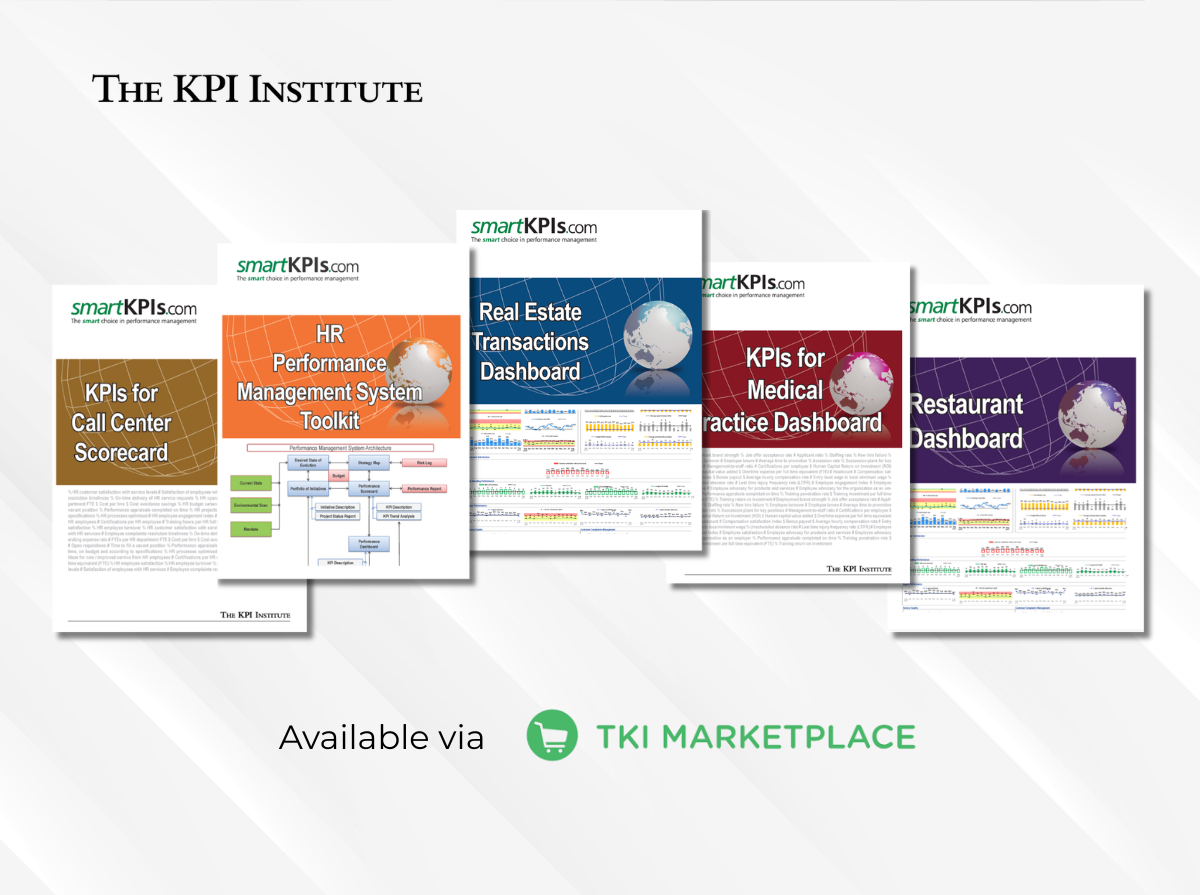
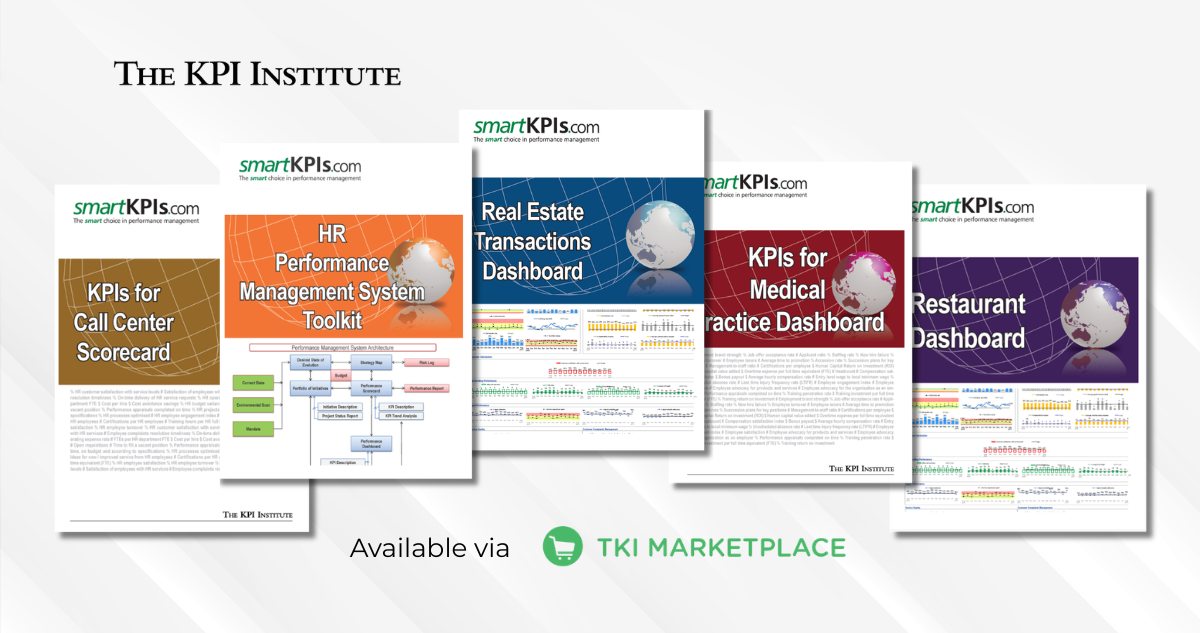
Organizations that seek ready-to-use tools for monitoring and reporting performance can access a collection of more than 50 templates developed by The KPI Institute, a global research institute with more than 20 years in strategy and performance management. 

The resources bring together dashboards, scorecards, and toolkits that support performance measurement across different industries and functional areas. The templates are available through the TKI Marketplace, the institute’s online platform dedicated to publications, training resources, and performance management tools. 

Among the available resources are over 20 dashboard templates designed for monitoring operational and departmental performance. These dashboards present key performance indicators (KPIs) through visual displays that support quick interpretation of results and trends.

Moreover, scorecard templates are offered to help organizations track strategic performance using organized indicator structures. Many of these templates follow the principles of the balanced scorecard, which connects performance indicators with perspectives such as financial results, customer outcomes, internal processes, and learning and growth.

The collection also includes performance management toolkits, which combine several templates in a single package designed to support the implementation of performance systems at the organizational, departmental, or individual levels. Each toolkit typically includes pre-populated documents that organizations can adapt according to their industry context or operational structure.

The templates cover a wide range of industries and functions. Users can find resources developed for areas such as human resources, retail, customer service call centers, recruitment agencies, restaurants, sports clubs, and libraries. The availability of sector-specific templates allows organizations to work with structures that already reflect common KPIs and reporting formats used in their field.

For managers, analysts, consultants, and researchers who work with performance systems, pre-built templates can reduce the time required to design reporting frameworks from scratch. If you’re interested in exploring ready-to-use resources for performance measurement, browse the full collection of templates through The KPI Institute Marketplace.

Access 3,200+ key performance indicators entries used across business functions

March 11th, 2026 Posted by KPIs 0 thoughts on “Access 3,200+ key performance indicators entries used across business functions”

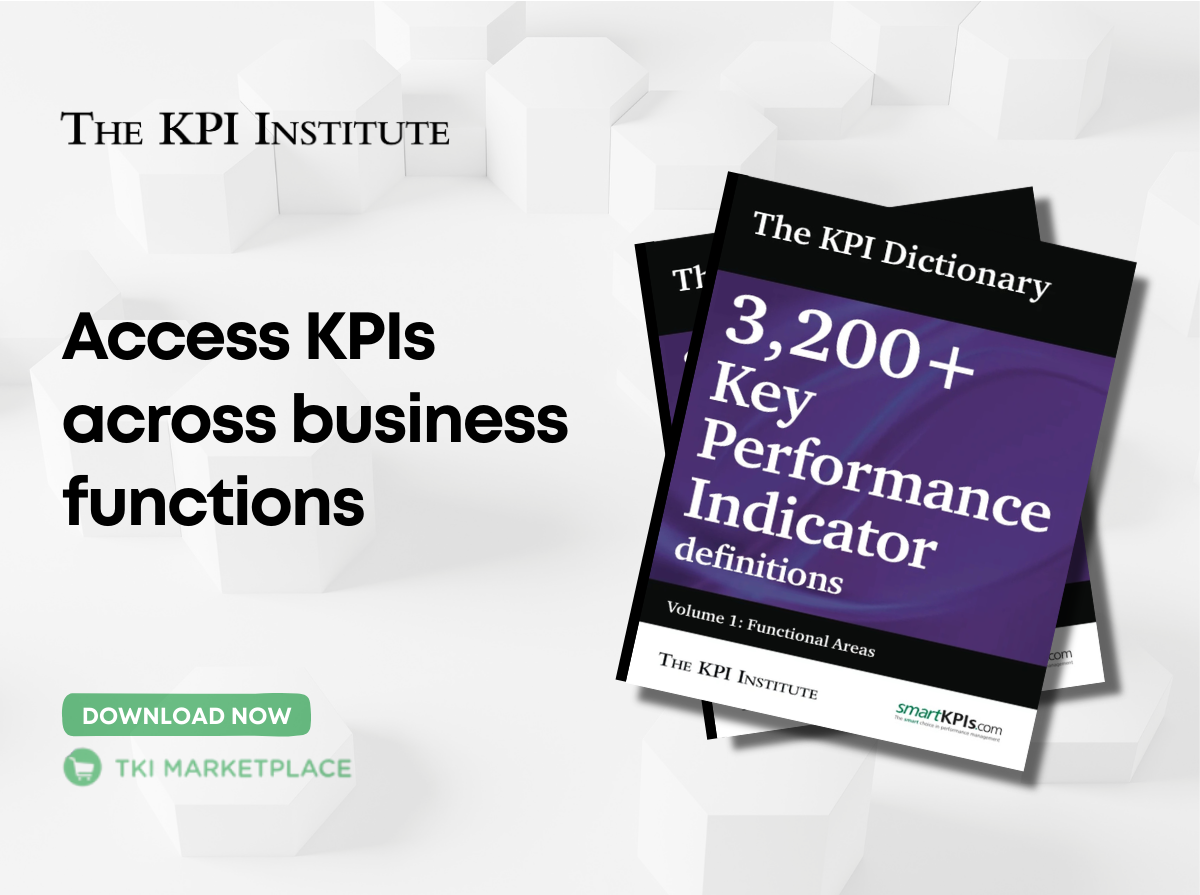
A reference work that gathers more than 3,200 key performance indicator definitions continues to serve professionals who work with performance measurement across industries. The KPI Dictionary Volume 1 Functional Areas, published by The KPI Institute, presents a structured collection of KPI definitions and formulas designed for practitioners who need clarity when working with metrics.

The publication forms part of a broader research program that spanned seven years. The research effort produced a detailed reference that complements the KPI Compendium, a separate resource that lists over 20,000 KPI examples. While the compendium focuses on examples, the dictionary focuses on definitions and arithmetic rules.

Volume 1 organizes KPI examples by functional area. The book lists names and calculation formulas for more than 3,200 indicators used in organizational performance management. Each KPI entry carries a unique identification number that links to its corresponding record in smartKPIs.com, an online database maintained by The KPI Institute.

The structure of the dictionary groups indicators into 16 functional areas. These include Accounting, Finance, Human Resources, Information Technology, Governance Compliance and Risk, Marketing and Communications, Sales and Customer Service, and Supply Chain Procurement Distribution. Additional sections cover fields such as Corporate Social Responsibility, Knowledge and Innovation, and Production and Quality Management.

The taxonomy spans multiple industries. Organizations that work in corporate services, project management, eCommerce, health and safety, and portfolio management can locate indicators that match their operational context. The format also places definitions and formulas in one location, which reduces the need to consult several different publications when reviewing performance indicators.

Professionals who work with KPIs often refer to the publication as a practical reference during research or implementation work. A senior performance specialist from the National Water Company in Saudi Arabia described the materials as simple yet rich in content. A human resources leader from Qatar Petroleum also reported that the concepts could be applied within organizational practice.

The dictionary remains relevant for practitioners who review performance indicators or design measurement frameworks. Teams that work in strategy execution, corporate performance management, or operational reporting often rely on consistent definitions and formulas when building KPI systems.

Readers who want a structured reference for KPI definitions across functional areas can learn more about the publication and purchase a copy through The KPI Institute Marketplace.

Quarterly KPI highlights: key performance drivers you should keep an eye on before 2025 ends

December 17th, 2025 Posted by KPIs 0 thoughts on “Quarterly KPI highlights: key performance drivers you should keep an eye on before 2025 ends”

As the year draws to a close, performance measurement becomes more critical than ever. The final quarter is not only about closing results, but it is a decisive period for validating strategic priorities, identifying performance gaps, and setting a solid baseline for the year ahead. At this stage, organizations rely heavily on well-defined key performance indicators (KPIs) to ensure financial discipline, operational stability, and informed decision-making.

The fourth quarter of 2025 placed a strong emphasis on controlling costs, strengthening incident response capabilities, and optimizing inventory levels. The featured KPIs for October, November, and December reflect key performance areas that help organizations finish the year with clarity and confidence, while also preparing for a smooth transition into 2026.

KPI of October: $ Cost of goods sold (COGS) – tracks the expenses directly associated with producing the goods a company sells, providing visibility into manufacturing and procurement spending. This KPI supports organizations in monitoring cost structures and maintaining control over production-related expenditures.

Effective monitoring of $ COGS helps leaders identify cost inefficiencies, optimize supplier and production decisions, and protect margins—making it essential for maintaining competitiveness and accurate pricing, especially at year-end. Download the free digital poster, via the TKI Marketplace, to learn more about how to define, measure, and apply the $ COGS effectively within your organization.

KPI of November: # Mean time to resolve (MTTR) –  measures the average duration required to identify, resolve, and prevent the recurrence of a security incident. It is used to evaluate an organization’s ability to respond to incidents efficiently and effectively and is one of several essential KPIs in incident management.

# MTTR offers insight into how quickly teams can detect issues, coordinate responses, and restore operations, and should be tracked alongside related indicators for a more complete view of incident response performance. Explore this indicator further by downloading the digital poster from the TKI Marketplace.

KPI of December: % Slow moving inventory – measures the share of inventory items that have remained unsold for a specified period (e.g., 90 or 180 days) compared to total inventory. This KPI helps organizations identify stock that may be at risk of becoming obsolete.

Monitoring slow-moving inventory enables organizations to make informed decisions on markdowns, promotions, redistribution, or discontinuation of underperforming items. Proactive management of this KPI supports healthier cash flow, leaner operations, and more accurate demand planning as organizations prepare for the new year. Download the digital poster from the TKI Marketplace to learn more.

These digital posters are part of the KPI of the Month series by The KPI Institute. It is a free infographic series designed to provide practical insights into the application of key performance indicators. Each edition focuses on one specific KPI, offering clear explanations of terminology, addressing common challenges in its use, and outlining essential details such as its definition, calculation, balanced scorecard relevance, data profile, typical targets, and actionable recommendations. Explore the other featured KPIs from the past quarters, visit the TKI Marketplace today!

Boost revenue with the right sales metrics, check out The KPI Institute’s Top 25 Sales KPIs report

November 26th, 2025 Posted by Publications 0 thoughts on “Boost revenue with the right sales metrics, check out The KPI Institute’s Top 25 Sales KPIs report”

Sales is the engine that powers revenue and growth in any organization. Beyond closing deals, it plays a strategic role in building customer relationships, gathering market insights, and shaping business strategy. By effectively measuring sales performance, organizations can identify strengths, address gaps, and optimize processes—ensuring teams consistently meet targets while adapting to evolving market dynamics.

The sales landscape this year is faster, more digital, and increasingly data-driven. Jannik Lindner, Co-Founder of Gitnux and an experienced digital strategist, noted in a recent report that the sales industry is undergoing a major transformation. With 70% of sales organizations adopting digital initiatives, companies are seeing significant gains—including a 33% increase in revenue and a 40% rise in productivity driven by artificial intelligence (AI)— reshaping how businesses engage with customers. This shift is transforming traditional sales models and redefining how organizations engage and retain customers. 

With buyer expectations rising and competition intensifying, sales leaders require clear, actionable key performance indicators (KPIs) to navigate complexity and deliver results. To meet this demand, The KPI Institute has released the Top 25 Sales KPIs – 2025 Edition, a comprehensive guide to the essential metrics every sales team should monitor in the year ahead.

To provide a glimpse into the report, here are five of the top KPIs featured in the 2025 edition:

  1.  % Cannibalization rate of new product offering – Measures the percentage of sales an existing product loses following the introduction of a new product offering within the same market segment. Its purpose is to indicate the highest level of internal product substitution the company can sustain before it begins to lose profit.
  2. % All commodity volume (ACV) distribution – Measures the share of market sales volume from stores that carry the organization’s product, with each store’s contribution weighted by its sales size. This metric specifically evaluates how efficiently products are being distributed.
  3.  % Sales quota attainment – Measures the percentage of total sales targets that were met during the reporting period. This indicator provides meaningful insight into how various enablement strategies, sales training approaches, and coaching practices impact the sales team’s overall effectiveness over time.
  4.  % Adjusted trial rate – Measures the percentage of potential customers expected to try a pre-launch product, adjusted for brand awareness and distribution reach during the reporting period. This is particularly helpful during early concept testing, as it measures initial consumer interest without factoring in real-world limitations.
  5. $ Revenue per successful call – Measures the average revenue generated per successful sales call in the reporting period. Its purpose is to assess how efficiently sales interactions generate revenue.

This report is part of the Top 25 KPIs – 2025 series developed by The KPI Institute. The series provides a comprehensive framework for effective performance measurement and addresses key challenges in KPI implementation. Each KPI is documented with practical definitions, calculation formulas, analysis guidelines, and recommended usage scenarios to support integration into performance management systems.

Explore the full report to enhance your sales performance measurement practices. The Top 25 Sales KPIs – 2025 Edition is now available on the TKI Marketplace, with printed copies available for order on Amazon. Get your copy today!

Telecommunications industry to grow by $1.7T, stay ahead with these must-track KPIs

October 29th, 2025 Posted by KPIs 0 thoughts on “Telecommunications industry to grow by $1.7T, stay ahead with these must-track KPIs”

In 2025, the global telecommunications industry is expected to surpass USD 1.7 trillion in market value, driven by rapid advancements in 5G, growing data consumption, and the continued convergence of digital technologies. The sector is not only a backbone of global connectivity but also a key enabler of innovation across industries. 

As telecom providers expand infrastructure and launch new services to meet rising demand, the importance of data-driven decision-making and performance optimization has never been greater. In this context, performance measurement has become a strategic priority. As service delivery becomes more complex and customer expectations evolve, key performance indicators (KPIs) offer critical insights for improving network efficiency, enhancing customer experience, managing operational costs, and driving sustainable growth.

To support telecom professionals in navigating these changes, The KPI Institute has released the Top 25 Telecommunications KPIs – 2025 Edition. This report features the most impactful KPIs, selected based on global usage and their relevance to real-world industry practices. 

To provide a glimpse into the report, here are five of the top KPIs featured in the 2025 edition:

  •  % Call setup success rate (CSSR) – Measures the percentage of call attempts that successfully connect to the dialed number, out of the total call attempts. It is used to assess the accessibility of the telecommunication network.
  •  $ Telecom subscriber acquisition cost –  Measures the average cost of acquiring a new subscriber. It helps optimize acquisition spending by ensuring each new subscriber provides long-term value.
  • % Answer seizure ratio (ASR) – Measures the percentage of calls successfully answered out of the total call attempts. It is used to evaluate the effectiveness of call handling. 
  • $ Telecom subscriber retention cost (SRC) – Measures the costs associated with retaining a customer, including customer service, retention marketing, and related expenses. It aims to track net retention spending per subscriber.
  •  % Data network availability – Measures the percentage of time the data network is operational and accessible. It is used to monitor the overall availability of the data network.

This report is part of the Top 25 KPIs – 2025 series developed by The KPI Institute. The series provides a comprehensive framework for effective performance measurement and addresses key challenges in KPI implementation. Each KPI is documented with practical definitions, calculation formulas, analysis guidelines, and recommended usage scenarios to support integration into performance management systems.

Explore the full report to strengthen your organization’s performance measurement practices. The Top 25 Telecommunications KPIs – 2025 Edition is now available on the TKI Marketplace, with printed copies available for order on Amazon. Get your copy today!

Quarterly KPI highlights: measuring speed, stability, and success

October 14th, 2025 Posted by KPIs 0 thoughts on “Quarterly KPI highlights: measuring speed, stability, and success”

Speed, stability, and effectiveness are more than industry buzzwords—they define how organizations compete in a rapidly changing landscape. As industries race to launch products faster, retain talent amid shifting work dynamics, and convert leads into loyal customers, three key performance indicators (KPIs) stand out as mission-critical: # Time to Market, # Employee Tenure, and % Conversion Rate.

Recent data from a Gartner survey reveals that 45% of product launches are delayed by at least one month, with these delays making companies far more likely to miss their internal targets. At the same time, median employee tenure has dropped to 3.9 years as of January 2024—the lowest since 2002—underscoring the growing difficulty of maintaining workforce stability. Meanwhile, average landing page conversion rates reached 6.6% in Q4 2024, offering a benchmark for organizations striving to turn interest into action. Together, these indicators tell a compelling story: sustainable success depends not only on moving quickly but also on keeping talent engaged and transforming opportunities into measurable results.

In this article, we spotlight three key indicators from the third quarter of 2025—exploring how organizations perform in terms of innovation speed through # Time to market, workforce stability through # Employee tenure, and marketing effectiveness through % Conversion rate.

KPI of July: # Time to market – This indicator tracks the duration between a product’s initial concept and its launch, serving as a measure of how efficiently an organization drives innovation from idea to execution.

This indicator is crucial for organizations aiming to stay competitive in today’s fast-moving landscape. While it may seem straightforward, its measurement is influenced by various factors. To ensure accurate assessment and meaningful benchmarking, download the free digital poster from the TKI Marketplace.

KPI of August: # Employee tenure – This measures the average length of time employees remain with their organization, providing insight and revealing trends into overall workforce stability and retention over time.By segmenting data by demographics or role duration, managers can make more informed decisions on promotions, rotations, and tenure-related benefits—supporting fair and strategic workforce planning. Explore this indicator further by downloading the digital poster from the TKI Marketplace.

KPI of September: % Conversion rate – This reflects the percentage of individuals who take a desired action—such as making a purchase or signing up—out of the total exposed audience, offering a clear view of how effective an organization’s marketing strategies are in driving engagement and results.

How well does your organization turn interest into action? Benchmark your % Conversion Rate against industry standards and discover ways to measure it more effectively. Download the digital poster from the TKI Marketplace to learn more.

These digital posters are part of the KPI of the Month series by The KPI Institute. It is a free infographic series designed to provide practical insights into the application of key performance indicators. Each edition focuses on one specific KPI, offering clear explanations of terminology, addressing common challenges in its use, and outlining essential details such as its definition, calculation, Balanced Scorecard relevance, data profile, typical targets, and actionable recommendations. Explore the other featured KPIs from the past quarters, visit the TKI Marketplace today!

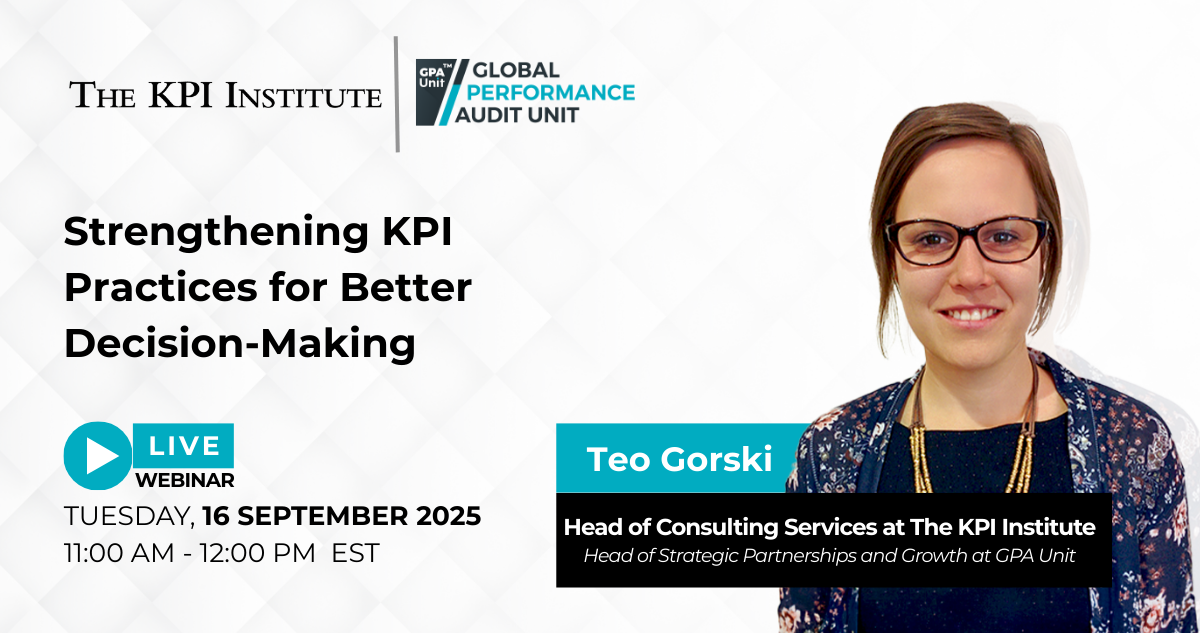
GPA Unit invites you to a live webinar: strengthening KPI practices for better decision-making

September 3rd, 2025 Posted by Webinar 0 thoughts on “GPA Unit invites you to a live webinar: strengthening KPI practices for better decision-making”

With today’s advanced technologies and digital tools, especially the widespread adoption of artificial intelligence, collecting data has never been easier and accessible. Yet, despite the abundance of numbers, many organizations still struggle to transform this information into meaningful insights that drive decision-making.

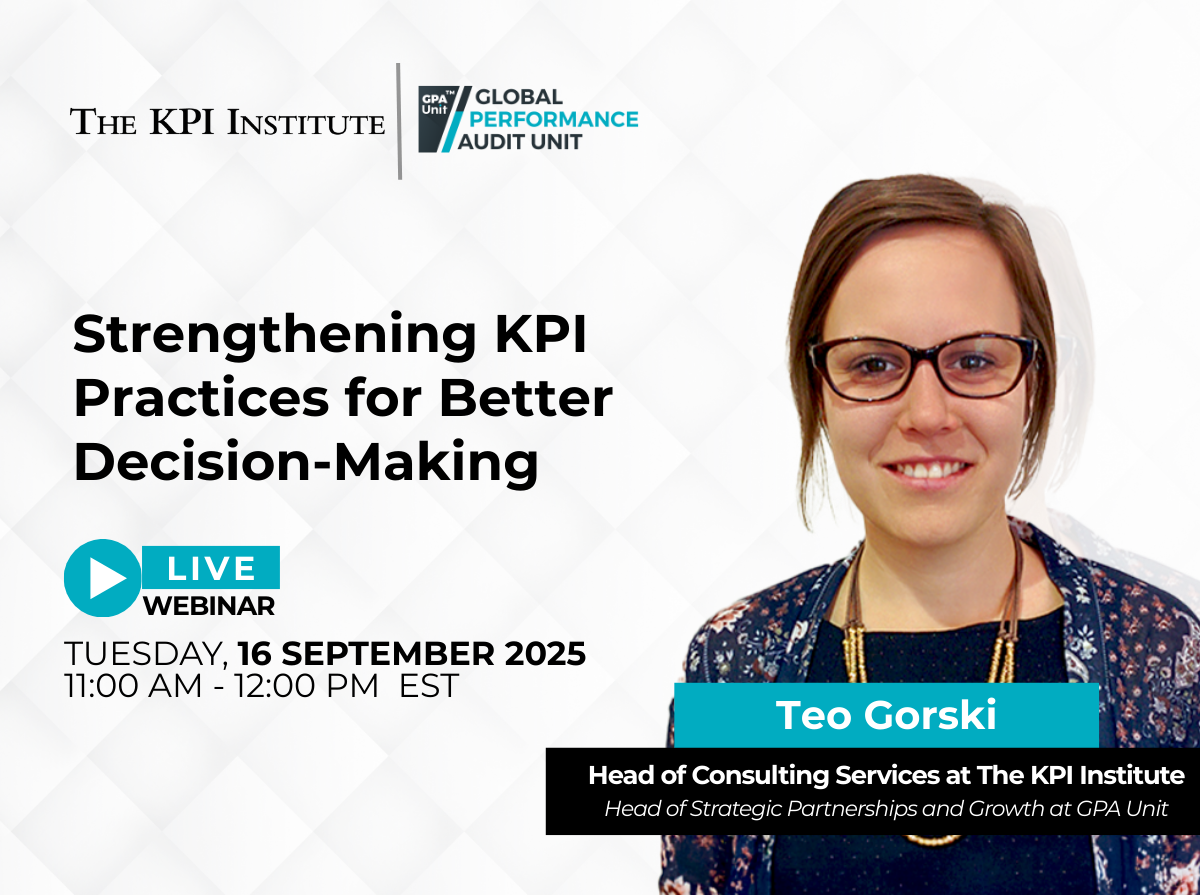
To address this gap, the Global Performance Audit (GPA) Unit, the strategy and performance audit division of The KPI Institute, is hosting the second session of its Performance Excellence Webinar Series: “Strengthening KPI Practices for Better Decision-Making.” Scheduled for 16 September 2025, this live 60-minute session is open to all participants with free registration.

The webinar will be led by Teo Gorski, Head of Consulting Services at The KPI Institute, who will guide participants on transforming performance measurement from a bureaucratic checkbox into a true catalyst for decision-making. She’s also the Head of Strategic Partnerships and Growth at GPA Unit.

Why you should attend

  • Spot the traps: In this webinar, you will learn how to identify low-maturity measurement habits, from data-driven confusion to over-engineered reports that go unread.
  • Design key performance indicators (KPIs) with purpose: Discover how you can align indicators with strategy, ownership, and learning cycles so every number has a clear role.
  • Govern for agility: Understand how you can keep the KPI system lean, decision-ready, and adaptable as organizational priorities evolve.

Who should attend

This session is designed for performance leaders, strategy professionals, project management office teams, and data owners—anyone tasked with turning metrics into meaningful action.

With practical insights and tools, the webinar promises to help participants streamline cluttered scorecards, focus on the KPIs that matter, and build governance systems that ensure lasting relevance.

Don’t miss this opportunity to strengthen your KPI practices and put your metrics to work. Register today! Visit the GPA Unit website for more information.

Resource roundup: 9 tools that get sales results without the guesswork

August 12th, 2025 Posted by KPIs 0 thoughts on “Resource roundup: 9 tools that get sales results without the guesswork”

Sales teams face nonstop pressure to hit targets, track performance, and respond to changing customer behavior. Metrics are everywhere, but using them well takes the right approach—and the right tools.

This roundup collects materials from The KPI Institute designed to help managers and teams get better at measuring, understanding, and improving sales performance. While some of these resources were created in earlier years, their content remains directly useful for today’s performance work. Expect practical examples, clear KPIs, and frameworks that still apply across industries.

  1. KPIs for Sales Performance: This infographic outlines key metrics across the sales function. It highlights how sales KPIs support broader strategy and provides examples for tracking outcomes at multiple levels. Part of The KPI Institute’s cross-functional KPI series.
  2. KPIs for Sales Cycle: Focuses on the process behind every sale—from lead generation to close. This resource groups KPIs based on sales cycle stages and helps with tracking both time and conversion at each point. Also part of the cross-functional KPI series.
  3. KPIs for Sales Force: Covers metrics used to evaluate individual and team performance across sales roles. Includes examples related to activity levels, pipeline contribution, and revenue impact. One of several functional KPI infographics developed for targeted use in departments.
  4. KPI of the Month: % Sales Conversion Rate: This infographic breaks down one of the most discussed KPIs in sales: conversion rate. It covers what the number really tells you, how to calculate it, and how to use it in context. Built for anyone who needs more than just a surface-level metric.
  5. Top 25 Sales KPIs – 2016 Extended Edition: This report lists the most popular sales KPIs as used by professionals worldwide between 2009 and 2015. It includes two pages of documentation per KPI, plus articles on setup and selection. A reliable reference for refreshing your KPI framework or comparing current metrics to established ones.
  6. The Sales and Customer Service KPI Dictionary: Covers over 220 KPIs across sales and customer service. Built for teams setting up measurement systems or fine-tuning existing ones. Includes formulas, category groupings, and terminology definitions that hold up across roles and industries.
  7. Leveraging Data for Improving Sales and Marketing by Understanding the Customers: This article outlines how to use customer data to improve targeting, messaging, and performance. Focused on practical steps for translating insights into better sales and marketing alignment.
  8. How Innovation Helps the Growth of Digital Sales: Explores how new tools and ideas are changing digital sales environments. The piece connects real shifts in buyer behavior with new ways of working in sales.
  9. 5 Ways You Can Boost the Sales Value of Your Green Business: Gives practical tactics for making sustainable products more compelling to buyers. This article looks at sales messaging, pricing, and customer expectations tied to green business models.

These resources give sales teams structure, not just ideas. Whether you’re rebuilding your KPI system or trying to improve daily decisions, they offer real support for getting better outcomes from your efforts!

10 things to know about the world’s largest database of documented KPIs

July 23rd, 2025 Posted by KPIs 0 thoughts on “10 things to know about the world’s largest database of documented KPIs”

Created by The KPI Institute, a global leader in strategy and performance research and education, smartKPIs is the most comprehensive online resource of its kind. With over 21,000 real KPIs collected from organizations worldwide, the platform helps organizations and professionals define, compare, and select the right metrics faster and with greater confidence. Whether you’re setting key performance indicators (KPIs) for the first time or refining an existing performance framework, knowing where to look and what to look for makes a difference. Here are 10 things to know about smartKPIs:

  1. Massive KPI database: smartKPIs is home to over 21,000 documented KPIs, making it the world’s largest searchable repository for real-world key performance indicators. These metrics are drawn from published reports, internal dashboards, and on-the-ground case studies.
  2. Structured by domains and industries: The database is organized by industry, functional area, and even departmental level, helping users find context-relevant KPIs in seconds. This makes it ideal for benchmarking, performance system design, or refreshing outdated metrics.
  3. Professionally documented format: Each KPI is described using a standardized structure that includes definition, calculation formula, data source, and usage recommendations. This eliminates ambiguity and makes it easier for teams to implement indicators consistently.
  4. Quality assured by research analysts: Every entry is reviewed by a team of research analysts with expertise in measurement and performance management. This curation ensures the data stays reliable, relevant, and aligned with evolving business practices.
  5. Updated with real-world insights: The platform is continuously updated with indicators from actual business scorecards, public reports, and newly published research. This gives users access to trends as they unfold across industries and geographies.
  6. Supports KPI selection and cascading: smartKPIs helps users identify KPIs that align with strategic objectives and cascade them across organizational levels. Whether you’re managing enterprise strategy or tracking individual performance, it offers examples that scale.
  7. Enables benchmarking across sectors: With thousands of KPIs covering both common and niche sectors, users can compare metrics across industries to see how others measure similar goals. It’s especially useful for organizations looking to innovate or localize best practices.
  8. Integrates with learning tools and guides: Each KPI links to additional resources, such as toolkits, implementation guides, and online training offered by The KPI Institute. This creates a more complete support system for users looking to build internal capability.
  9. Trusted by global users: From Fortune 500 companies to government agencies and non-profits, the database is used by strategy, HR, finance, and operations teams around the world. It’s a preferred reference for those designing performance systems from scratch or improving legacy setups.
  10. Accessible with flexible plans: The platform offers a range of subscription options depending on organizational needs, from individual licenses to enterprise access. Users can also explore free samples before committing to full access.

For anyone working in performance design or KPI reporting, smartKPIs is more than a database—it’s a decision support tool. Visit the platform to explore real indicators, save time, and sharpen your measurement approach!

Recent Comments

    Archives