
12 AI use cases in strategy and performance management that aren’t just hype
July 30th, 2026 Posted by Len Cristobal AI, Publications 0 thoughts on “12 AI use cases in strategy and performance management that aren’t just hype”
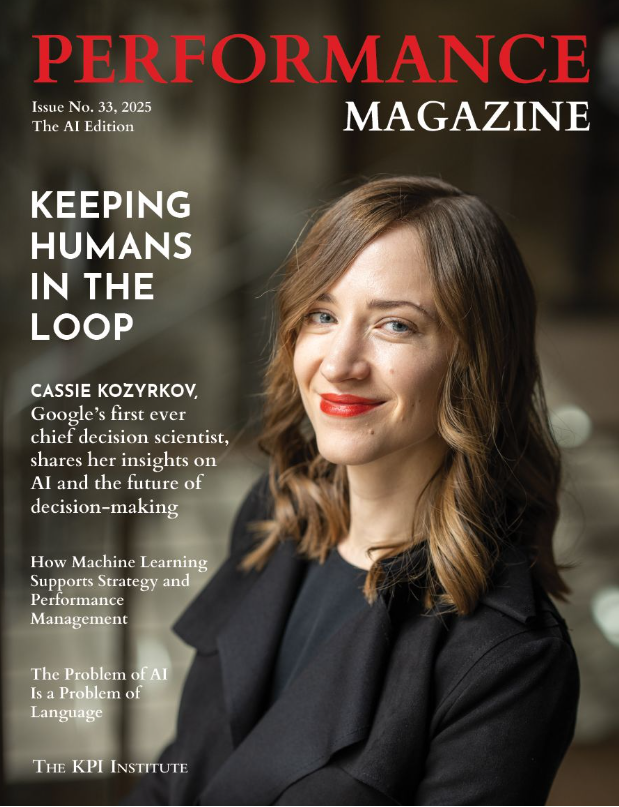
Most performance teams still design KPIs, screen candidates, and check operational risk through methods barely different from a decade ago. A new set of AI use cases inside the world of strategy and performance management tells a different story. Practitioners across HR, finance, manufacturing, and public health now put AI to work on real bottlenecks. Here are twelve of them. Each one comes from an interview or article in Performance Magazine Issue No. 33, the 2025 AI Edition.
AI Use Cases in KPI Design and Diagnostics
Islam Salahuddin, a data consultant quoted in the Performance Magazine article “AI in Action: How Machine Learning Supports Strategy and Performance Management,” describes language models that formulate and cascade KPIs across an entire organization, from the corporate level down to individual roles. The models apply frameworks such as the Balanced Scorecard and cut the time spent on documentation. Salahuddin also flags a second application. When a KPI underperforms, a language model can read the diagnostic data, point to the likely cause, and an AI agent can act on the fix. The article gives one hypothetical example: a website-speed KPI drops in a region, the model traces it to a missing content delivery network, and the agent recommends the fix, or buys it.
AI Use Cases in Recruitment and Talent Management
Recruitment has turned into one of the most common places to spot AI at work day to day. Nadiyah Afifah, a recruitment specialist quoted in Andra Rotar’s article “AI in the Workplace,” describes an applicant tracking system that recommends suitable candidates while Microsoft Copilot handles interview transcripts and summaries. Salahuddin, quoted in the same piece, uses Copilot to brainstorm KPI ideas for new sectors and GitHub Copilot to build quick prototypes before a client sees them.
Mai Ismail’s article “How Do AI Agents Really Work?” goes a step further. When a company shifts strategy, a goal-based AI agent can draft updated job descriptions that match the new direction, though a person still checks for errors. CHROs also turn to AI agents to screen résumés, filter candidates, and schedule interviews. That cuts time-to-hire and frees recruiters for interview prep and higher-level work.
AI Use Cases in Strategic and Financial Decision-Making
Ismail’s article also covers AI agents built for investment strategy. These agents read credit histories, transaction patterns, and market volatility to flag risk earlier than a model that leans on historical data alone. Portfolio allocation adjusts to match a client’s goals and risk tolerance. Ismail cites IBM research: AI agents can cut decision-making cycles by 30 to 50 percent and lift organizational productivity by 15 to 25 percent.
Tarry Singh, CEO of several AI ventures including DK AI Lab and RealAI, told Performance Magazine how leaders should judge whether an AI initiative earns its budget. His answer: track leading indicators such as process efficiency and data quality next to lagging indicators such as revenue growth and risk reduction. Singh also backs a crawl-walk-run roadmap for smaller organizations. Start with narrow, low-complexity problems such as data entry or basic sales forecasting, then scale up once the early wins build momentum.
AI Use Cases in Risk and Organizational Monitoring
J. Mark Bishop, Chief Scientific Adviser at FACT360 and Professor of Cognitive Computing (Emeritus) at Goldsmiths, University of London, brought two contrasting stories to Performance Magazine. In one, custom software reviewed National Health Service purchasing data and found close to 500 million pounds in potential annual savings. Most of those savings never came through once real buying behavior got in the way. Bishop’s lesson is blunt: a strong analytical result does not guarantee execution.
The second case runs the opposite direction. Law firm Quinn Emanuel used an early version of FACT360’s platform to spot key bad actors within four minutes, after the system ingested over 1.3 million emails. The platform checks communication metadata first (who talks to whom, how often) and applies natural language processing only where something looks off. The same core technology now supports HR analytics too, on the lookout for early signs of harassment or workplace risk in team communication patterns.
AI Use Cases in Change Management and Manufacturing
Frank Nussbaum, data scientist at JENOPTIK, told Performance Magazine how his team built an internal chatbot so staff could get answers about company processes and benefits without a wait on HR. The rollout leaned on Diffusion of Innovation theory: win over early adopters first, and the rest of the workforce tends to follow. Nussbaum’s team also has a harder, longer project on its hands: automated visual inspection of wafers in photonics manufacturing. No results yet. The work still runs in progress.
One Technology, Many Functions
Twelve use cases point to one pattern. AI use cases in performance management rarely stay inside a single department. The same underlying technology moves between recruitment, risk detection, and quality control. Where it lands depends only on which team decides to pick it up first. A chatbot built for internal communications and a platform built to catch fraud share more in common than either function might expect.
These twelve sit inside Performance Magazine Issue No. 33, the 2025 AI Edition, a full print and digital issue built around how AI changes strategy and performance management in practice. The issue holds the complete interviews behind Singh’s investment framework and Bishop’s account of the FACT360 rollout, plus several use cases beyond the twelve above.
Get the full AI Edition of Performance Magazine now!
__________________________________________________________________________________
The KPI Institute is a global leader in business performance research and solutions, specializing in practice domains including strategy, key performance indicators (KPIs), employee performance, customer service, and innovation management. For over 20 years, The KPI Institute has established international standards and best practices for KPIs across both private and public sectors.
What We Offer:
- Certifications & Training: Practical programs delivered worldwide—live online, offsite, and customized—spanning 6 continents and 7 offices in Australia, Southeast Asia, Europe, and the Middle East.
- Knowledge Platforms: Access to www.smartKPIs.com, the world’s largest documented database of KPIs, with over 21,600 examples published and 148,000+ members in our online communities.
- Publications: Over 460 publications, including books, research papers, and practical guides, providing insights to enhance organizational performance.
- Advisory & Implementation Support: Expert guidance to apply insights in practice for measurable impact.
Our Reach and Impact:
- 81,000+ companies registered on our platforms
- 2.5 million+ professionals reached through training and knowledge services
- 128 research client countries and 120 global partner organizations
Website: www.kpiinstitute.org
Email: office@kpiinstitute.org
LinkedIn: The KPI Institute