
Posts tagged "Business Intelligence"

Choosing the right data analytics certification for career growth banner

Choosing the right data analytics certification for career growth

June 10th, 2026 Posted by Business Education, Career Growth, Certification, Courses, E-learning, Upskilling 0 thoughts on “Choosing the right data analytics certification for career growth”

Choosing the right data analytics certification for career growth banner

The demand for data and analytics skills continues to grow as organizations increasingly rely on evidence-based decision-making. According to the World Economic Forum’s Future of Jobs Report 2025, technological transformation is expected to create 170 million new jobs globally by 2030, while analytical thinking remains one of the most important skills employers seek across industries. The report also highlights the growing importance of data and AI-related competencies in the evolving workforce.

Against this backdrop, many professionals are exploring certifications that can help them strengthen their analytical capabilities and remain competitive in a rapidly changing job market.

The search for the best data analytics certification often leads to one important question: which programs provide skills that can be applied in real business situations?

The KPI Institute’s Certified Data Analysis Professional and Practitioner certification is one example of a program that combines statistical concepts with practical application.

Why Data Analytics Certifications Matter

Data is no longer limited to specialist departments. Today, professionals across operations, finance, strategy, human resources, marketing, and performance management are expected to interpret information, identify trends, and support decision-making using data.

As a result, employers increasingly value professionals who can:

  • Analyze data accurately
  • Translate findings into business insights
  • Support strategic and operational decisions
  • Communicate analytical results effectively
  • Solve problems using evidence rather than assumptions

A well-designed certification can help bridge the gap between technical knowledge and practical business application.

What Should You Look for in a Data Analytics Certification?

Not all certifications are built the same. While some focus heavily on software tools or statistical theory, others emphasize the application of analytics within real organizational contexts.

When evaluating a certification, consider whether it develops the following areas:

Business Understanding

Before data can generate value, professionals must understand the business problem they are trying to solve.

Strong programs typically cover:

  • The role of data analysis in organizations
  • Business problem framing
  • Data analysis processes
  • Decision-making frameworks

Statistical Foundations

Statistics remains a critical component of effective analysis.

Professionals should be familiar with:

  • Data collection methods
  • Sampling techniques
  • Hypothesis testing
  • Data interpretation
  • Statistical reasoning

Data Preparation and Organization

Analysts often spend significant time preparing and validating data before any analysis begins.

Understanding how to structure, clean, and organize information is essential for generating reliable insights.

Practical Application

Perhaps the most important consideration is whether participants have opportunities to apply what they learn.

Employers generally place greater value on professionals who can demonstrate analytical capabilities in realistic business situations rather than simply completing theoretical coursework.

A Closer Look at The KPI Institute’s Certified Data Analysis Professional and Practitioner

The KPI Institute’s certification program is structured around both knowledge acquisition and practical application.

The learning experience consists of:

  • Pre-course activities
  • Three days of core-course learning
  • Post-course assignments and assessments

The program is designed to help participants develop competencies across the full data analysis cycle, from understanding business needs and collecting data to interpreting results and presenting findings.

Key Skills Developed

Participants learn how to:

  • Define the role of data analysis in business
  • Apply statistical techniques for decision-making
  • Structure and prepare data for analysis
  • Solve business problems using advanced Excel techniques
  • Interpret analytical findings
  • Present data-driven insights effectively

Core Learning Areas

The curriculum includes topics such as:

Business Understanding

  • What is data analysis?
  • Types of data analysis
  • Data analysis in business
  • Data analysis processes

Data Collection

  • Types of data
  • Data sources
  • Sampling methods

Data Analytics Foundations

  • Organizational context understanding
  • Problem framing
  • Data cleaning
  • Data preparation

Statistical Techniques

  • One-sample hypothesis testing
  • Two-sample hypothesis testing
  • Statistical analysis methods
  • Business-focused interpretation of results

Benefits Beyond Technical Knowledge

One characteristic that professionals often seek in a certification is the opportunity to demonstrate practical competence.

The Practitioner component of the program focuses on the application of analytical methods in business environments, encouraging participants to adapt concepts and techniques to real organizational challenges.

Additional benefits include:

  • Recognition of practitioner-level expertise
  • Development of a professional portfolio
  • Feedback from assessors on analytical approaches and processes
  • Exposure to practical business scenarios
  • Enhanced confidence in data-driven decision-making

Who Can Benefit from This Certification?

The program may be relevant for:

  • Data analysts
  • Business analysts
  • Performance management professionals
  • Consultants
  • Operations specialists
  • Team leaders and managers
  • Professionals transitioning into analytics-focused roles

It can also benefit individuals who regularly work with data and want a more structured understanding of statistical methods and business analytics practices.

Choosing the Right Certification

The best data analytics certification ultimately depends on your professional goals. Some individuals may prioritize technical specialization, while others may be looking for a broader understanding of how data supports business performance and decision-making.

For professionals seeking a balance between statistical knowledge, practical application, and business relevance, The KPI Institute’s Certified Data Analysis Professional and Practitioner certification offers a structured approach to developing analytical skills that can be applied across a range of organizational contexts.

KPI and business strategy courses

___________________________________________________________________________________

The KPI Institute is a global leader in business performance research and solutions, specializing in practice domains including strategy, key performance indicators (KPIs), employee performance, customer service, and innovation management. For over 20 years, The KPI Institute has established international standards and best practices for KPIs across both private and public sectors.

What We Offer:

  • Certifications & Training: Practical programs delivered worldwide—live online, offsite, and customized—spanning 6 continents and 7 offices in Australia, Southeast Asia, Europe, and the Middle East.
  • Knowledge Platforms: Access to www.smartKPIs.com, the world’s largest documented database of KPIs, with over 21,600 examples published and 148,000+ members in our online communities.
  • Publications: Over 460 publications, including books, research papers, and practical guides, providing insights to enhance organizational performance.
  • Advisory & Implementation Support: Expert guidance to apply insights in practice for measurable impact.

Our Reach and Impact:

  • 81,000+ companies registered on our platforms
  • 2.5 million+ professionals reached through training and knowledge services
  • 128 research client countries and 120 global partner organizations

Website: www.kpiinstitute.org.

Email: office@kpiinstitute.org

LinkedIn: The KPI Institute

World’s largest KPI database now features 21,772 documented key performance indicators

June 1st, 2026 Posted by KPIs, Performance Management, Research 0 thoughts on “World’s largest KPI database now features 21,772 documented key performance indicators”

Organizations collect vast amounts of data, yet many still face a familiar challenge: identifying the right key performance indicators (KPIs) to measure performance and support decision-making. The search for reliable business metrics has fueled interest in KPI databases that provide documented KPIs, KPI examples, and established performance measurement practices.

smartKPIs, developed by The KPI Institute, has reached a new milestone with a database containing 21,772 documented KPIs.

This achievement strengthens its position as the world’s largest KPI database and one of the most extensive KPI libraries available to professionals across industries.

The KPI database includes more than 7,000 premium documented KPIs and covers 16 functional areas and 25 industries. Its collection spans sectors such as finance, healthcare, manufacturing, education, retail, logistics, public administration, sustainability, customer service, human resources, and supply chain management. Users can explore KPI examples and business metrics based on industry, department, or area of expertise.

What sets the platform apart is the breadth of contexts covered within its KPI library. Organizational context KPIs focus on business performance at the industry and functional level. Global context KPIs address topics such as economic development, public health, social progress, environmental performance, and sustainability. Personal context KPIs provide metrics related to productivity, time management, work-life balance, budgeting, and personal well-being.

The platform also serves as a resource for professionals who want to strengthen their understanding of KPI managementand performance measurement. Its learning materials cover topics such as performance management and measurement, KPI formulation and selection, target setting, KPI visualization, analytics, reporting practices, performance management levels, and common KPI pitfalls. These resources help both newcomers and experienced practitioners build stronger measurement frameworks.

Interest in KPI benchmarking and KPI documentation has grown as organizations seek greater consistency in reporting. Different teams often use different definitions for the same metric, which can affect reporting accuracy and make performance comparisons more difficult. Access to documented KPIs gives professionals a common reference point when selecting indicators and developing performance management systems.

The platform’s reach extends beyond its database. More than 75,000 members form a global community focused on KPI management, business metrics, organizational performance, and performance measurement. This network allows professionals to exchange ideas, discuss industry practices, and learn from peers across different sectors.

A comprehensive KPI database can help organizations reduce the time spent searching for relevant indicators and provide access to proven KPI examples. Documented KPIs that include definitions, formulas, data sources, reporting frequencies, and interpretation guidelines can support more informed performance discussions and stronger reporting practices.

Free Preview Subscription and More!

Professionals interested in exploring the platform can begin with the free Preview subscription.

The plan provides access to 100 KPI names, the KPI Dashboard, and the Top 10 KPIs, offering an introduction to the world’s largest KPI database at no cost.

Those who require deeper KPI documentation, premium KPI examples, industry KPI reports, and expanded access to documented KPIs can review the Starter, Standard, and Premium subscription options. These plans provide varying levels of access based on individual and organizational needs. Subscribe to smartKPIs for free and discover how KPI documentation, KPI benchmarking resources, and performance measurement guidance can support better business decisions.

For additional features, premium content, and expanded access to the world’s largest KPI database, visit the platform and explore the subscription plan that best matches your requirements.

Four Business Intelligence Trends in 2022

August 11th, 2022 Posted by Certification, Courses, Research 0 thoughts on “Four Business Intelligence Trends in 2022”

Editor’s Note: “Four Business Intelligence Trends in 2022” is an article written by The KPI Institute’s Research Analyst, Brian Kiprop. This piece is originally published in the 22nd Performance Magazine – Printed Edition.

As the year progresses, entrepreneurs and managers are developing growth strategies as they establish data-driven cultures in their companies. Business intelligence assists in making data-driven decisions by utilizing data infrastructure, tools, and best practice benchmarks. Many businesses can identify new opportunities by having a wide view and utilization of data. This could spark change, eradicate inefficiencies, and adjust to market changes.

To determine the trending scientific business intelligence concepts for 2022, we conducted secondary research by collecting recent publications from the Scopus engine, the largest database of highly influential scientific publications. In 2022, there are 45 documents from a range of disciplines; computer science (28), Engineering (22), Decision Sciences (11), Social Sciences (11), Mathematics (6), Business and Management (5), Energy (2), Materials Science (2), and Biochemistry and Molecular Biology (1). 

Since all 45 documents have been published this year in well-recognized journals like Springer and Emerald, we exported the data for analysis to the latest version of Voss viewer software released this year. Voss viewer software is a data visualization tool developed at the Center for Science and Technology Science at Leiden University. 

Our results from a keyword analysis show four keywords (concepts) predominant in up-to-date publications of business intelligence by researchers in 2022. They include business intelligence, information analysis, artificial intelligence, and decision making. 

Business Intelligence

As a standalone concept and the most occurring keyword (32 instances) in our research, business intelligence is an attractive area of interest for businesses and researchers. Business intelligence enables companies to make fast decisions by understanding historical and current data in a business context. These will promote better performance, assess customer behavior patterns, analyze competitors, and identify market opportunities. 

When designing business intelligence tools, IBM suggests that companies adopt an easy-to-operate business intelligence analytical solution, integrating data sources from different platforms and understanding capabilities like artificial intelligence and machine learning before implementation. 

Microsoft uncovers four stages that business intelligence undergoes, from raw data to reports and insights. Step 1 involves data collection, followed by spotting patterns in the data. The third step focuses on visualizing the data, while the last step concerns taking action on findings in real time. 

Information Analysis

The information analysis concept has 16 occurrences across our literature review. Information analysis is known to be part and parcel of intelligence gathering to influence firm decisions. After gathering the business data, assessing data sets to provide insights is crucial for deciding the actions to take from them. Data can then be processed using a different range of tools, and some of the major software are Microsoft Power BI and Tableau. 

The tools for data analysis usually consisted of dashboards, visualizations, data mining, Extract Transfer Load, reporting, and Online Analytical Processing. However, the most popular among users are visualizations and dashboards.

Artificial Intelligence 

Artificial intelligence refers to systems and machines that draw knowledge from previous experiences, adapt fresh inputs, and conduct human-like activities. In our study, we found artificial intelligence to have four keyword occurrences. 

According to Harvard Business Review, three types of Artificial Intelligence relate to solving business needs. The first one, process automation, enables administrative tasks like data transfer through emails to be updated in the recording system. The second is cognitive insight, which utilizes algorithms to determine patterns in large amounts of data and generate insights. Lastly, cognitive engagement comprises intelligent agents and chatbots that respond to customer inquiries. 

Decision Making

In our findings, decision-making had a keyword occurrence of five across all 45 papers. Decision-making is an essential outcome of collecting business intelligence. Many companies want to make better decisions concerning their strengths, weaknesses, opportunities, and threats within their business environment. 

In Minggao Yang’s paper on the influence of business intelligence on the financial performance of innovative companies, the author finds a direct correlation between business intelligence and business performance, thereby confirming that data-driven choices influence business profitability positively.

Managers and founders looking into expanding business intelligence capabilities to identify and act on sustainable and profitable opportunities could benefit from understanding the four emerging concepts in business intelligence. As collecting business intelligence requires basic skills in analyzing data, one can consider taking The KPI Institute’s Certification in Data Analysis to build or upgrade their data analysis skills.

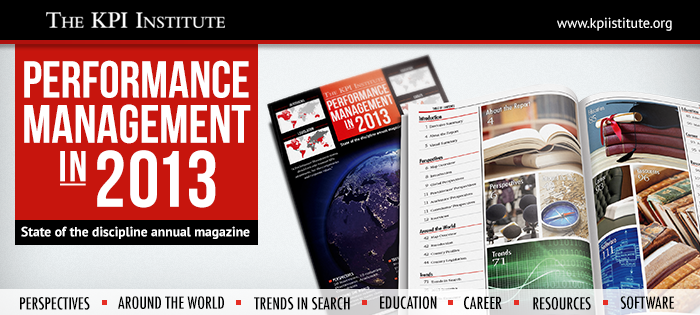
The KPI Institute launches “Performance Management in 2013”

February 18th, 2014 Posted by Research 0 thoughts on “The KPI Institute launches “Performance Management in 2013””

February 18th, 2014, Melbourne, Australia – The KPI Institute, the global authority on Key Performance Indicators (KPIs) research and education, announces the launch of “Performance Management in 2013”, the second from a series of annual publications which provides an overview on the state of the discipline.

Performance Management is continuously growing in popularity and maturity, assessing the exact position and development of the discipline each year is essential. The report Performance Management in 2013 is the result of a qualitative research study conducted in the period of September 2013 – January 2014, by The KPI Institute. The research study used both primary and secondary sources.

Performance Management in 2013

(more…)

Recent Comments

    Archives