Posts tagged "Strategic Planning"

AI Is Changing Strategy. What Does Agile Execution Look Like Now?

September 10th, 2026 Posted by Certification, Courses, Strategy 0 thoughts on “AI Is Changing Strategy. What Does Agile Execution Look Like Now?”

Artificial intelligence is changing how organizations make decisions, allocate resources and respond to opportunities. But as the business environment becomes more dynamic, how should organizations adapt the way they execute strategy?

Artificial intelligence is moving beyond experimentation and into the core of business operations. The World Economic Forum’s Future of Jobs Report 2025 found that 86% of employers expect AI and information-processing technologies to transform their businesses by 2030. At the same time, the Forum identifies resilience, flexibility and agility among the core skills expected to remain important as organizations adapt to technological and economic change.

This combination creates a strategic challenge.

Organizations can use AI to process information faster, identify patterns and support decisions. But they still need the organizational capability to translate those insights into action.

And when the assumptions behind a strategy change, execution may need to change with them.

This is where agile strategy execution becomes particularly relevant.

AI can accelerate decisions. What happens next?

AI can give organizations access to new sources of information and new ways of working. Yet adopting AI does not automatically translate into better organizational performance.

A peer-reviewed study published in the International Journal of Information Management examined data from 205 supply-chain executives in the United States and found that AI assimilation was associated with organizational agility, customer agility and firm performance. The researchers also found that organizational and customer agility partially mediated the relationship between AI assimilation and firm performance.

The finding suggests that the organizational response to AI matters alongside the technology itself.

More recent research reinforces the connection. A 2025 study in Industrial Marketing Management examined 246 B2B firms in Australasia and found that AI-enabled systems can support innovation through improved decision-making performance, while strategic agility plays a significant role in the relationship between AI adoption, decision-making and innovation.

The implication for strategy professionals is straightforward: AI may improve the information available for decision-making, but organizations still need the ability to respond effectively to what that information reveals.

Agile does not mean changing strategy every time something changes

Agility is sometimes reduced to the idea of moving quickly or changing direction whenever something new happens.

For strategy execution, that interpretation is too narrow.

Agility can instead mean having a structured way to sense changes, evaluate their implications, take action and adjust implementation while maintaining strategic direction.

Consider an organization that launches a strategic initiative based on a particular customer process. Six months later, an AI capability makes part of that process significantly faster or less expensive. The strategic objective may still be valid, but the initiative supporting it may no longer be the most effective way to achieve it.

An execution-oriented organization needs to be able to recognize that difference.

Recent research supports this broader view of agility. A 2025 study published in Industrial Marketing Management found that organizational learning can contribute to strategic agility in volatile, uncertain, complex and ambiguous environments, with the researchers emphasizing continuous learning, decentralized decision-making and adaptability.

Agility, therefore, is not simply about speed. It is about the organization’s capacity to respond intelligently to changing conditions.

The execution problem is also a coordination problem

Strategy does not execute itself.

A systematic review in the European Management Journal describes strategy implementation as a dynamic and complex process through which managers and employees turn strategic plans into reality. The review identifies managerial actions, organizational conditions and dynamic managerial capabilities as important elements of effective implementation.

That means execution involves considerably more than approving a strategic plan.

People need to understand what the strategy means for their work. Resources need to be aligned with priorities. Different functions need to coordinate their efforts. Leaders need to monitor progress and intervene when implementation begins to diverge from strategic intent.

This becomes even more important when technology is changing rapidly.

A peer-reviewed study on strategy implementation and organizational agility found that organizational agility can influence managerial discretion, which in turn supports strategy implementation and unit performance.

In practical terms, organizations need enough structure to maintain strategic alignment—but enough flexibility to allow decision-makers to respond when circumstances change.

What should organizations actually monitor?

This is where performance measurement enters the picture.

A strategy needs more than objectives and initiatives. Leaders also need evidence that implementation is moving in the intended direction.

KPIs can provide that visibility.

When appropriately connected to strategic objectives, KPIs can help organizations monitor implementation, identify performance gaps and determine where management attention may be required.

In a rapidly changing environment, however, measurement should not become purely retrospective.

A significant change in a KPI can prompt a broader strategic question:

Does the original plan still make sense?

This creates a feedback loop between strategy and execution. Performance information does not simply tell an organization whether it achieved a target; it can also provide evidence for deciding whether an initiative, resource allocation or implementation approach needs to change.

This view is consistent with research published in Long Range Planning on strategy implementation, which conceptualizes implementation through practices including structure and process matching, resource matching, monitoring, framing and negotiating.

The result is a more dynamic understanding of execution: strategy provides direction, while implementation generates information that can inform subsequent strategic decisions.

Agile strategy execution is becoming a practical discipline

Recent research is also beginning to connect agile principles directly with strategy deployment.

A 2025 study published in Management Research Review examined strategy development and deployment within an automotive company through 39 semi-structured interviews. The researchers identified challenges involving process integration, communication, information quality, strategy mentality and coordination, and proposed an agile framework for strategy development and deployment.

This is significant because agile principles have often been associated with project or product development rather than the broader process of executing organizational strategy.

The emerging research suggests that the same underlying challenge exists at the strategic level: how can organizations maintain direction while responding effectively to new information and changing conditions?

For professionals responsible for strategy and performance, that requires a combination of planning, measurement, stakeholder engagement, monitoring and change management.

Building the capability to execute strategy

The Certified Agile Strategy Execution Professional (C-ASE) from The KPI Institute is designed around this challenge.

The program introduces a proprietary framework for strategy implementation and combines best practices with practical advice, process maps and implementation tools.

Participants develop capabilities to:

  • Use strategy planning tools
  • Deploy KPIs to monitor strategy implementation
  • Engage the right stakeholders in strategy execution
  • Monitor strategy implementation
  • Drive organizational change

The live-online certification involves 40 hours in total, including four hours of pre-course requirements, 20 hours of live online sessions delivered over five consecutive days, three hours for an Individual Learning Map, a one-hour certification exam and 12 hours of after-course requirements.

Participants also gain access to the international Certified Agile Strategy Professional Community and can pursue international recognition for their strategy execution skills.

The next question for strategy professionals

AI is changing what organizations can do. It is also changing the speed at which assumptions can become outdated.

The strategic challenge, therefore, is not simply adopting AI. It is developing the organizational capability to turn new information and capabilities into coordinated action—and adjust that action when circumstances change.

That is where agile strategy execution becomes relevant.

For professionals working in strategy, performance management and organizational transformation, developing this capability can help strengthen the connection between strategic objectives, initiatives, KPIs, stakeholders and organizational change.

Explore the Certified Agile Strategy Execution Professional →
90% of strategies never get executed: the uncomfortable truth about strategy and business planning

September 3rd, 2026 Posted by Strategy 0 thoughts on “90% of strategies never get executed: the uncomfortable truth about strategy and business planning”

Picture the last strategy offsite your organization ran. The whiteboard full of ambitions. The slide deck with the five-year vision. The applause when the CEO said “this is the year we execute.” Now, picture where that plan is today.

If your company looks anything like most, it’s sitting half-finished in a folder nobody opens.

That’s not a guess.

According to Harvard Business School Professor Robert Kaplan, co-creator of the Balanced Scorecard, 90% of organizations fail to execute their strategies successfully. Read that twice. Most strategy work in most companies simply dies somewhere between the whiteboard and the results dashboard.

The real problem isn’t strategy

Ask around and you’ll hear the usual excuses: bad market timing, weak leadership buy-in, a distracted team. A 2026 benchmark of 180 strategy and operations leaders tells a more specific story: 86% of companies have employees who cannot actually name their organization’s strategy, and only 7% of leaders say more than three-quarters of their teams’ daily work connects back to it. In 93% of companies, a meaningful share of daily work simply isn’t serving the strategy at all. People aren’t failing to execute strategy. They’re failing to even see it.

Academics have spent decades trying to pin down exactly how bad this gets, and the honest answer is: it varies more than any single number suggests.

A review published in the Journal of Management & Organization found implementation failure estimates ranging from 28% to 90% across the literature, largely because most of the evidence behind those headline figures is outdated, fragmented, or thin. What the research does agree on is this: writing a good strategy is rarely the hard part. Making it survive contact with the organization is.

What this means for business planning professionals

Here’s the uncomfortable part: none of this is a strategy-writing problem. Every failed plan in these studies started with a strategy someone believed in. What separates organizations that execute from the ones that don’t is the discipline of planning practice — clear ownership structures, cascading goals people can actually name, review rhythms that catch drift before it becomes failure, and metrics built to be used, not filed.

That discipline is a learnable craft, not a personality trait some executives happen to have. It’s built through structured frameworks, KPI design, and planning methodologies that hold up once the offsite excitement fades.

If you want to move from writing plans to making them stick, this is exactly what The KPI Institute’s Strategy and Business Planning certification is built around. Bring the practical toolkit back to your organization. Sign up for the course →

What really causes strategic initiatives to lose momentum?

June 25th, 2026 Posted by Certifications, Courses, E-learning, Professional Development, Strategy 0 thoughts on “What really causes strategic initiatives to lose momentum?”

Organizations rarely struggle to come up with strategic initiatives.

Leadership teams spend weeks or even months on planning sessions. Objectives become clear. Roadmaps receive approval. Budgets follow. Teams know what they need to accomplish.

Then something changes.

New priorities emerge. Resources shift. Urgent operational work begins to compete with long-term goals. Before long, strategic initiatives lose momentum.

This challenge has led many organizations to adopt more agile approaches to strategy execution. The KPI Institute has long advocated this approach through its research and professional education. The principles behind agile strategy execution focus on regular prioritization, disciplined performance reviews, and continuous alignment between strategic objectives and day-to-day work. These principles also form the foundation of The KPI Institute’s Certified Agile Strategy Execution Professional course.

This pattern appears across industries. According to the Project Management Institute’s Pulse of the Profession research, organizations with mature project and execution practices report stronger business performance and lower levels of wasted investment than their peers.

Priorities need regular review

Organizations rarely pursue a single initiative at a time.

Most manage a portfolio of projects, transformation programs, operational improvements, and compliance requirements. Each initiative competes for attention, funding, and people.

Without a clear process for prioritization, teams can spread their efforts too thin. Critical initiatives move forward at a slower pace while lower-impact work continues simply because it started months earlier.

Successful organizations review priorities on a regular basis. They ask difficult questions. Does this initiative still support strategic objectives? Does it deserve the same level of investment today? Has another opportunity become more urgent?

These conversations help leaders focus resources where they matter most.

Four questions every strategy review should answer

A strategy review does not have to become a lengthy exercise. A few well-chosen questions can reveal whether strategic initiatives still deserve attention and resources.

Ask these questions:

  • Does this initiative still support at least one strategic objective?
  • Are the expected business benefits still realistic?
  • Has another initiative become a higher priority?
  • What obstacle is slowing progress, and who owns the next action?

These questions create a simple structure for executive discussions. They also reduce the risk of keeping initiatives alive simply because time or money has already gone into them.

Practical tools that support strategy execution

Clear discussions need clear documentation. Many organizations rely on simple tools that keep strategic initiatives organized and make review meetings more productive.

Some of the most common tools include:

  • Initiative portfolios to compare priorities across the organization.
  • Benefits realization registers to monitor expected business outcomes.
  • Initiative description forms that define ownership, timelines, milestones, and success criteria.
  • Performance reports and scorecards that track progress against strategic objectives.
  • Process maps that clarify complex initiatives and identify bottlenecks.

These tools create consistency across the execution process. They also give leaders better information when priorities need to change.

Progress deserves more than status updates

Many organizations rely on project updates to monitor strategic initiatives.

Completion percentages and milestone reports have their place. They show whether activities move forward.

Business leaders also need answers to different questions.

What results has the initiative produced so far? Do the expected benefits still look realistic? Have new risks appeared? Does the initiative still support current business priorities?

A structured review process creates room for these discussions. It shifts attention from activity to business outcomes and gives decision-makers stronger evidence when plans require adjustment.

Strategy works best when teams stay connected

Even well-designed initiatives can lose momentum when departments work in isolation.

Marketing, operations, finance, and human resources often contribute to the same strategic objective. If each function follows separate priorities without regular coordination, progress slows. Small disconnects grow into larger obstacles over time.

Frequent communication and shared visibility help teams stay aligned. Leaders gain a clearer picture of progress across the organization. Employees also understand how their work contributes to broader business objectives.

Adaptability supports long-term execution

Business conditions rarely stay the same for long.

A strategy may remain relevant while the path toward it changes. Customer expectations shift. New technologies appear. Market conditions create fresh opportunities or new constraints.

Organizations that review initiatives on a regular basis can adjust timelines, redistribute resources, or revise priorities without losing sight of strategic objectives.

This approach reflects the principles of agile strategy execution. Teams continue to move toward long-term goals while they respond to changing business conditions with discipline and consistency.

Building stronger strategy execution skills

These practices require more than experience alone. Professionals also need practical methods for initiative prioritization, portfolio development, benefits realization, performance reporting, and agile organizational practices.

The KPI Institute’s Certified Agile Strategy Execution Professional course covers these topics through a structured learning experience. Participants explore strategy execution frameworks, initiative planning, portfolio development, benefits realization, performance reviews, and agile organizational practices. Practical exercises and assessments give participants the opportunity to apply these concepts to realistic business scenarios.

Strategic initiatives rarely lose momentum because organizations lack ambition. Priorities shift. Resources become stretched. Execution practices fall behind business needs.

Professionals who want a more structured approach to strategy execution can build these capabilities through dedicated learning. To learn more about The KPI Institute’s Certified Agile Strategy Execution Professional course and reserve a place in an upcoming cohort, visit the course page and complete the registration process.

KPI and business strategy courses

__________________________________________________________________________________________

The KPI Institute is a global leader in business performance research and solutions, specializing in practice domains including strategy, key performance indicators (KPIs), employee performance, customer service, and innovation management. For over 20 years, The KPI Institute has established international standards and best practices for KPIs across both private and public sectors.

What We Offer:

  • Certifications & Training: Practical programs delivered worldwide—live online, offsite, and customized—spanning 6 continents and 7 offices in Australia, Southeast Asia, Europe, and the Middle East.
  • Knowledge Platforms: Access to www.smartKPIs.com, the world’s largest documented database of KPIs, with over 21,600 examples published and 148,000+ members in our online communities.
  • Publications: Over 460 publications, including books, research papers, and practical guides, providing insights to enhance organizational performance.
  • Advisory & Implementation Support: Expert guidance to apply insights in practice for measurable impact.

Our Reach and Impact:

  • 81,000+ companies registered on our platforms
  • 2.5 million+ professionals reached through training and knowledge services
  • 128 research client countries and 120 global partner organizations

Website: www.kpiinstitute.org

Email: office@kpiinstitute.org

LinkedIn: The KPI Institute

World’s largest KPI database now features 21,772 documented key performance indicators

June 1st, 2026 Posted by KPIs, Performance Management, Research 0 thoughts on “World’s largest KPI database now features 21,772 documented key performance indicators”

Organizations collect vast amounts of data, yet many still face a familiar challenge: identifying the right key performance indicators (KPIs) to measure performance and support decision-making. The search for reliable business metrics has fueled interest in KPI databases that provide documented KPIs, KPI examples, and established performance measurement practices.

smartKPIs, developed by The KPI Institute, has reached a new milestone with a database containing 21,772 documented KPIs.

This achievement strengthens its position as the world’s largest KPI database and one of the most extensive KPI libraries available to professionals across industries.

The KPI database includes more than 7,000 premium documented KPIs and covers 16 functional areas and 25 industries. Its collection spans sectors such as finance, healthcare, manufacturing, education, retail, logistics, public administration, sustainability, customer service, human resources, and supply chain management. Users can explore KPI examples and business metrics based on industry, department, or area of expertise.

What sets the platform apart is the breadth of contexts covered within its KPI library. Organizational context KPIs focus on business performance at the industry and functional level. Global context KPIs address topics such as economic development, public health, social progress, environmental performance, and sustainability. Personal context KPIs provide metrics related to productivity, time management, work-life balance, budgeting, and personal well-being.

The platform also serves as a resource for professionals who want to strengthen their understanding of KPI managementand performance measurement. Its learning materials cover topics such as performance management and measurement, KPI formulation and selection, target setting, KPI visualization, analytics, reporting practices, performance management levels, and common KPI pitfalls. These resources help both newcomers and experienced practitioners build stronger measurement frameworks.

Interest in KPI benchmarking and KPI documentation has grown as organizations seek greater consistency in reporting. Different teams often use different definitions for the same metric, which can affect reporting accuracy and make performance comparisons more difficult. Access to documented KPIs gives professionals a common reference point when selecting indicators and developing performance management systems.

The platform’s reach extends beyond its database. More than 75,000 members form a global community focused on KPI management, business metrics, organizational performance, and performance measurement. This network allows professionals to exchange ideas, discuss industry practices, and learn from peers across different sectors.

A comprehensive KPI database can help organizations reduce the time spent searching for relevant indicators and provide access to proven KPI examples. Documented KPIs that include definitions, formulas, data sources, reporting frequencies, and interpretation guidelines can support more informed performance discussions and stronger reporting practices.

Free Preview Subscription and More!

Professionals interested in exploring the platform can begin with the free Preview subscription.

The plan provides access to 100 KPI names, the KPI Dashboard, and the Top 10 KPIs, offering an introduction to the world’s largest KPI database at no cost.

Those who require deeper KPI documentation, premium KPI examples, industry KPI reports, and expanded access to documented KPIs can review the Starter, Standard, and Premium subscription options. These plans provide varying levels of access based on individual and organizational needs. Subscribe to smartKPIs for free and discover how KPI documentation, KPI benchmarking resources, and performance measurement guidance can support better business decisions.

For additional features, premium content, and expanded access to the world’s largest KPI database, visit the platform and explore the subscription plan that best matches your requirements.

FREE mid-year performance review resources to help organizations finish 2026 strong

May 25th, 2026 Posted by Performance Management, Publications, Research, Webinar 0 thoughts on “FREE mid-year performance review resources to help organizations finish 2026 strong”

Half of 2026 has already passed.

Many organizations now face a familiar question: What comes next?

January brought ambitious plans. Leadership teams approved strategic initiatives. Departments rolled out new KPIs. Managers tracked targets with optimism. Then daily operations took over. Priorities shifted. Reports piled up. Some initiatives lost momentum.

A mid-year performance review gives organizations a chance to pause and reassess. This period can expose weak reporting practices, misaligned KPIs, and execution gaps. It can also uncover new opportunities.

Several business leaders now look for practical support instead of lengthy theory. Free performance management resources can help teams rethink priorities, refine KPI reporting, and improve decision-making during the second half of the year.

The KPI Institute offers a wide range of free resources that support strategy and performance management. From articles and webinars to KPI toolkits and publications, these materials can support organizations that want clearer direction for the months ahead.

Why a Mid-Year Performance Review Matters

A business strategy may look solid on paper and still fall short during execution.

Some organizations collect too many metrics. Others track KPIs with little connection to strategic priorities. In some cases, teams produce reports every month without any discussion about performance trends.

A mid-year performance review can help organizations identify:

  • KPIs that no longer reflect current priorities
  • Reporting practices that consume too much time
  • Departments that work in silos
  • Initiatives with weak follow-through
  • Data that lacks context

Business conditions also change throughout the year. Market shifts, operational issues, and workforce challenges can alter priorities within a few months. Companies that revisit performance data during the middle of the year often gain a clearer picture of what deserves attention.

Free KPI Resources for Better Performance Tracking

KPI reporting remains a challenge for many organizations.

Some reports contain too much information. Others focus on metrics that offer little insight into operational performance. Confusing dashboards can also slow down decision-making.

The KPI Institute provides free KPI resources that can help teams improve reporting practices and KPI selection.

These resources include:

Organizations can use these materials to review existing KPIs and remove metrics that no longer serve a purpose. Clear KPI documentation can also reduce confusion among departments.

A KPI should support action. A metric without direction often turns into noise.

Strategy Execution Resources for the Second Half of 2026

A strategy document alone will not keep projects on track.

Execution problems usually appear during the middle of the year. Deadlines slip. Teams lose focus. Managers shift attention to urgent operational concerns. Strategic initiatives move into the background.

This pattern appears across many industries.

Strategy execution resources can help organizations reassess priorities and restore alignment between objectives and day-to-day work.

The KPI Institute shares free materials on:

Readers can also explore Performance Magazine articles that discuss real business cases, performance trends, and management practices from different sectors.

These resources can help leadership teams ask better questions during a mid-year performance review:

  • Which initiatives still support strategic priorities?
  • Which KPIs need revision?
  • Which projects no longer justify additional resources?
  • Which departments require stronger coordination?

Clear discussions often produce better outcomes than lengthy reports.

Free Business Performance Review Resources

A business performance review should go beyond numbers.

Financial results matter, but they rarely tell the full story. Operational delays, employee engagement issues, and weak communication can affect organizational performance long before financial problems appear.

Free business performance review resources can help managers examine performance from multiple perspectives.

The KPI Institute offers:

Common Mid-Year Performance Problems

Several issues tend to surface during a mid-year performance review.

  • KPI overload: Some organizations track too many metrics. Teams spend more time collecting data than discussing results.
  • Reporting fatigue: Employees may see reports as routine paperwork instead of decision-support tools.
  • Weak alignment: Departments may pursue different priorities without clear coordination.
  • Outdated targets: Business conditions can change after the first quarter. Some targets may no longer reflect current realities.
  • Lack of accountability: KPIs without ownership often lead nowhere.

These problems rarely disappear on their own. Organizations need structured discussions, practical tools, and reliable resources.

A Practical Time for Reassessment

The second half of the year still offers enough time for course correction.

Organizations do not always need major restructuring. Small adjustments can produce noticeable results. A revised KPI dashboard, a focused review meeting, or a clearer reporting structure may improve performance discussions across teams.

A mid-year performance review can also help organizations prepare for next year. Teams that identify recurring problems early may avoid the same issues during annual planning cycles.

The KPI Institute continues to publish research, articles, newsletters, and performance management resources for professionals across industries. And this may be the right time to review what works, address weak spots, and move forward with clearer priorities.

_____________________________________________________________________________________

The KPI Institute is a global leader in business performance research and solutions, specializing in practice domains including strategy, key performance indicators (KPIs), employee performance, customer service, and innovation management. For over 20 years, The KPI Institute has established international standards and best practices for KPIs across both private and public sectors.

What We Offer:

  • Certifications & Training: Practical programs delivered worldwide—live online, offsite, and customized—spanning 6 continents and 7 offices in Australia, Southeast Asia, Europe, and the Middle East.
  • Knowledge Platforms: Access to www.smartKPIs.com, the world’s largest documented database of KPIs, with over 21,600 examples published and 148,000+ members in our online communities.
  • Publications: Over 460 publications, including books, research papers, and practical guides, providing insights to enhance organizational performance.
  • Advisory & Implementation Support: Expert guidance to apply insights in practice for measurable impact.

Our Reach and Impact:

  • 81,000+ companies registered on our platforms
  • 2.5 million+ professionals reached through training and knowledge services
  • 128 research client countries and 120 global partner organizations 

Website: www.kpiinstitute.org.

Email: office@kpiinstitute.org

LinkedIn: The KPI Institute

The KPI Institute provides top-tier performance management system assessment for SCFHS

January 25th, 2024 Posted by Press release 0 thoughts on “The KPI Institute provides top-tier performance management system assessment for SCFHS”

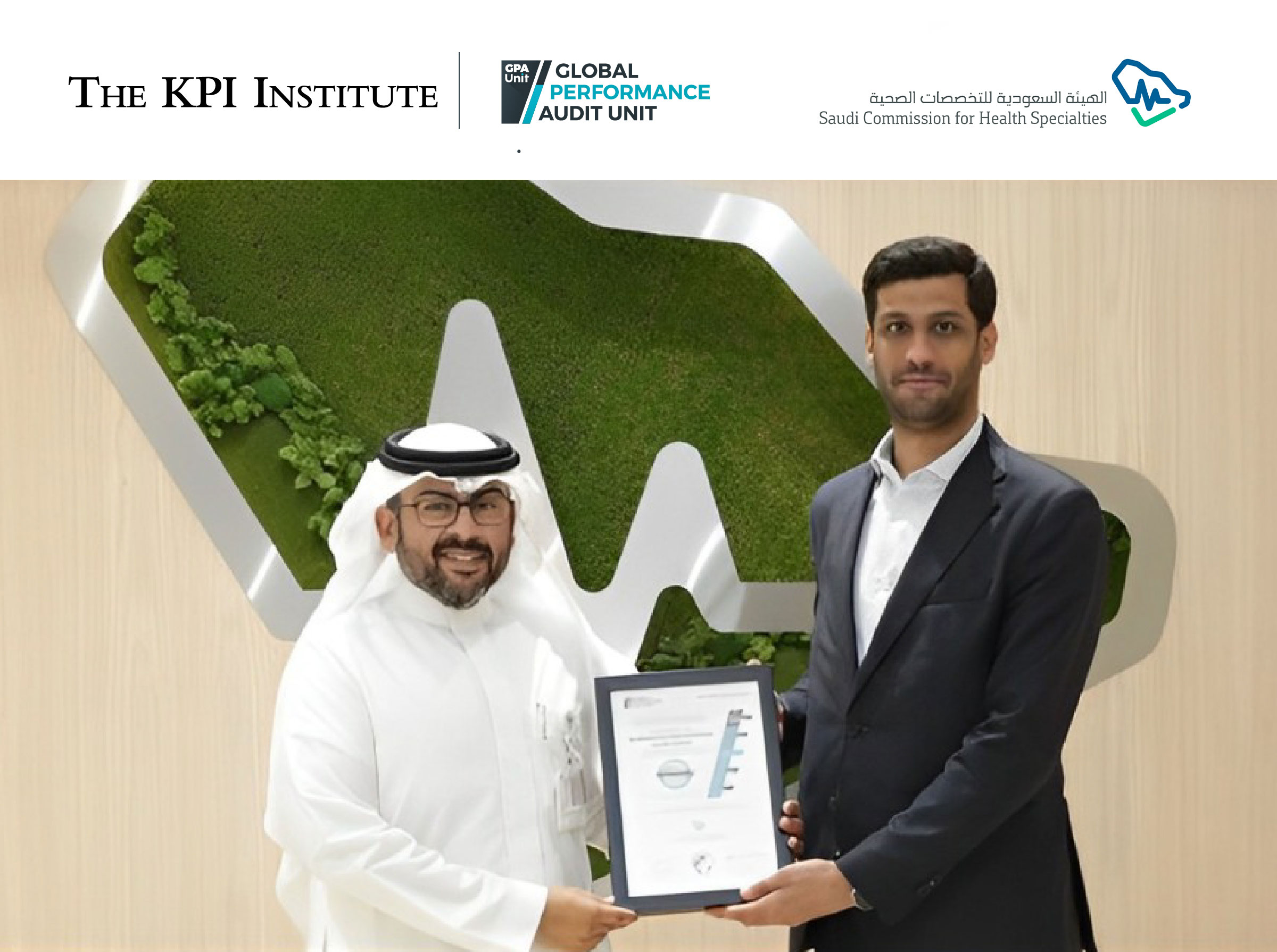
The Global Performance Audit (GPA) Unit, the division at The KPI Institute (TKI) that specializes in strategy and performance management audits, has successfully completed an extensive performance management system maturity assessment for Saudi Commission for Health Specialties (SCFHS). The evaluation encompassed the entity’s maturity level for five organizational capabilities: strategic planning, performance measurement, performance improvement, performance culture and employee performance management.

With its Maturity Model Framework, the GPA Unit applied a robust methodology comprising over 300 statements that encapsulate industry best practices. This approach integrated evidence-based assessment, perception-based assessment, and interview-based assessment, providing a thorough and insightful analysis of SCFHS’s performance management landscape.

SCFHS is an independent scientific professional body established in 1992, with the goal of contributing to a healthy society through qualified health practitioners. According to the audit findings, SCFHS has an integrated and robust performance management system, the result of a collaborative effort of the entire organization and under the coordination of an experienced management. 

Adrian Brudan, General Manager EMEA of The KPI Institute and GPA unit, acknowledged the positive outcome and extended his congratulations to SCFHS for their outstanding performance: “The assessment results reflect the entity’s commitment to excellence and readiness to embrace best practices. May the current results be a stepping stone for even greater accomplishments in the future. I have no doubt that your commitment to excellence will continue to drive SCFHS towards new milestones and further success.”

As a pioneer in setting performance standards, TKI collaborates with organizations to guarantee thorough assessments, steadfast commitment to enhancement, and unwavering adherence to global performance management standards. SCFHS stands as evidence of this dedication, marking a positive stride forward.

************  

About the Saudi Commission for Health Specialties 

The Saudi Commission for Health Specialties (SCFHS) is an independent scientific professional body, established in 1992, with the goal of contributing to a healthy society through qualified health practitioners. SCFHS is centered around their training, accreditation, and health transactions. It oversees the classification of health certificate holders, evaluates their certificates, sets the foundation and standards for practicing health professions, and conducts the professional registration of health practitioners. This ensures that the health practitioner is thoroughly qualified, possessing the skills, knowledge, and competencies needed to diagnose and treat diseases in a distinctive and secure manner. For more information, visit their website at: www.scfhs.org.sa

About The KPI Institute & the GPA Unit 

The KPI Institute (TKI) is a worldwide leader in performance management and KPIs training and certification. It operates research programs in 12 practice domains, disseminates industry insights through publications and knowledge platforms, and provides support in deploying those insights through training and advisory services.

The Global Performance Audit Unit (GPA Unit) is the strategy and performance audit division of The KPI Institute. Its purpose is to provide integrated strategy and performance assessment solutions through rigorous research, education and analysis.

Based on over 15 years of experience and a combination of academic and practitioner research in the field of strategy and performance, we have developed a unique set of frameworks for assessing the maturity level of organizational performance management systems.

The concept and services of the GPA Unit are available worldwide, as it is supported by a dedicated online platform and a global network of collaborators, www.gpaunit.org.

Contact details

For more information, please contact:

Adrian Brudan: General Manager EMEA, TKI

adrian.brudan@kpiinstitute.com | Contact Number: +40 721 233 084

What’s Inside “State of Strategy Management Practice Report – 2022”?

May 24th, 2022 Posted by Research 0 thoughts on “What’s Inside “State of Strategy Management Practice Report – 2022”?”

“State of Strategy Management Practice Report – 2022” is an international research study that explores the latest issues, trends, and best practices impacting the field of strategic planning, KPI usage, and strategy execution.

Developed and published by The KPI Institute, the report presents the results of a survey held from November to December 2021. The survey questions were formulated by forming a focus group of internal subject matter experts and aggregating the feedback of thousands of professionals and practitioners in The KPI Institute’s community.

The report covers the major areas affecting organizations today, from target setting to performance measurement and from the role of communication in strategic planning to the common pitfalls in strategy execution.

The data captured in the study reflects the insights of 500 professionals (27% are Executives, and another 34% occupy managerial positions), and nearly half of them are either directly involved in strategy planning or responsible for the design and maintenance of the strategy and performance management system. The survey has addressed 26 topic-related items.

Inside the report, readers would find:

Report overview

  • Introduction
  • Methodology
  • Executive summary

Key Findings

Strategic Planning

  • Highlights
  • Strategy formulation process
  • Strategy alignment
  • Strategy tools
  • Key success factors
  • Strategy communication

Performance Measurement

  • Highlights
  • KPI usage
  • Target setting
  • Technology

Strategy Execution

  • Highlights
  • Overview
  • Initiative Management
  • Agility

Demographics

Conclusions and Implications for Practice

  • Conclusions
  • Implications for practice

Get your free copy of “State of Strategy Management Practice Report – 2022” today! For inquiries regarding the report, contact Cristina Mihăiloaie, Business Unit Manager – Research Division:  cristina.mihailoaie@kpiinstitute.com, +61 (390) 282 223 or +40 (749) 424 517.

The Success Factors of a Corporate Performance Management Implementation Process

May 23rd, 2022 Posted by Certification, Courses, Employees 0 thoughts on “The Success Factors of a Corporate Performance Management Implementation Process”

This piece was first published in the latest edition of Performance Magazine. Andrea Minelli is the head of Professional Services SEA and a trainer and Performance Management Consultant at The KPI Institute. Andrea shared his views on the question “What Are the Success Factors of a Corporate Performance Management Implementation Process?”

A performance management system (PMS) implementation is not an easy feat regardless of the maturity of their implementation SOPs and the capability of those individuals guiding the implementation exercise. The success rate of a PMS implementation is highly dependent on the degree of buy-in of the members of the organization regardless of whether the member is involved in the implementation per se of the framework or if they will be appraised using the mentioned system. 

Such buy-in or organizational support towards the framework can be secured via continuous and transparent knowledge-sharing sessions. We explain to all members the motivation of the implementation and the desired outcomes. We train all allocated members in raising their knowledge and awareness towards the technicality of the framework (the specificity of these training should be customized as per the audience). 

For instance, the implementation team, which is generally members of the departments of Strategy Execution, Performance Management, Quality Assurance, or Organizational Excellence, will have a more in-depth technical preparation with respect to a non-PMS-implementation member. 

Such knowledge-sharing sessions aim at upskilling those members involved in applying standardized practices related to Strategic Planning and Execution, selection of Performance Measurement indicators, such as KPIs, at different organizational layers, and above all, proper cascading/alignment practices for Strategic and Performance Management matters. 

Last but not least, it is relevant to remember that the implementation of all the mentioned practices requires not only informed, skilled, and capable individuals from specific departments of the organization, but a proper dedicated governance framework that will foster and assist both the implementation team and all the members of the organization. Crucial support is required by Top Management and BoDs members pre-during and after the PMS framework is in place. 

There is no one-size-fits solution as organizational readiness, both technical and human-wise, play a big role in the PMS success. A governance-led standardized implementation approach will provide the foundations of success though.

Andrea Minelli facilitates the Certified Performance Management Professional Live Online Course of The KPI Institute. Stay tuned to The KPI Institute’s LinkedIn official page for the upcoming schedule and learn more about the Certification in Performance Management here.


Key Drivers for Strategic Planning in a Post-pandemic Business Environment [Excerpt]

March 31st, 2022 Posted by Research 0 thoughts on “Key Drivers for Strategic Planning in a Post-pandemic Business Environment [Excerpt]”

Editor’s Note: Below is an excerpt from the article “Key Drivers for Strategic Planning in a Post-pandemic Business Environment,” written by Daniela Vuta and published in the latest edition of Performance Magazine. It presents trends, solutions, and best practices for strategy and performance management through in-depth articles, first-hand how-to’s, concept presentations, case studies, and expert insights.

The business landscape has always been complex and dynamic. Organizations use strategic frameworks and business models validated through practice to cope with an ever-changing environment. But this was exacerbated by the COVID-19 pandemic, which led to radical and disruptive changes across industries. 

The European Business Review identified six essential forces driving change into the world of business: impactful technology, demographic change, rapid urbanization, amplified individuals, economic power shifts to climate, and resource security.  

“For years, we have been hearing and talking about the impending VUCA (volatility, uncertainty, complexity, and ambiguity) world,” wrote Quy Huy, INSEAD Professor of Strategic Management, in an article for INSEAD Knowledge. “Over and over again, we were told to prepare for the seismic change that was sure to arrive, to boost agility in anticipation of abrupt, profound disruption.”

“COVID-19 was a misfortune long foreseen; only the dates and other specific details were missing. Now that the whole world has experienced the VUCA that only emerging markets used to face, it can never again be treated as an abstraction,” Huy added.

Many organizations are still relying on the five-year plan as a strategic framework, but this type of planning, while proven to be useful in the past, may not be feasible today. It puts business leaders in a reactive mode when responding to business events. Given these conditions, what are the key drivers that executives will need to consider in strategic planning for the years to come? 

According to Euromonitor’s Voice of the Industry: Lifestyles Survey 2020, corporate strategy planning and recovery should rely on three main pillars: consumer, digital investment, and sustainability. Findings from the study showed that the most common strategic objectives for 2021 among the interviewed companies were focused on recovery and growth, brand image, technology investment, and organizational structure redesign, mostly by transforming operations for greater agility and flexibility. 

The capacity to identify drivers that might compromise the organization’s long-term profitability or determine strategic success in the future is going to be critical. For decision-makers, this will imply both questioning long-standing assumptions and future visions in a systematic way. Nonetheless, making predictions for an uncertain future and integrating them into strategic decisions is not an easy endeavor.

Want to understand the importance of prediction, adaptability, and resilience; digitalization; and agile integration to businesses in the post-pandemic world? Read the rest of the article in the latest edition of Performance Magazine  Download your FREE COPY now!

Towards a Performance-oriented Culture: How To Build Healthy Work Relationships

March 4th, 2022 Posted by Certification, Courses, Events 0 thoughts on “Towards a Performance-oriented Culture: How To Build Healthy Work Relationships”

Building healthy work relationships is essential for both the employees and their employer when they are building a performance-oriented culture.

Citing several studies on work relationships, SHRM Foundation’s Effective Practice Guidelines Series shows that high-quality human relationships can impact one’s physical and psychological health, cognitive abilities, thinking capacity, learning, resiliency, commitment, creativity, and organizational citizenship behavior. This means more efficient employee coordination with qualities that support “greater organizational effectiveness and efficiency.”

However, the work setup of most companies changed when the COVID-19 pandemic struck the world. Organizations moved their operations online, forcing employees to perform their duties and communicate virtually. 

Cultivating professional relationships is not easy in such an environment. Employees connecting virtually rather than face-to-face communication have lesser chances of building relationships, according to a study held by Xiao-Ping Chen, the Philip M. Condit Endowed Chair in Business Administration at the University of Washington Foster School of Business.

Findings showed that it is difficult to understand the nonverbal cues of remote workers, such as facial expressions, hand gestures, silence, or delayed responses. Moreover, most employees struggle with paying attention during a meeting done via video conferencing.

What Organizations Can Do

Increasing resilience in the workplace as people recover from a crisis means giving them purpose and hope, flexibility and adaptability, and connection to their colleagues. Organizations can arrange activities that can help employees stay connected even while working remotely. 

In an interview with CNBC, Jason Fried, CEO of the project management company Basecamp, recommends a daily check-in with colleagues or a time at work where they can share ideas and express support over personal matters.

Meanwhile, education company General Assembly implemented watercooler chat over coffee through video chat rooms. Meg Randall, the director of product delivery for the company’s tech team in New York City, said that those coffee breaks help her mentally start her day. “It’s a small talk that lasts for a few minutes, but it’s a nice ritual if you’re craving that human connection every day, which I have been,” said Randall. 

Trust, transparency, and open communication can also help organizations nurture healthy work relationships. One of the ways this can be tested, particularly between leaders and employees, is performance evaluation. Assessing employee performance has changed due to the pandemic. 

In the online event held by ECCP and HURIS on August 2021, Cristina Mihăiloaie, Business Unit Manager at The KPI Institute, said that the performance criteria used for employee evaluations, whether it involves key performance indicators or not, should be “flexible, easy to adapt to changes, and more focused on the extent to which the role is successfully achieved, compared to looking at operational details.”

“For example, employees who worked from home and multitasked between being a parent and a professional may have missed some meetings, or maybe they seemed more absent during work. Overall, if the output of their job is good, the operational details may be less important,” she said. 

Join Cristina as she delivers the Certified Performance Management Systems Audit Professional Live Online course on 07 – 11 March 2022 / EMEA 18:00 – 22:00 GST and ASEAN 09:00 – 13:00 CST (US).

This 40-hour course will discuss how to diagnose and audit the maturity of performance architectures for five capabilities: strategic planning, performance measurement, performance management, performance culture and employee performance management.

Don’t miss this opportunity to widen your knowledge and experience in employee performance management. You can sign up here.

Recent Comments

    Archives