Posts tagged "Performance Measurement"

The 10 best-selling KPI dictionaries of 2026 (so far)

August 12th, 2026 Posted by KPIs, Publications 0 thoughts on “The 10 best-selling KPI dictionaries of 2026 (so far)”

Every organization says it’s “data-driven.” Far fewer can say every manager in the room means the same thing when they say “customer satisfaction,” “on-time delivery,” or “risk exposure.” That gap — between having metrics and having shared, defensible metrics — is where most performance management initiatives quietly stall.

It’s also the gap this list is built to close. Drawing on The KPI Institute’s own sales records for the first eight months of 2026, these are the ten KPI dictionaries that strategy and performance professionals turned to most often. Each earns its place here not because of how well it sold, but because of the specific problem it solves for the people who lead performance conversations rather than just sit in them.

1. The Healthcare KPI Dictionary: 300+ Key Performance Indicator Definitions

Healthcare performance is uniquely hard to standardize: clinical outcomes, patient experience, operational efficiency, and financial sustainability all compete for the same dashboard real estate. This dictionary lays out precise, industry-recognized definitions across all of them, so a hospital administrator and a clinical director can finally sit in the same meeting and agree on what “quality of care” is actually measuring.

Download here

2. The Constructions and Capital Works KPI Dictionary: 70+ Key Performance Indicator Definitions

Capital projects are notorious for cost overruns and timeline slippage that only become visible once it’s too late to correct course. This dictionary gives project sponsors and site leadership a common set of indicators — covering cost control, schedule adherence, safety, and quality — early enough in the project lifecycle to actually act on them.

Download here

3. The KPI Dictionary: 4,800+ Key Performance Indicator Definitions — Volume 2: Industries

For leaders operating across multiple sectors, or benchmarking against companies outside their own industry, this volume is the closest thing to a universal translator. It organizes thousands of indicators by industry vertical, making it possible to compare performance logic across manufacturing, retail, energy, and beyond — instead of assuming every sector measures success the same way.

Download here

4. The Local Government KPI Dictionary: 660+ Key Performance Indicator Definitions

Public-sector leaders answer to a harder audience than most: taxpayers, auditors, and elected officials, often with conflicting definitions of success. This dictionary gives municipal and government performance teams a vocabulary that holds up under public scrutiny — turning “we’re improving services” into indicators that can actually be reported and defended.

Download here

5. The KPI Dictionary: 3,200+ Key Performance Indicator Definitions — Volume 1: Functional Areas

Where Volume 2 organizes by industry, this companion volume organizes by function — HR, finance, marketing, operations, and more, all under one cover. It’s built for leaders whose real challenge isn’t finding a KPI, but finding the right one across departments that rarely speak the same performance language.

Download here

6. The Supply Chain KPI Dictionary: 360+ Key Performance Indicator Definitions

Supply chain reporting has outgrown “on-time delivery” as a catch-all metric. This dictionary reflects how granular the discipline has become — covering everything from inventory accuracy to supplier performance to fulfillment cost — giving supply chain leaders a reference precise enough to match how the function is actually run today.

Download here

7. The Accounting KPI Dictionary: 220+ Key Performance Indicator Definitions

Accounting functions tend to inherit their KPIs informally, one controller passing a slightly different ratio set to the next. This dictionary offers a standardized foundation instead — definitions precise enough to survive an audit and consistent enough to hold their meaning as teams and leadership change.

Download here

8. The Finance KPI Dictionary: 190+ Key Performance Indicator Definitions

Where accounting records what happened, finance is responsible for deciding what happens next — and that shift in purpose demands a different set of indicators. This dictionary picks up where its accounting counterpart leaves off, giving finance leaders the metrics to support forecasting, capital allocation, and strategic decision-making rather than historical reporting alone.

Download here

9. The Governance, Compliance and Risk KPI Dictionary: 130+ Key Performance Indicator Definitions

As ESG obligations and risk oversight climb further up every board agenda, “we’re managing risk” is no longer an acceptable answer on its own. This dictionary equips governance, compliance, and risk leaders with indicators built to be reported, audited, and defended — not just discussed.

Download here

10. The Knowledge and Innovation KPI Dictionary: 130+ Key Performance Indicator Definitions

Innovation is one of the hardest areas to measure honestly — it’s easy to track activity (patents filed, ideas submitted) and much harder to track whether any of it moved the business forward. This dictionary gives strategy leaders a way to measure knowledge management and innovation output with the same rigor applied to more traditional functions, instead of leaving it to anecdote.

Download here

The Common Thread

None of these are generic introductions to KPIs. Each is a specific, functional reference chosen by people who already understood they needed better metrics and were looking for precision, not inspiration. That’s the real signal here: the professionals shaping strategy and performance management in 2026 aren’t short on ideas — they’re closing the gap between having a metric and having one that survives contact with a boardroom, an auditor, or a cross-functional argument.


High-performing organizations invest in KPI governance training before scaling AI adoption

August 6th, 2026 Posted by Certifications, Employees, KPI, Professional Development, Upskilling 0 thoughts on “High-performing organizations invest in KPI governance training before scaling AI adoption”

Most enterprises are not short on AI ambition. They are short on the KPI governance needed to point that ambition somewhere useful. A growing body of data suggests the organizations getting AI right are not the ones moving fastest. They are the ones that paused to fix their metrics first.

The scale of the problem is hard to ignore.

AI project failure rates jumped from 17% to 42% between 2024 and 2025. A separate industry report cited in the same analysis found that 72% of businesses expect to shut down AI pilots this year because those pilots failed to meet the KPIs set for them. That detail is worth sitting with.

The pilots did not fail on technology grounds.

They failed against indicators the organization had set but could not govern well enough to track, interpret, or act on. Closing that gap is a KPI governance training problem before it is an AI problem.

When AI Meets Ungoverned KPIs, Pilots Stall

AI systems amplify whatever measurement discipline already exists in an organization. Feed a model into a KPI environment with unclear ownership, inconsistent definitions, or thresholds nobody reviews, and the model produces outputs at a pace no governance process can absorb.

The result looks like a technology failure, but the root cause sits upstream, in how the KPIs were defined and managed before AI arrived.

This is consistent with what governance researchers are seeing across adjacent domains. Deloitte’s 2025 research found that 74% of enterprises plan to adopt AI agents within two years, while only 21% report having a mature governance model in place for them.

The gap between deployment appetite and governance maturity is not a coincidence. It is the same gap that shows up whenever a fast-moving initiative outpaces the measurement structure meant to keep it accountable.

Why KPI Governance Training Comes Before Automation

Organizations that treat KPI governance as a prerequisite for AI, rather than a parallel workstream, tend to sequence their investment differently.

A 2025 survey of senior data and analytics executives found that 85% were prioritizing improvements to data governance specifically to prepare for AI, ahead of investment in the AI tools themselves. The same survey found 65% prioritizing workforce upskilling and reskilling as part of that same readiness effort.

That sequencing has a logic to it. A KPI cannot be automated, monitored, or trusted by an algorithm if the people who own it cannot define it precisely, document its calculation method, or explain what a threshold breach should trigger.

Governance is not a compliance checkbox sitting beside AI adoption. It is the specification the AI eventually relies on. Skipping it does not speed up adoption. It just moves the failure point from the pilot phase to production.

The Capability Layer Underneath KPI Governance

Building that governance layer is a skills problem before it is a systems problem. Someone in the organization needs to know how to write a proper KPI definition, structure a scorecard architecture, and run a monitoring process disciplined enough that an AI system can plug into it safely. Templates for KPI documentation, scorecard design, and performance monitoring give teams a consistent starting point for this work.

Structured KPI governance training turns those templates into applied capability. Teams that understand KPI governance at a working level, not just a conceptual one, are the teams positioned to bring AI into their measurement systems without repeating the pattern behind so many stalled pilots.

Conclusion

AI adoption failures are increasingly measurement failures wearing a technology label. Organizations that invest in KPI governance training before scaling automation are the ones with a real foundation. The ones that skip it are the ones filing the failure statistics.

Getting the sequence right starts with building governance capability before adding automation on top of it.

Strengthen your team’s KPI governance foundations through The KPI Institute’s performance management training courses.

FREE download: What 126 countries reveal about the way we measure “good government”

July 17th, 2026 Posted by Publications, Research 0 thoughts on “FREE download: What 126 countries reveal about the way we measure “good government””

One hundred twenty six countries. Thirty indicators. Five dimensions.

One question sitting underneath all of it: what actually counts as “good government” — and how do you measure something that broad without turning it into a popularity contest?

The KPI Institute’s Government Services Index (GSI), now in its fourth consecutive edition and built on 2025 data, set out to answer exactly that. Expanding coverage from 122 to 126 countries across five global regions, the index doesn’t just rank public service performance — it exposes the mechanics of how “good” gets defined and measured at a scale most performance frameworks never get tested at.

The measurement problem hiding in plain sight

“Good government” sounds like a single idea. In practice, it’s five separate ones the GSI treats as distinct dimensions:

  • Future Readiness — can the system adapt before it’s forced to?
  • Digitalization — how far has service delivery actually moved online?
  • Governance — is the institution transparent and accountable, or just says it is?
  • Society Welfare — do outcomes in health, education, and social protection back up the promises?
  • Citizen Experience — what does it actually feel like to be on the receiving end?

Getting to those five wasn’t a shortcut. The framework is rooted in data derived from 30 specific indicators aligned with these dimensions, distilled from a review of over 100 research articles and 40 global indices during development. The harder work wasn’t scoring 126 countries — it was deciding what was even worth scoring in the first place, and building a methodology precise enough to make five very different governance systems comparable on the same terms.

That discipline shows up in how the report is structured. Beyond the headline rankings, it breaks performance down by income group, maps a global heatmap of scores, and builds regional dashboards alongside individual country profiles — treating each country less like a single data point and more like a full scoreboard in its own right.

Why this is a measurement story, not a government story

Strip away the word “government” and what’s left is a familiar shape: a multi-dimensional scorecard, tracked consistently, across a growing number of units, with certain indicators quietly moving ahead of the rest.

  1. No single score wins. The GSI refuses to collapse performance into one number — it’s a weighted scorecard, the kind that tends to hold up better than any single metric ever does on its own. A country can lead on Digitalization and still lag on Citizen Experience; the index is built to show both, not average them into a false sense of balance.
  2. Some dimensions are doing the heavy lifting, ahead of the others. Future Readiness and Digitalization move first; Citizen Experience and Society Welfare follow. One set tends to predict the other, whether or not the index ever spells that out in so many words.
  3. The scope grew, and the methodology had to hold. Going from 122 to 126 countries without breaking comparability is its own kind of discipline — data collection, elimination, imputation, and scaling all have to stay consistent even as the dataset expands. It’s the sort of quiet rigor that matters anywhere a benchmark has to keep working as the list of things being measured keeps changing.
  4. Context changes the read. The index doesn’t just rank countries against each other in a vacuum — it also breaks performance out by income group, which matters, because “good government” doesn’t mean the same investment capacity everywhere. A framework that accounts for that is doing more than ranking; it’s contextualizing.

The question worth sitting with

Rankings answer “who’s ahead.” Measurement design answers a harder question: what are we actually choosing to value, and did we pick the right proxies for it?

The GSI’s five dimensions, 30 indicators, and income-adjusted view are one answer to that question. They won’t be the only reasonable one — which is exactly what makes the framework worth studying, not just the leaderboard it produces.

For strategy and performance professionals, that’s the real reason this report is worth opening, even outside the public sector. It’s a working example of how to build a scorecard that stays credible while scaling, how to weight dimensions instead of flattening them into one score, and how to read context into a comparison instead of ignoring it. Those are the exact problems every performance function eventually runs into internally — just rarely tested across 126 “business units” at once.

The full Government Services Index 2025 report is free to download — all 380 pages, covering the complete methodology, global and regional rankings, income-group breakdowns, and individual country profiles across all five dimensions.

Get your copy at The KPI Institute’s Marketplace: marketplace.kpiinstitute.org/government-services-index-2025.html

If you had to define “good performance” for your own organization in five dimensions, what would they be? Tell us on LinkedIn.

__________________________________________________________________________________________

The KPI Institute is a global leader in business performance research and solutions, specializing in practice domains including strategy, key performance indicators (KPIs), employee performance, customer service, and innovation management. For over 20 years, The KPI Institute has established international standards and best practices for KPIs across both private and public sectors.

What We Offer:

  • Certifications & Training: Practical programs delivered worldwide—live online, offsite, and customized—spanning 6 continents and 7 offices in Australia, Southeast Asia, Europe, and the Middle East.
  • Knowledge Platforms: Access to www.smartKPIs.com, the world’s largest documented database of KPIs, with over 21,600 examples published and 148,000+ members in our online communities.
  • Publications: Over 460 publications, including books, research papers, and practical guides, providing insights to enhance organizational performance.
  • Advisory & Implementation Support: Expert guidance to apply insights in practice for measurable impact.

Our Reach and Impact:

  • 81,000+ companies registered on our platforms
  • 2.5 million+ professionals reached through training and knowledge services
  • 128 research client countries and 120 global partner organizations

Website: www.kpiinstitute.org

Email: office@kpiinstitute.org

LinkedIn: The KPI Institute

World’s largest KPI database now features 21,772 documented key performance indicators

June 1st, 2026 Posted by KPIs, Performance Management, Research 0 thoughts on “World’s largest KPI database now features 21,772 documented key performance indicators”

Organizations collect vast amounts of data, yet many still face a familiar challenge: identifying the right key performance indicators (KPIs) to measure performance and support decision-making. The search for reliable business metrics has fueled interest in KPI databases that provide documented KPIs, KPI examples, and established performance measurement practices.

smartKPIs, developed by The KPI Institute, has reached a new milestone with a database containing 21,772 documented KPIs.

This achievement strengthens its position as the world’s largest KPI database and one of the most extensive KPI libraries available to professionals across industries.

The KPI database includes more than 7,000 premium documented KPIs and covers 16 functional areas and 25 industries. Its collection spans sectors such as finance, healthcare, manufacturing, education, retail, logistics, public administration, sustainability, customer service, human resources, and supply chain management. Users can explore KPI examples and business metrics based on industry, department, or area of expertise.

What sets the platform apart is the breadth of contexts covered within its KPI library. Organizational context KPIs focus on business performance at the industry and functional level. Global context KPIs address topics such as economic development, public health, social progress, environmental performance, and sustainability. Personal context KPIs provide metrics related to productivity, time management, work-life balance, budgeting, and personal well-being.

The platform also serves as a resource for professionals who want to strengthen their understanding of KPI managementand performance measurement. Its learning materials cover topics such as performance management and measurement, KPI formulation and selection, target setting, KPI visualization, analytics, reporting practices, performance management levels, and common KPI pitfalls. These resources help both newcomers and experienced practitioners build stronger measurement frameworks.

Interest in KPI benchmarking and KPI documentation has grown as organizations seek greater consistency in reporting. Different teams often use different definitions for the same metric, which can affect reporting accuracy and make performance comparisons more difficult. Access to documented KPIs gives professionals a common reference point when selecting indicators and developing performance management systems.

The platform’s reach extends beyond its database. More than 75,000 members form a global community focused on KPI management, business metrics, organizational performance, and performance measurement. This network allows professionals to exchange ideas, discuss industry practices, and learn from peers across different sectors.

A comprehensive KPI database can help organizations reduce the time spent searching for relevant indicators and provide access to proven KPI examples. Documented KPIs that include definitions, formulas, data sources, reporting frequencies, and interpretation guidelines can support more informed performance discussions and stronger reporting practices.

Free Preview Subscription and More!

Professionals interested in exploring the platform can begin with the free Preview subscription.

The plan provides access to 100 KPI names, the KPI Dashboard, and the Top 10 KPIs, offering an introduction to the world’s largest KPI database at no cost.

Those who require deeper KPI documentation, premium KPI examples, industry KPI reports, and expanded access to documented KPIs can review the Starter, Standard, and Premium subscription options. These plans provide varying levels of access based on individual and organizational needs. Subscribe to smartKPIs for free and discover how KPI documentation, KPI benchmarking resources, and performance measurement guidance can support better business decisions.

For additional features, premium content, and expanded access to the world’s largest KPI database, visit the platform and explore the subscription plan that best matches your requirements.

FREE mid-year performance review resources to help organizations finish 2026 strong

May 25th, 2026 Posted by Performance Management, Publications, Research, Webinar 0 thoughts on “FREE mid-year performance review resources to help organizations finish 2026 strong”

Half of 2026 has already passed.

Many organizations now face a familiar question: What comes next?

January brought ambitious plans. Leadership teams approved strategic initiatives. Departments rolled out new KPIs. Managers tracked targets with optimism. Then daily operations took over. Priorities shifted. Reports piled up. Some initiatives lost momentum.

A mid-year performance review gives organizations a chance to pause and reassess. This period can expose weak reporting practices, misaligned KPIs, and execution gaps. It can also uncover new opportunities.

Several business leaders now look for practical support instead of lengthy theory. Free performance management resources can help teams rethink priorities, refine KPI reporting, and improve decision-making during the second half of the year.

The KPI Institute offers a wide range of free resources that support strategy and performance management. From articles and webinars to KPI toolkits and publications, these materials can support organizations that want clearer direction for the months ahead.

Why a Mid-Year Performance Review Matters

A business strategy may look solid on paper and still fall short during execution.

Some organizations collect too many metrics. Others track KPIs with little connection to strategic priorities. In some cases, teams produce reports every month without any discussion about performance trends.

A mid-year performance review can help organizations identify:

  • KPIs that no longer reflect current priorities
  • Reporting practices that consume too much time
  • Departments that work in silos
  • Initiatives with weak follow-through
  • Data that lacks context

Business conditions also change throughout the year. Market shifts, operational issues, and workforce challenges can alter priorities within a few months. Companies that revisit performance data during the middle of the year often gain a clearer picture of what deserves attention.

Free KPI Resources for Better Performance Tracking

KPI reporting remains a challenge for many organizations.

Some reports contain too much information. Others focus on metrics that offer little insight into operational performance. Confusing dashboards can also slow down decision-making.

The KPI Institute provides free KPI resources that can help teams improve reporting practices and KPI selection.

These resources include:

Organizations can use these materials to review existing KPIs and remove metrics that no longer serve a purpose. Clear KPI documentation can also reduce confusion among departments.

A KPI should support action. A metric without direction often turns into noise.

Strategy Execution Resources for the Second Half of 2026

A strategy document alone will not keep projects on track.

Execution problems usually appear during the middle of the year. Deadlines slip. Teams lose focus. Managers shift attention to urgent operational concerns. Strategic initiatives move into the background.

This pattern appears across many industries.

Strategy execution resources can help organizations reassess priorities and restore alignment between objectives and day-to-day work.

The KPI Institute shares free materials on:

Readers can also explore Performance Magazine articles that discuss real business cases, performance trends, and management practices from different sectors.

These resources can help leadership teams ask better questions during a mid-year performance review:

  • Which initiatives still support strategic priorities?
  • Which KPIs need revision?
  • Which projects no longer justify additional resources?
  • Which departments require stronger coordination?

Clear discussions often produce better outcomes than lengthy reports.

Free Business Performance Review Resources

A business performance review should go beyond numbers.

Financial results matter, but they rarely tell the full story. Operational delays, employee engagement issues, and weak communication can affect organizational performance long before financial problems appear.

Free business performance review resources can help managers examine performance from multiple perspectives.

The KPI Institute offers:

Common Mid-Year Performance Problems

Several issues tend to surface during a mid-year performance review.

  • KPI overload: Some organizations track too many metrics. Teams spend more time collecting data than discussing results.
  • Reporting fatigue: Employees may see reports as routine paperwork instead of decision-support tools.
  • Weak alignment: Departments may pursue different priorities without clear coordination.
  • Outdated targets: Business conditions can change after the first quarter. Some targets may no longer reflect current realities.
  • Lack of accountability: KPIs without ownership often lead nowhere.

These problems rarely disappear on their own. Organizations need structured discussions, practical tools, and reliable resources.

A Practical Time for Reassessment

The second half of the year still offers enough time for course correction.

Organizations do not always need major restructuring. Small adjustments can produce noticeable results. A revised KPI dashboard, a focused review meeting, or a clearer reporting structure may improve performance discussions across teams.

A mid-year performance review can also help organizations prepare for next year. Teams that identify recurring problems early may avoid the same issues during annual planning cycles.

The KPI Institute continues to publish research, articles, newsletters, and performance management resources for professionals across industries. And this may be the right time to review what works, address weak spots, and move forward with clearer priorities.

_____________________________________________________________________________________

The KPI Institute is a global leader in business performance research and solutions, specializing in practice domains including strategy, key performance indicators (KPIs), employee performance, customer service, and innovation management. For over 20 years, The KPI Institute has established international standards and best practices for KPIs across both private and public sectors.

What We Offer:

  • Certifications & Training: Practical programs delivered worldwide—live online, offsite, and customized—spanning 6 continents and 7 offices in Australia, Southeast Asia, Europe, and the Middle East.
  • Knowledge Platforms: Access to www.smartKPIs.com, the world’s largest documented database of KPIs, with over 21,600 examples published and 148,000+ members in our online communities.
  • Publications: Over 460 publications, including books, research papers, and practical guides, providing insights to enhance organizational performance.
  • Advisory & Implementation Support: Expert guidance to apply insights in practice for measurable impact.

Our Reach and Impact:

  • 81,000+ companies registered on our platforms
  • 2.5 million+ professionals reached through training and knowledge services
  • 128 research client countries and 120 global partner organizations 

Website: www.kpiinstitute.org.

Email: office@kpiinstitute.org

LinkedIn: The KPI Institute

Is a performance management certification actually worth it? Here’s the truth

April 29th, 2026 Posted by Certification, Certifications, Courses, Performance Management 0 thoughts on “Is a performance management certification actually worth it? Here’s the truth”


Performance management looks straightforward when it is written down. KPIs get defined, dashboards get built, reports go upward, and decisions are expected to follow. In practice, the link between measurement and action often feels weaker than it should be.

A study published in the International Journal of Productivity and Performance Management found that a large portion of organizations struggle to connect performance measurement systems with actual strategic execution, even when KPI frameworks are already in place .

That gap tends to push performance management work into redesign territory rather than simple reporting.

When KPIs exist but decisions still drift

Most organizations do not suffer from a lack of data. They suffer from too much of it, without clear structure.

Research shows that excessive KPI counts can reduce managerial focus and weaken prioritization quality, especially when metrics are not clearly tied to strategic objectives .

This is where dashboards start looking complete but still leave leadership discussions unclear.

Strategy execution still struggles in many settings

A peer-reviewed study in Strategic Management Journal observed that strategy implementation failures often stem from weak alignment between planning systems and operational measurement structures .

Even when strategic goals are well defined, the absence of a structured performance system can slow down execution and reduce consistency across departments.

What structured performance management training focuses on

The KPI Institute’s Certified Performance Management Professional program is built around this type of gap between strategy and execution.

The focus is less about isolated KPIs and more about how a full performance system operates. Strategy mapping is used to translate high-level objectives into measurable elements. Scorecards and dashboards are treated as decision tools rather than reporting outputs.

A significant part of the learning also looks at performance governance. That includes how reporting flows are structured, how accountability is distributed across teams, and how data quality is maintained so that reporting cycles remain consistent.

There is also emphasis on how performance systems support real operational decisions, particularly when KPIs signal underperformance and require structured action rather than informal response.

Topics usually discussed inside the program

The content moves across several connected areas of performance practice rather than isolated tools.

There is coverage of how performance management systems developed over time and how modern environments introduced new pressures such as digital transformation, ESG reporting requirements, and stakeholder expectations.

A large portion of the discussion focuses on system architecture. This includes how strategy maps, scorecards, dashboards, and initiative portfolios work together rather than function separately.

Governance models also take a central role. Topics include reporting structures, data quality control, audit readiness, and how performance responsibilities are distributed across organizational levels.

On the operational side, attention goes into diagnosing weak KPIs, tracing root causes, and translating findings into structured improvement initiatives that can be tracked over time.

Educational resources and practical support materials

Alongside the sessions, participants receive a set of structured materials that support real application work.

At The KPI Institute, these typically include course slides, detailed notes, quizzes, and reference guides that explain how performance systems are built and maintained in practice. There is also a performance management poster and supporting documentation formats used for initiative tracking.

The learning materials extend further into published research reports on performance management trends and strategy execution practices, covering multiple years of industry observation.

A large part of the toolkit focuses on ready-to-use templates. These include strategy maps, scorecards, dashboards, performance maturity models, initiative portfolios, KPI documentation forms, and monthly reporting structures. Separate guides also explain how to build and administer scorecards and dashboards in operational settings.

Additional resources include KPI catalogues, glossary references, and curated publications that document how organizations structure performance systems in real environments.

Participants also gain access to video content and webinar series that cover applied performance management topics, along with a KPI database containing hundreds of fully documented indicators and thousands of additional KPI references for benchmarking and design work.

So does a certification like this actually matter?

The usefulness depends on where someone stands inside an organization.

When performance systems already function smoothly, the benefit may feel incremental. When reporting is fragmented, KPIs are overloaded, or strategy execution feels disconnected from measurement, structured training becomes more relevant.

The core focus is not on learning more metrics. It is on understanding how performance systems are built, governed, and used so that strategy, measurement, and action do not operate in separate lanes.

In many organizations, that alignment is still the missing piece.

To better understand whether a performance management certification fits your needs, take a look at how The KPI Institute delivers the Certified Performance Management Professional program in this brochure.

KPI and business strategy courses

_____________________________________________________________________________________

The KPI Institute is a global leader in business performance research and solutions, specializing in practice domains including strategy, key performance indicators (KPIs), employee performance, customer service, and innovation management. For over 20 years, The KPI Institute has established international standards and best practices for KPIs across both private and public sectors.

What We Offer:

  • Certifications & Training: Practical programs delivered worldwide—live online, offsite, and customized—spanning 6 continents and 7 offices in Australia, Southeast Asia, Europe, and the Middle East.
  • Knowledge Platforms: Access to www.smartKPIs.com, the world’s largest documented database of KPIs, with over 21,600 examples published and 148,000+ members in our online communities.
  • Publications: Over 460 publications, including books, research papers, and practical guides, providing insights to enhance organizational performance.
  • Advisory & Implementation Support: Expert guidance to apply insights in practice for measurable impact.

Our Reach and Impact:

  • 81,000+ companies registered on our platforms
  • 2.5 million+ professionals reached through training and knowledge services
  • 128 research client countries and 120 global partner organizations 

Website: www.kpiinstitute.org.

Email: office@kpiinstitute.org

LinkedIn: The KPI Institute

Saudi Arabia’s LPTC achieves level IV maturity in performance measurement

July 8th, 2025 Posted by Press release 0 thoughts on “Saudi Arabia’s LPTC achieves level IV maturity in performance measurement”

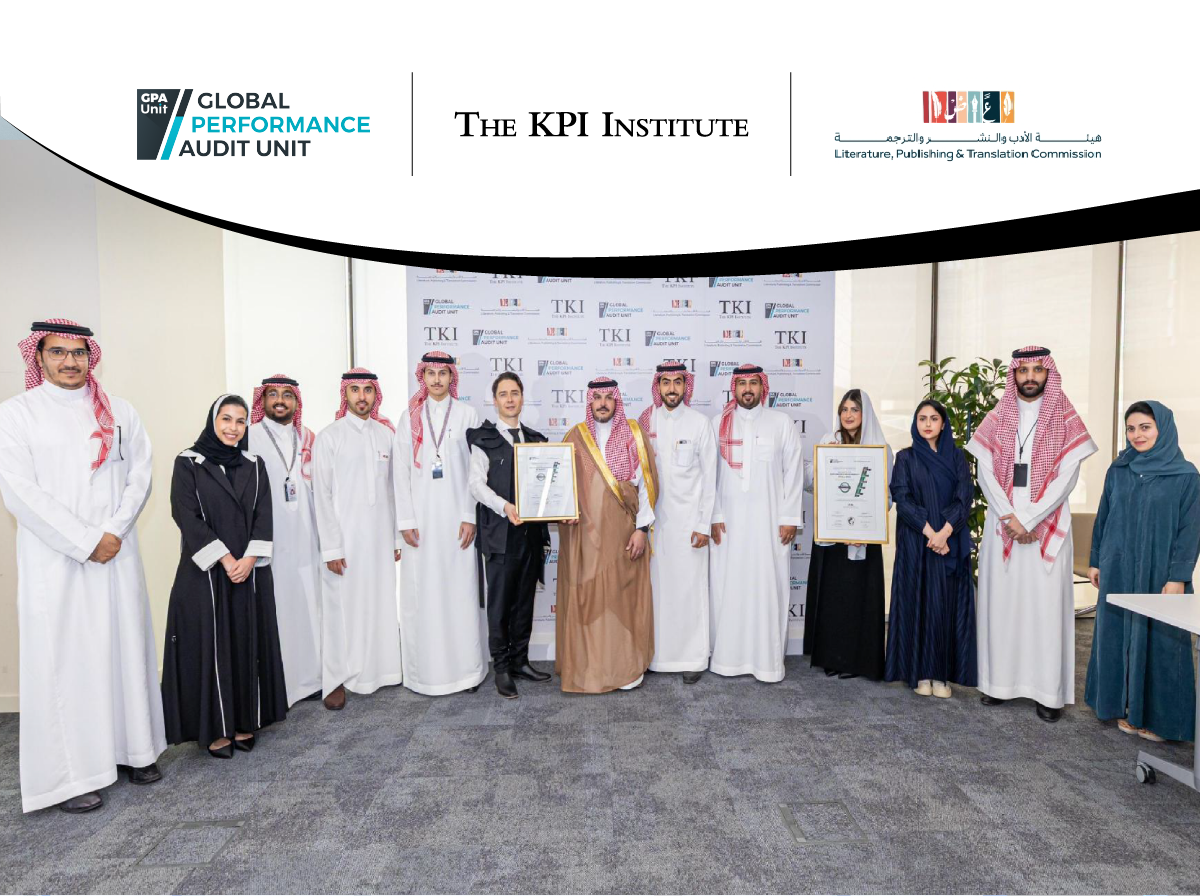
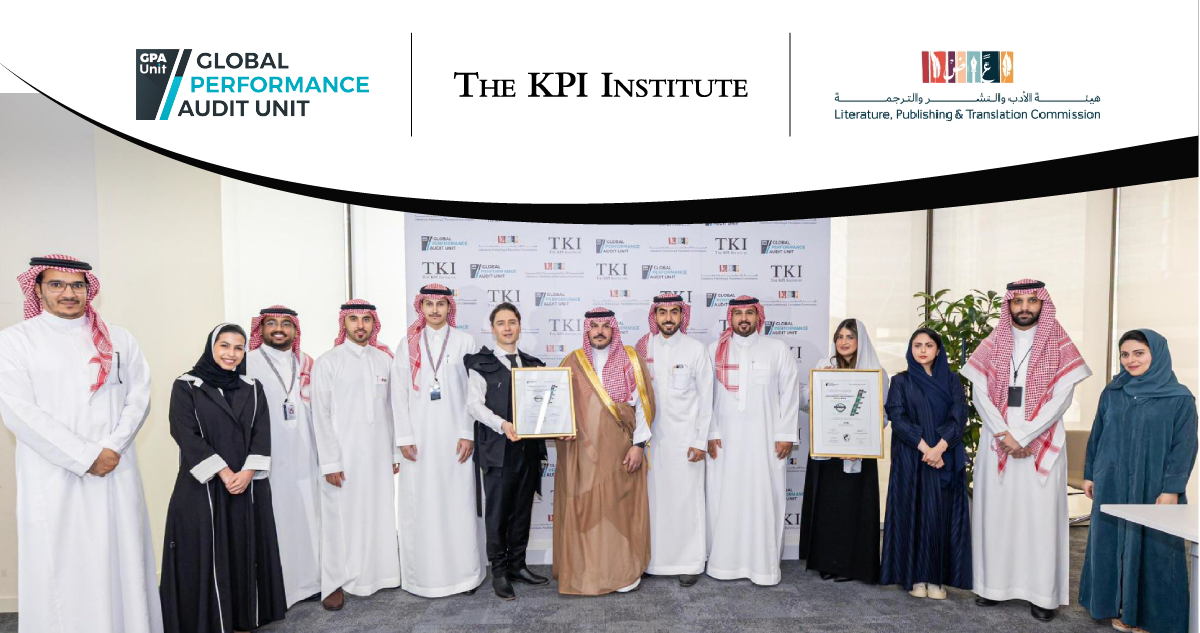
The Global Performance Audit Unit (GPA Unit) has formally recognized the Literature, Publishing, and Translation Commission (LPTC) for achieving Maturity Level IV – Integrated in the Performance Measurement capability, following a maturity assessment conducted using the GPA Unit’s Integrated Performance Maturity Model Framework. This recognition reflects the Commission’s commitment to advancing its internal performance measurement practices and supporting its strategic objectives through reliable, structured, and data-driven approaches.

As the national body responsible for shaping Saudi Arabia’s literary and publishing ecosystem, LPTC operates at the intersection of culture, innovation, and policy. Its recent efforts to strengthen performance measurement mark an important step in aligning internal systems with its strategic and cultural objectives.

The evaluation followed a comprehensive methodology that combined evidence-based, perception-based and interview-based analysis. Evidence was collected through detailed reviews of internal documentation, frameworks, and procedures. Perception-based insights were obtained via internal quantitative surveys, complemented by qualitative interviews with staff and stakeholders during the interview phase. This approach enabled a well-rounded assessment across six key dimensions: KPI selection, KPI documentation, target setting, data gathering, data visualization, and governance.

The findings confirmed that LPTC has developed a cohesive and well-integrated performance measurement system. KPIs are clearly defined and aligned with strategic priorities, supported by strong practices in target setting, data collection, and visualization. These efforts are reinforced by committed leadership and a clear focus on continuous improvement. Effective governance structures and well-defined roles promote accountability and execution, laying a solid foundation for sustained progress.

“LPTC’s recognition is a demonstration of what disciplined performance stewardship looks like in the public sector.” Said Teodora Gorski, Head of Strategic Partnerships & Growth at the GPA Unit. ” The ability to define what matters, measure it with consistency, and act on it with purpose reflects operational strength and institutional clarity. At this level, performance measurement is no longer a function; it becomes a leadership instrument. It enables alignment, drives accountability, and positions the Commission as a reference point for excellence in public sector performance.”

The assessment was conducted as part of the GPA Unit’s ongoing work with public sector institutions in Saudi Arabia, supporting the national direction under Vision 2030 to strengthen transparency, strategic alignment, and performance across government entities. By reaching Level IV in Performance Measurement, the Literature, Publishing, and Translation Commission joins a growing group of entities recognized for their structured and forward-looking approach to managing performance.

The GPA Unit commends the Commission’s leadership and teams for their openness, professionalism, and dedication throughout the assessment process. This milestone not only validates existing practices but also provides a solid foundation for future development and continuous improvement.

Discover TKI’s Certified Performance Management Systems Audit Professional today!

June 5th, 2024 Posted by Certification 0 thoughts on “Discover TKI’s Certified Performance Management Systems Audit Professional today!”

Have you ever wondered how some organizations consistently achieve exceptional performance while others struggle to keep up? What if there was a way to uncover the secrets behind their success and unlock the full potential of your organization? 

Course overview

The Certified Performance Management Systems Audit Professional equips participants with the knowledge and skills to conduct comprehensive performance audits by assessing the maturity level of Performance Management Systems that drive organizational excellence. The program embeds over 10 years of research in performance architecture development, employing maturity models for capability maturity levels diagnosis. This learning session presents a rigorous approach to diagnosing and auditing the maturity of performance architectures across five capabilities: 

  • Strategic planning 
  • Performance measurement
  • Performance management 
  • Performance culture
  • Employee performance management

Benefits and importance

  • By joining the global community of Performance Management System Audit, you gain access to a multitude of advantages, which include ensuring you have the right tools, processes, and people in the right place for your Performance Management System
  • Identify the weaknesses of your current Performance Management Framework and learn how to shift from one maturity level to the next one.
  • Maximize the added value generated by your Performance Management System by elevating current practices to best practices.
  • Educate stakeholders to be oriented toward continuous learning and improvement.
  • Assess your organization’s maturity level using the full audit methodology developed by The KPI Institute in collaboration with the GPA Unit.

Course structure and methodology

The course is structured into three stages, with an estimated duration of 40 hours:

  1. Pre-course stage: This initial phase ensures a smooth transition into the training program. Participants will assess their current skills, interact with peers through an engaging online forum, and establish the foundation for a collaborative learning experience.
  2. Core-course stage: During this stage, participants can opt for live online sessions or in-person interactions. They will actively participate in experiential learning, fostering a high level of interactivity. Additionally, they will complete their Individual Learning Maps and take the certification exam.
  3. After-course stage: In this final phase, participants will participate in stimulating forum discussions and explore supplementary readings. They will have the opportunity to craft an actionable plan tailored to their organization’s specific needs.                                          

The Certified Performance Management Systems Audit Professional course also provides participants with a lot of meaningful resources like materials, samples, and toolkits (Desired State of Evolution, Strategy Map, Performance Scorecard, Performance Dashboard, Performance Healthogram, Initiatives Portfolio, Performance Management System Architecture, Monthly Performance Management Process, Employee Scorecard).

Course syllabus

The core course comprises nine learning modules:

  1. The Role of the Performance Management Systems Audit
  2. The Capabilities of an Integrated Performance Maturity Model Framework
  3. Performance Management Maturity Assessment Methodology
  4. Evidence-based Assessment
  5. Perception-based Assessment
  6. Interview-based Assessment
  7. Data Interpretation
  8. Audit Reports Consolidation
  9. Audit Outputs

Flexible learning options

The course is regularly available in multiple languages, accommodating every participant’s schedule and language preferences.

Certification and recognition

Upon completion, participants will receive the following certificates (soft copy):

  • Certificate of Attendance: for course session participation.
  • Certificate of Completion: after fulfilling pre-course activities and passing the Certification Exam.
  • Certified Professional Diploma: Upon successfully completing all three stages of the learning experience, as well as the full payment received by the contractor.
  • CPD Certificate of Attendance: provided once you achieve Professional Status.

Seize the opportunity to unleash your organization’s potential through efficient performance management. Enroll today to become a Certified Performance Management Systems Audit Professional!

The KPI Institute provides top-tier performance management system assessment for SCFHS

January 25th, 2024 Posted by Press release 0 thoughts on “The KPI Institute provides top-tier performance management system assessment for SCFHS”

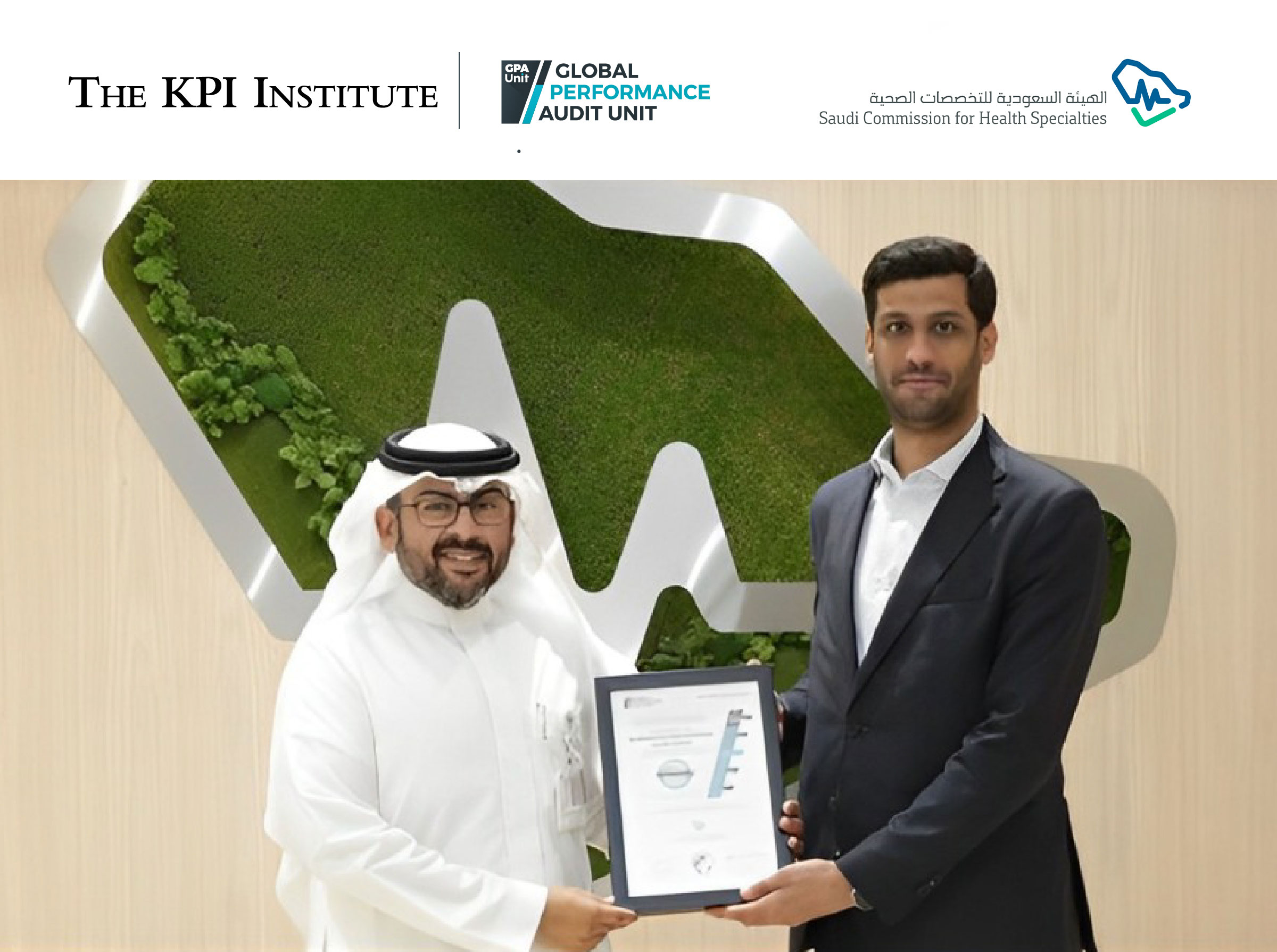
The Global Performance Audit (GPA) Unit, the division at The KPI Institute (TKI) that specializes in strategy and performance management audits, has successfully completed an extensive performance management system maturity assessment for Saudi Commission for Health Specialties (SCFHS). The evaluation encompassed the entity’s maturity level for five organizational capabilities: strategic planning, performance measurement, performance improvement, performance culture and employee performance management.

With its Maturity Model Framework, the GPA Unit applied a robust methodology comprising over 300 statements that encapsulate industry best practices. This approach integrated evidence-based assessment, perception-based assessment, and interview-based assessment, providing a thorough and insightful analysis of SCFHS’s performance management landscape.

SCFHS is an independent scientific professional body established in 1992, with the goal of contributing to a healthy society through qualified health practitioners. According to the audit findings, SCFHS has an integrated and robust performance management system, the result of a collaborative effort of the entire organization and under the coordination of an experienced management. 

Adrian Brudan, General Manager EMEA of The KPI Institute and GPA unit, acknowledged the positive outcome and extended his congratulations to SCFHS for their outstanding performance: “The assessment results reflect the entity’s commitment to excellence and readiness to embrace best practices. May the current results be a stepping stone for even greater accomplishments in the future. I have no doubt that your commitment to excellence will continue to drive SCFHS towards new milestones and further success.”

As a pioneer in setting performance standards, TKI collaborates with organizations to guarantee thorough assessments, steadfast commitment to enhancement, and unwavering adherence to global performance management standards. SCFHS stands as evidence of this dedication, marking a positive stride forward.

************  

About the Saudi Commission for Health Specialties 

The Saudi Commission for Health Specialties (SCFHS) is an independent scientific professional body, established in 1992, with the goal of contributing to a healthy society through qualified health practitioners. SCFHS is centered around their training, accreditation, and health transactions. It oversees the classification of health certificate holders, evaluates their certificates, sets the foundation and standards for practicing health professions, and conducts the professional registration of health practitioners. This ensures that the health practitioner is thoroughly qualified, possessing the skills, knowledge, and competencies needed to diagnose and treat diseases in a distinctive and secure manner. For more information, visit their website at: www.scfhs.org.sa

About The KPI Institute & the GPA Unit 

The KPI Institute (TKI) is a worldwide leader in performance management and KPIs training and certification. It operates research programs in 12 practice domains, disseminates industry insights through publications and knowledge platforms, and provides support in deploying those insights through training and advisory services.

The Global Performance Audit Unit (GPA Unit) is the strategy and performance audit division of The KPI Institute. Its purpose is to provide integrated strategy and performance assessment solutions through rigorous research, education and analysis.

Based on over 15 years of experience and a combination of academic and practitioner research in the field of strategy and performance, we have developed a unique set of frameworks for assessing the maturity level of organizational performance management systems.

The concept and services of the GPA Unit are available worldwide, as it is supported by a dedicated online platform and a global network of collaborators, www.gpaunit.org.

Contact details

For more information, please contact:

Adrian Brudan: General Manager EMEA, TKI

adrian.brudan@kpiinstitute.com | Contact Number: +40 721 233 084

What’s Inside “State of Strategy Management Practice Report – 2022”?

May 24th, 2022 Posted by Research 0 thoughts on “What’s Inside “State of Strategy Management Practice Report – 2022”?”

“State of Strategy Management Practice Report – 2022” is an international research study that explores the latest issues, trends, and best practices impacting the field of strategic planning, KPI usage, and strategy execution.

Developed and published by The KPI Institute, the report presents the results of a survey held from November to December 2021. The survey questions were formulated by forming a focus group of internal subject matter experts and aggregating the feedback of thousands of professionals and practitioners in The KPI Institute’s community.

The report covers the major areas affecting organizations today, from target setting to performance measurement and from the role of communication in strategic planning to the common pitfalls in strategy execution.

The data captured in the study reflects the insights of 500 professionals (27% are Executives, and another 34% occupy managerial positions), and nearly half of them are either directly involved in strategy planning or responsible for the design and maintenance of the strategy and performance management system. The survey has addressed 26 topic-related items.

Inside the report, readers would find:

Report overview

  • Introduction
  • Methodology
  • Executive summary

Key Findings

Strategic Planning

  • Highlights
  • Strategy formulation process
  • Strategy alignment
  • Strategy tools
  • Key success factors
  • Strategy communication

Performance Measurement

  • Highlights
  • KPI usage
  • Target setting
  • Technology

Strategy Execution

  • Highlights
  • Overview
  • Initiative Management
  • Agility

Demographics

Conclusions and Implications for Practice

  • Conclusions
  • Implications for practice

Get your free copy of “State of Strategy Management Practice Report – 2022” today! For inquiries regarding the report, contact Cristina Mihăiloaie, Business Unit Manager – Research Division:  cristina.mihailoaie@kpiinstitute.com, +61 (390) 282 223 or +40 (749) 424 517.

Recent Comments

    Archives